An air squat routine that builds lower body strength without equipment, training quads, glutes, and hamstrings together.
1. No barbell or weights needed — bodyweight only
2. 3 sets of 15-25 reps, 4 days a week
3. Visible leg and glute strength within 6-8 weeks
4. Guided by senior instructor Saurabh Bothra's live sessions
5. One of the most efficient home lower-body exercises
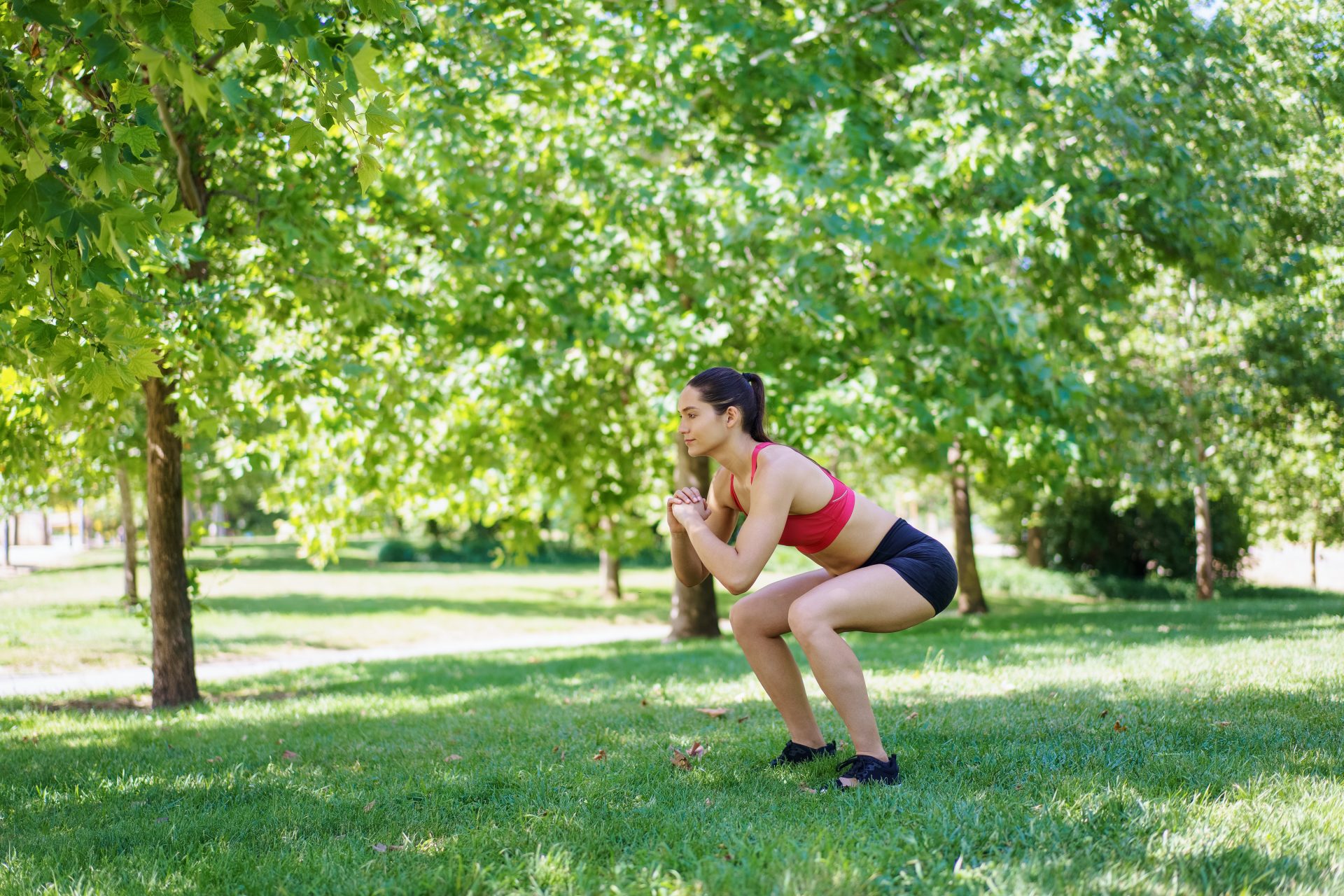
An air squat is a bodyweight squat performed without any added load — no barbell, no dumbbells, no kettlebells, just your own body weight pushing through full range of motion. Despite its simplicity, the air squat exercise is the foundational movement of every legitimate lower-body strength programme. Olympic lifters, powerlifters, sprinters, and physiotherapists all use it as the patterning movement that everything else builds on. If your air squat form is wrong, every weighted squat that follows magnifies the error. If it’s right, you’ve got the template for a .
The mechanism is integrated. As you lower into the squat, the quadriceps eccentrically lengthen under load, the glutes stretch, the hamstrings activate to control descent, the calves stabilise the ankles, and the core braces against forward fall. As you stand, all of these muscles work concentrically to drive the body upward. Few exercises engage as many muscle groups simultaneously. Slow air squats — performed with 4-second descents and 1-second ascents — multiply the time-under-tension and produce strength gains rivalling moderately weighted variations. The lower-body air squat is the most efficient bodyweight exercise that exists.
Strengthens Quadriceps, Glutes, Hamstrings, and Core in One Movement
Air squats benefits centre on integrated lower-body development. Bodyweight squats engage every major lower-body muscle group plus the core in a single movement — few exercises recruit as much musculature simultaneously. The result: faster strength gains than isolation work and dramatically higher training efficiency for time-poor home trainers.
Builds the Movement Pattern for All Future Lower-Body Training
Every future weighted squat, lunge, deadlift, and Olympic lift uses the same fundamental hip hinge and knee tracking pattern as the air squat. Get this right, and the rest is easier. Get it wrong, and the rest is dangerous.
Improves Joint Mobility, Knee Health, and Hip Function
Research and clinical experience link daily bodyweight squats — performed with proper form — to improved knee joint health, better synovial fluid circulation, and reduced stiffness in adults over 40. Anyone with diagnosed osteoarthritis or active knee pain should clear movement with an orthopaedist before starting.
Builds Cardiovascular Conditioning at Higher Rep Ranges
At 15+ reps per set, air squats elevate heart rate into a moderate cardio zone. Combining strength and cardio in one exercise is a significant time advantage for home trainers.
Variation 1: Standard Air Squat — Quads, Glutes, Hamstrings — 3 sets × 15–25 reps
How to perform: Stand with feet shoulder-width apart, toes slightly turned out. Push hips back and bend knees, lowering until thighs are parallel to the ground (or below if mobility allows). Drive through the heels to stand up. Why it suits this goal: It’s the foundation. Master 50 unbroken reps before progressing to weighted variations. Modification: Squat to a chair or bench at first to control depth and prevent collapsing.
Variation 2: Slow Air Squat — Quads, Glutes — 3 sets × 8–10 reps
How to perform: Same form as standard, but lower for 4 seconds, hold at the bottom for 1 second, drive up in 1 second. Why it suits this goal: 4× the time-under-tension produces strength gains comparable to moderately weighted squats — without any equipment. Modification: Start at 2-second descents and progress to 4 seconds over 2–3 weeks.
Variation 3: Jump Air Squat (Plyometric) — Quads, Glutes, Calves, Cardio — 3 sets × 10 reps
How to perform: Standard squat, then drive up explosively into a jump, landing softly back into the squat position. Why it suits this goal: Adds power development and cardiovascular conditioning. Excellent for fat loss and athletic performance. Modification: Skip the jump initially — just stand up explosively without leaving the floor. Add the jump only when standard form is solid.
Mistake 1: Knees Caving Inward — Correction: Push Knees Out Toward Pinky Toes
What it is + why it undermines results: Knee valgus (inward knee collapse) is the single most common air squat error. It strains the medial knee and reduces glute activation. What to do instead: Throughout the rep, actively push the knees out — toward the line of your pinky toes. The cue “spread the floor” works for most lifters.
Mistake 2: Heels Lifting Off the Floor — Correction: Keep Weight in Heels
What it is + why it undermines results: Lifting the heels shifts load to the quads and away from the glutes, dramatically reducing the squat’s effectiveness. It also creates forward fall risk in heavier variations. What to do instead: Drive up by pushing the floor away with your heels. If your heels lift consistently, work on ankle mobility with daily calf stretches.
Mistake 3: Half-Reps Without Full Depth — Correction: Hips Below Parallel Every Rep
What it is + why it undermines results: Most people stop the descent at quarter or half depth, missing the bottom range where the glutes do the most work. Result: strong quads, underdeveloped glutes. What to do instead: Lower until your hip crease drops below your knee crease. If mobility prevents this, regress to box squats and rebuild range over time. In a live Habuild class, the coach measures depth on the first rep — half-depth is the silent reason most home programmes never grow the glutes.

Squat-Specific Programming With Form-First Progression
Habuild’s lower-body sessions begin every leg day with an air squat warm-up — 20 reps focused entirely on form. Members don’t add load or variation until 50 unbroken reps with perfect form are achievable. No shortcuts.
Live Daily Sessions With Real-Time Form Correction
The three air squat failures — knee cave, heel lift, half-depth — are invisible while you’re doing them. A live coach catches them immediately, before they become ingrained patterns that wreck your knees down the line.
Progressive Overload Built Into Every Session
Members progress from standard → slow → tempo → jump → weighted variations on a structured schedule. No guessing when to increase difficulty — the programme handles progression based on rep benchmarks.
Accountability, Streaks, and Community
Daily streak tracking and the live cohort timing keep members consistent. Most home leg training fails by week 4 from inconsistency — Habuild’s live structure removes that failure point entirely.
Complete Beginners Starting from Zero
Air squats require no equipment and can be done in any space the size of a yoga mat. The depth and range of motion are entirely self-regulated — shallow squats are the perfect starting point for anyone new to lower-body training. The only requirement is showing up consistently — strength and technique follow from that.
Intermediate Trainees Looking to Fill a Gap
Air squats are the entry point for all lower-body strength training — building the quad, glute, and core base that every more complex exercise requires. They are equally essential for runners maintaining leg strength without adding gym equipment. Adding air squats to an existing routine addresses a specific conditioning gap that most general workouts miss.
Beginners, Runners, and Those Building Lower-Body Foundation
Air squats are the entry point for all lower-body strength training — building the quad, glute, and core base that every more complex exercise requires. They are equally essential for runners maintaining leg strength without adding gym equipment.
Senior Citizens and Older Adults (50+)
Air Squats can be adapted for older adults by controlling tempo, reducing range of motion, and using supported variations. Habuild’s live instructors modify exercises in real time for different fitness levels and physical conditions in the same session.
Is Air Squats Good for Beginners?
Yes — absolutely. Air Squats begin at very low intensity with fully accessible entry-level variations. Habuild’s live instructor adapts the session in real time so beginners and experienced trainees can train together without either being left behind.
How Often to Do Air Squats — Frequency Guide
Train air squats daily, or 5 times per week. This frequency gives the muscle and nervous system adequate stimulus without outpacing recovery. Consistency matters more than intensity in the early weeks — showing up regularly produces better results than infrequent all-out sessions.
When in Your Workout to Do Air Squats
Place air squats at the start of a lower-body session as an activation movement, or as a standalone conditioning exercise in sets of 20–30. Sequencing exercises correctly ensures you bring maximum quality to air squats rather than performing them under accumulated fatigue from earlier work.
What to Pair Air Squats With
Combine air squats with glute bridges, lunges, and calf raises for a complete bodyweight lower-body session. This combination develops complementary muscle groups in the same session and builds the balanced strength that prevents compensation and injury.
How to Progress Air Squats Over Time
Once the base movement feels controlled and repeatable, increase repetitions and depth first, then add a pause at the bottom, then progress to jump squats, single-leg squats, and finally weighted goblet or barbell squats. Progress only when form is consistent — adding difficulty before mastering the base movement reinforces poor mechanics and stalls long-term results.
Habuild is India’s First Habit Building Program — and through its strength and fitness sessions, it brings the same habit-based philosophy to targeted exercise training. Every session is structured around your specific goal, not a one-size-fits-all class.
Goal-Specific Programming — Not a Generic Fitness Class
Every exercise, rep range, and rest period in Habuild’s air squats sessions is chosen because it produces results for air squats specifically. Habuild does not run the same session for every goal — the programme is structured to drive your specific outcome with every session, not general fitness that happens to include air squats.
Live Daily Sessions with Real-Time Form Correction
Unlike pre-recorded videos, Habuild’s live daily sessions allow the instructor to see and correct your form in real time — the specific errors that limit air squats results and increase injury risk. This live correction is the difference between training that works and training that wastes effort and creates bad habits.
Progressive Overload Built into Every Session
Members do not need to design their own progressive overload for air squats — it is built into the programme structure. Each week, sessions are deliberately more challenging than the last, ensuring the body never fully adapts and results continue coming rather than stalling.
Accountability, Streaks, and Community
The most common reason people stop exercising is not effort — it is missing sessions until the habit breaks. Habuild’s streak system, live session accountability, and community of members training the same goal alongside you resolves this directly. Members who join with a specific goal like air squats and stay consistent for 30 days almost universally report that showing up has become automatic.
My homeopathy doctor suggested yoga and I found Habuild. In the free 14 days, I already felt changes. The biggest surprise: I used to be unable to get down from a pavement by myself. Now I can jump. My core and lower body strength have rebuilt themselves through consistent practice. Habuild is a complete package — it strengthens everything, not just flexibility.
I am 82 years old. I have arthritis with worn-out knees and cannot sit cross-legged. I also have water in my lungs. My orthopaedic doctor, after seeing my X-ray, said I would be in a wheelchair for the rest of my years. Today, 99% of my knee pain is gone. I do only 25% of the movements Saurabh Sir teaches, but I do them consistently. I am now visiting old temples and climbing the steps to enter them — holding support, but climbing. Leg exercises have strengthened my muscles enough to support my joints. I am walking with confidence.


Practice Strong Everyday with Trishala Bothra, an IIT-B and London School of Business alumni
Trishala is focused on making movement feel lighter, more engaging, and something you actually look forward to.
In just 3 years, over 50,000 people began their strength journey, and 10,000+ join every week to keep getting stronger.