

Yoga for Knee Pain
Join live yoga classes from home with beginner-friendly guidance

Key Takeaways
- Yoga can meaningfully reduce chronic knee pain within weeks.
- Gentle, guided poses are safer than high-impact exercise for damaged joints.
- Consistency matters more than intensity for long-term joint health.
- Consistency matters more than intensity for long-term joint health.
- Consistency matters more than intensity for long-term joint health.
Transform Your Knee Health with Yoga for Knee Pain

Knee pain affects millions of Indians across all ages — arising from weak quadriceps and hamstrings, tight hip flexors and IT band, excess body weight, or the cartilage and joint degeneration of arthritis and osteoarthritis. Yoga for knee pain addresses the biomechanical root causes: strengthening the quadriceps, hamstrings, and glutes that stabilise the knee joint; stretching the hip flexors and IT band that pull the knee out of alignment; improving the proprioceptive awareness that governs safe knee mechanics; and reducing the systemic inflammation that accelerates joint degeneration. Our flexibility training resources provide the complete framework for yoga-based joint health improvement.
Unlike high-impact exercise that loads damaged knees, yoga for knee pain exercises provide progressive joint strengthening and flexibility improvement without the impact that worsens degeneration — making it specifically appropriate for knee pain management across all severity levels and ages. Over 50,000+ Habuild members have reduced their knee pain, improved their joint mobility, and returned to activities that knee pain had limited.
Can Yoga for Knee Pain Really Help?
Watch the video
Yes — yoga for knee pain exercises are among the most effective conservative interventions for knee pain management, with multiple clinical studies demonstrating meaningful pain reduction and function improvement in knee osteoarthritis, patellofemoral pain syndrome, and non-specific knee pain. Our yoga for health conditions guide covers the evidence base for yoga as a joint health intervention.
Yoga addresses knee pain through three complementary mechanisms: strengthening the surrounding musculature (particularly the quadriceps, whose weakness is the primary biomechanical cause of knee joint stress); improving joint lubrication through the gentle range-of-motion movements that stimulate synovial fluid production; and reducing the systemic inflammation that accelerates osteoarthritic degeneration through the cortisol reduction and anti-inflammatory cytokine modulation of regular practice.
A randomised controlled trial published in the Journal of Rheumatology found that eight weeks of yoga produced a 30% reduction in pain and a 34% improvement in function in knee osteoarthritis patients — improvements comparable to and in some measures exceeding conventional physiotherapy. While severe osteoarthritis with significant cartilage loss requires medical management, the vast majority of knee pain presentations respond meaningfully to consistent, appropriately modified yoga practice.
Benefits of Yoga for Knee Pain
1.Strengthens the Knee's Protective Musculature
The quadriceps, hamstrings, and glutes that surround and protect the knee joint are the primary biomechanical determinants of knee health. Yoga for aching knees systematically strengthens these muscle groups through progressive loading — reducing the joint stress that weak surrounding musculature allows. Our fitness tips cover the complete exercise approach to knee joint health.
2.Improves Knee Joint Mobility and Flexibility
Tight hamstrings, hip flexors, and IT band pull the knee joint out of alignment — increasing shear forces and accelerating cartilage wear. Yoga for knee pain exercises systematically release these tension patterns, restoring the proper alignment that joint longevity requires. See also yoga for flexibility for the comprehensive flexibility programme.
3.Reduces Knee Inflammation and Pain
Regular yoga practice reduces the systemic inflammation — through cortisol reduction and parasympathetic activation — that drives the inflammatory component of knee pain, producing meaningful pain reduction alongside the strengthening and flexibility improvements.
4.Improves Proprioception and Joint Stability
Proprioceptive awareness — the body's sense of joint position — is progressively impaired by knee pain and joint degeneration. Yoga for knee pain's balance postures specifically retrain proprioception, improving the joint stability awareness that prevents the falls and missteps that worsen knee conditions.
5.Supports Healthy Body Composition
Every kilogram of excess body weight adds approximately four kilograms of force to the knee joint during walking. Yoga for knee pain's metabolic activation, stress reduction, and progressive physical strengthening support the healthy body composition that is the most important modifiable risk factor for knee osteoarthritis progression.
6.Promotes Synovial Fluid Production
The gentle, rhythmic range-of-motion movements of yoga postures stimulate synovial fluid production and distribution — the joint lubrication that nourishes cartilage and reduces the friction that accelerates joint wear. See also yoga for hips for the hip health programme that directly supports knee biomechanics.
Best Yoga Poses for Knee Pain
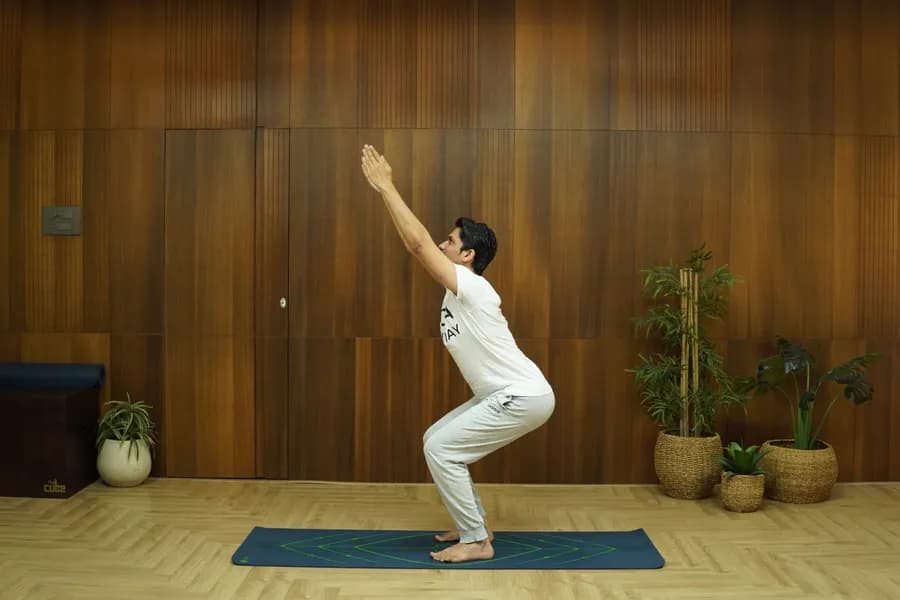
1.Chair Pose (Utkatasana) — Modified
A quadriceps-strengthening posture performed with the back against a wall for support — the primary knee-stabilising muscle strengthener that directly addresses the quadriceps weakness underlying most knee pain. Begin with shallow depth and build progressively.
Difficulty Level: Beginner
2.Warrior I (Virabhadrasana I) — Shallow Stance
A standing lunge-based posture that strengthens quadriceps, glutes, and hip flexors simultaneously — building the complete lower limb strength that protects the knee. Begin with a shorter stance and shallower knee bend.
Difficulty Level: Beginner
3.Bridge Pose (Setu Bandhasana)
A supine posture that strengthens the glutes, hamstrings, and posterior chain — the muscle groups whose weakness allows the knee to bear excessive joint stress. Bridge pose is one of the most consistently recommended yoga postures for knee pain physiotherapy integration.
Difficulty Level: Beginner
4.Supine Hamstring Stretch
Lying on the back with a strap or rolled towel around the foot, gently straightening the leg — progressive hamstring lengthening that reduces the posterior pull on the knee that tight hamstrings create.
Difficulty Level: Beginner
5.Reclining Hand-to-Big-Toe Pose (Supta Padangusthasana)
A supine IT band and lateral hip stretch that reduces the lateral pulling tension on the knee produced by IT band tightness — one of the most common and most overlooked biomechanical contributors to knee pain.
Difficulty Level: Beginner
6.Tree Pose (Vrksasana) — Against Wall
Single-leg balance with wall support — progressively training the proprioception and knee stabiliser activation that balance postures require, without the full balance challenge that acute knee pain makes inappropriate initially.
Difficulty Level: Beginner
7.Legs Up the Wall (Viparita Karani)
A passive inversion that reduces knee joint compression, drains inflammatory fluid from the knee, and activates the parasympathetic nervous system that reduces pain amplification. Specifically beneficial for post-activity knee swelling and inflammation.
Difficulty Level: Beginner
8.Butterfly Pose (Baddha Konasana)
A seated inner thigh and groin opener that reduces the valgus knee stress (knee collapsing inward) that inner thigh and hip abductor tightness produces — addressing one of the primary biomechanical contributors to patellofemoral pain.
Difficulty Level: Beginner
How Habuild's Yoga for Knee Pain Classes Help
1.Knee-Safe Modification for Every Posture
Every standing and seated posture in Habuild's yoga for knee pain programme includes specific knee-safe modifications — prop use, stance adjustments, and depth limitations that make every posture appropriately challenging without stressing compromised knee structures.
2.Progressive Strengthening Programme
Habuild's yoga for knee pain exercises follow a progressive strengthening protocol — beginning with the supine and wall-supported postures that provide strengthening without joint loading, and advancing to standing and balance work as strength improves.
3.Live Guidance for Proper Knee Alignment
The most common knee-worsening mistakes in yoga — allowing the knee to collapse inward, going too deep in lunges before adequate strength, and forcing flexibility beyond appropriate range — are corrected in real time by Habuild's instructor in every session.
4.Anti-Inflammatory Practice for Joint Health
Every Habuild session integrates the pranayama, stress reduction, and parasympathetic activation that reduce systemic inflammation — the chronic inflammatory environment that accelerates joint degeneration and amplifies pain perception.
Flexible Batch Timing
Choose morning or evening classes and join the slot that suits your day.
Morning
6:30 am - 7:15 am
7:30 am - 8:15 am
8:30 am - 9:15 am

Evening
5pm - 5:45pm
6pm - 6:45pm
7pm - 7:45pm


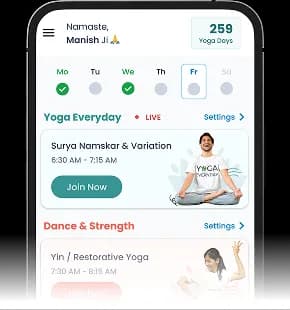
Continue your habit on the Habuild app
Use the Habuild app for reminders, live access, progress support, and habit tracking.


Choose Your Membership Plan
Continue after the trial with membership options designed for long-term consistency support.