Core Strength Routine
A core strength routine that improves stability, posture, and real core power through daily practice.

Key Takeaways
- Builds stability and core power together
- Improves posture through consistent practice
- Follows a structured, repeatable daily routine
- Guided by senior instructor Saurabh Bothra's live classes
- Delivers real strength gains, not just aesthetic ones
What is Core Strength Routine?
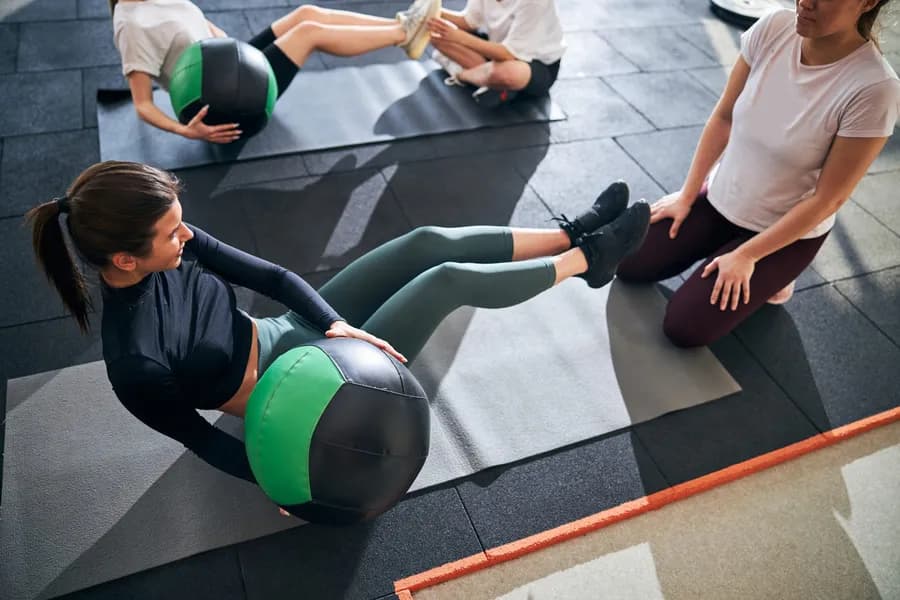
A core strength routine is a structured training programme targeting the full complex of muscles that stabilise and move the trunk — the rectus abdominis, transverse abdominis, internal and external obliques, multifidi, and spinal erectors.
What makes a core strength routine distinct from general ab training is its emphasis on stabilisation — training the core not just to move the spine but to resist unwanted movement under load, which is how the core functions in every sport and daily activity.
The mechanism is progressive loading of anti-extension, anti-rotation, and anti-lateral flexion patterns — the three planes in which the core must stabilise.
By training the transverse abdominis through bracing (not just crunching), the obliques through rotational resistance, and the spinal erectors through controlled extension, a core strength routine builds the integrated stability that isolated ab exercises cannot produce.
Benefits of Core Strength Routine
Benefit 1: Improved Spinal Stability and Reduced Back Pain
Strong core stabilisers reduce the mechanical load on intervertebral discs by providing muscular support to the spinal column. Many practitioners report meaningful lower back pain reduction within 6–8 weeks of consistent core training.
Benefit 2: Better Posture and Reduced Neck Tension
A strong core — particularly the thoracic erectors and deep cervical flexors — supports the upright spinal alignment that poor posture compromises. Improved core strength directly reduces the forward head posture and rounded shoulders that produce chronic neck and upper back tension.
Benefit 3: Improved Athletic Performance Across All Activities
The core is the force transfer link between the upper and lower body — every athletic movement depends on core stability for efficient power transmission. A stronger core improves running economy, lifting performance, and movement quality across all physical activities.
Benefit 4: Reduced Risk of Injury in Daily Activities
Strong core muscles protect the spine during everyday loading — lifting, carrying, and twisting movements that cause injury in those with weak stabilisers. A well-conditioned core reduces the risk of the lumbar strain that affects most adults at some point in their lives.
What to Eat to Support Your Core Strength Routine — Nutrition Pairing
Protein — The Foundation of Core Strength Routine Training
Aim for 1.6–2.0g of protein per kg of bodyweight per day. Best sources include eggs, paneer, lentils (dal), chicken, Greek yoghurt, and whey protein. Distribute protein evenly across 3–4 meals rather than loading it all in one sitting. Adequate protein is non-negotiable — without it, training effort produces minimal adaptation regardless of programme quality.
Carbohydrates — Fuel for Core Strength Routine Performance
Complex carbohydrates (oats, brown rice, sweet potato, whole wheat roti) should form 40–50% of total calories. Consume a carbohydrate-containing meal 60–90 minutes before your core strength routine session to ensure glycogen availability. Post-session carbohydrates restore muscle glycogen within the critical 30-minute recovery window.
Anti-Inflammatory Foods for Recovery
Include turmeric (with black pepper for bioavailability), ginger, and omega-3 rich foods (flaxseeds, walnuts, fatty fish) daily. These directly reduce the systemic inflammation that accumulates with consistent training, speeding recovery between sessions.
Hydration — Often Underestimated
Aim for 35–40ml of water per kg of bodyweight daily. Add an additional 500ml for every 30 minutes of active training. Even mild dehydration (2% body weight) measurably reduces strength output and exercise capacity.
How to Start Core Strength Routine Safely
Before You Begin — What to Check
Consult your doctor if you have any diagnosed spinal conditions (disc herniation, spinal stenosis, spondylolisthesis), recent abdominal surgery, or any condition that affects intra-abdominal pressure. Begin a self-assessment: can you hold a plank for 10 seconds with a neutral spine? Can you perform a dead bug without your lower back leaving the floor? These are your baseline starting points.
Your First 2 Weeks — Foundation Phase
Two sessions per week. Bodyweight movements only. Focus entirely on learning the abdominal brace — the 360-degree expansion of the core that precedes and supports every exercise. Exercises: Dead Bug (10 reps each side), Plank hold (20 seconds), Bird-Dog (10 each side). Prioritise neutral spine throughout every movement.
Weeks 3–8 — Progressive Loading Phase
Three sessions per week. Introduce tempo manipulation (slower movements to increase time under tension). Add side plank variations. Begin hollow body holds. Focus on increasing duration and reps before adding any external resistance. Normal to feel muscular fatigue in the lower abdominals and obliques — stop if lower back pain develops.
Beyond 8 Weeks — Long-Term Maintenance
Introduce anti-rotation exercises (Pallof press with band), loaded carries, and more demanding plank variations. Begin moving toward a 3–4 session per week frequency. Measure progress through plank duration, dead bug reps, and improvements in posture and back comfort rather than purely through appearance metrics.
Best Core Strength Routine Exercises
Dead Bug — Core Stabilisers (Transverse Abdominis, Rectus Abdominis, Hip Flexors)
The Dead Bug trains the core in anti-extension — requiring the lower back to stay flat while the arms and legs extend away from the centre. It is the safest and most effective foundational core exercise, developing the deep stabilisers without loading the spine. Beginner: begin with arm-only or leg-only movement until the lower back maintains contact with the floor throughout.
Plank (Standard + Side) — Transverse Abdominis, Obliques, Glutes, Shoulder Girdle
The plank develops core endurance in isometric stabilisation — the function the core performs constantly in all daily and athletic activities. The side plank specifically targets the quadratus lumborum and obliques that lateral spine stability requires. Beginner: perform from the knees; build to 30 seconds before progressing to toes.
Bird-Dog — Multifidi, Spinal Erectors, Glutes, Core Stabilisers
The Bird-Dog develops the posterior core musculature through contralateral limb extension — the most functional core stability pattern, directly replicating the single-leg balance demands of walking, running, and sport. It is the most effective exercise for developing the deep spinal stabilisers (multifidi) that conventional exercises rarely reach. Beginner: perform with one limb only before combining arm and leg.
Common Mistakes to Avoid in Core Strength Routine
Mistake 1: Training Core in Isolation Without Progressive Overload
Many practitioners perform the same plank duration and dead bug reps every session without increasing the challenge. The core adapts just like any other muscle — without progressive difficulty increase (more reps, longer holds, additional complexity), adaptation plateaus within 4–6 weeks.
Mistake 2: Focusing on Crunches at the Expense of Stabilisation Work
Crunches train only one function of the core (spinal flexion) in a partial range while neglecting the stabilisation functions that matter most for back health and athletic performance. A core routine built primarily on crunches leaves the transverse abdominis undertrained.
Mistake 3: Neglecting the Posterior Core (Spinal Erectors, Multifidi)
Most core training programmes emphasise the anterior core (abs) while ignoring the posterior core (spinal erectors, multifidi) that support the lumbar spine from behind. This imbalance produces the forward lean and lower back vulnerability that anterior-only training cannot address.
Mistake 4: Holding Breath During Core Exercises
Breath-holding during core exercises produces Valsalva manoeuvre-like intra-abdominal pressure that is inappropriate for routine core training and may stress pelvic floor muscles unnecessarily. Consistent breathing throughout every exercise maintains appropriate intra-abdominal pressure management.
Who Is Core Strength Routine Best For?
Complete Beginners Starting from Zero
No prior experience with core strength routine is required to start. Every movement is taught from its most foundational form, with modifications for those who cannot yet perform the standard version. Live instructor feedback prevents the form errors that cause beginners to plateau or get injured before results arrive.
Intermediate Trainees Who Have Hit a Plateau
If you have been exercising inconsistently or without structured progressive overload, core strength routine delivers the systematic load progression that general fitness classes do not. The programme targets the specific weaknesses and imbalances holding you back, producing results that months of unstructured training have failed to achieve.
Desk Workers and Sedentary Professionals
Extended sitting creates the exact muscle imbalances and weaknesses that core strength routine training corrects. No gym, no equipment, and no prior experience is required — the programme begins with bodyweight fundamentals and builds progressively from there. Habuild’s morning sessions fit into a working day without disruption.
How Habuild Teaches Core Strength Routine
Live Daily Sessions with Real-Time Instructor Feedback
Habuild’s live sessions — delivered daily by expert instructors — provide real-time form corrections for the specific technique errors that core strength training requires attention to. Unlike pre-recorded content, the live format means the instructor can see you and correct in the moment — the difference between building correct habits and reinforcing incorrect ones.
Condition-Specific Modifications in Every Session
Every exercise in the Habuild core strength programme is selected and modified with this specific goal in mind. Members are not attending a generic fitness class with a modification option bolted on — they are in a programme designed from the ground up for core strength outcomes.
Progressive Programming That Respects Your Recovery Timeline
The programme structure follows the physiological timeline of improvement — not an arbitrary 4-week or 8-week marketing format. Progression is earned through demonstrated capacity, not assumed by a calendar week.
Community of Members With the Same Goals
Flexible Batch Timing
Choose morning or evening classes and join the slot that suits your day.
Morning
6:30 AM
7:30 AM
8:30 AM

Evening
5:00 PM
6:00 PM
7:00 PM
8:00 PM


Choose Your Membership Plan
Continue after the trial with membership options designed for long-term consistency support.
Continue your habit on the Habuild app
Use the Habuild app for reminders, live access, progress support, and habit tracking.