Hip rotation exercises are movements specifically designed to train the hip joint’s ability to rotate — both inward (internal rotation) and outward (external rotation). Unlike general leg exercises that primarily work flexion and extension, these movements target the deep rotator muscles and connective tissue that control how freely and safely your hip moves through its full range. Most standard gym routines overlook this plane of motion entirely, which is why hip stiffness is so common even in people who exercise regularly. When you perform internal rotation (femur turning inward) and external rotation (femur turning outward) movements, you stimulate the deep hip rotators — including the piriformis, obturators, gemelli, and gluteus medius — along with the hip capsule itself. Consistent training in this rotational plane increases synovial fluid production in the joint, lengthens tight hip flexors, activates underused glute fibres, and trains the nervous system to control movement through a fuller range. The result is a hip that moves more freely with less compensatory strain on adjacent joints.
Improved Joint Mobility and Daily Movement Quality
The most immediate benefit of training hip rotation is what you notice in everyday life — getting up from a chair, climbing stairs, or walking without that familiar stiffness. Your hip is a ball-and-socket joint designed to move in multiple directions. When rotation is restricted, every adjacent structure — the lower back, knees, and ankles — compensates by absorbing forces they were never designed to handle.
Restoring rotational range gives every lower-body muscle and joint the mechanical environment it needs to function correctly. Research indicates that hip mobility deficits are a primary contributor to non-specific low back pain in sedentary adults, making rotation work highly relevant for desk workers and those with inactive lifestyles.
Reduced Hip and Lower Back Stiffness
Most people searching for hip rotation exercises are dealing with a specific complaint — that grinding tightness after hours of sitting, or the dull ache at the back of the hip that won’t quite go away. Targeted internal rotation movements like supine hip rotations and seated figure-four stretches, and external rotation exercises like clamshells and lateral band walks, directly counteract the shortening of hip flexors and deep rotators that prolonged sitting causes.
Addressing this mechanically — rather than only with stretching — produces more lasting relief because strength stabilises the range you open up.
Stronger Glutes and Better Lower-Body Stability
Hip rotation training is one of the most effective ways to activate the gluteus medius and minimus — muscles that are chronically underused in most people. These muscles are critical for single-leg stability, which governs every step you take. The WHO recommends at least 150 minutes of moderate-intensity muscle-strengthening activity per week; hip rotation exercises count directly toward that target while simultaneously building the lateral hip strength that prevents knee valgus, IT band syndrome, and hip drop during walking and running.
Better Posture and Downstream Athletic Performance
When hip rotation is limited, the lumbar spine rotates more to compensate — a common cause of poor posture and spinal fatigue. Restoring rotational capacity at the hip offloads the spine, improves how you sit and stand, and has a direct downstream effect on athletic output. Runners generate more power per stride, yoga practitioners access poses with less strain, and strength athletes lift more efficiently when their hips rotate correctly.
What you eat directly determines how fast you recover, how much you progress, and how consistently you can train. Here is what your nutrition plan should look like to support your hip rotation training effectively.
Protein and Collagen — Nourishing Your Connective Tissue
Mobility and flexibility training still requires adequate protein (1.2–1.6 g/kg/day) to support connective tissue repair. Collagen synthesis — critical for joint and fascia health — needs dietary amino acids as raw material. Include eggs, bone broth, paneer, dal, and lean meats across your meals.
Calcium and Vitamin D — Joint and Bone Health
Joint and connective tissue health depends heavily on calcium and Vitamin D working together. Aim for 1000–1200 mg of calcium daily from dairy (milk, curd, paneer), ragi, sesame seeds (til), and leafy greens. Get 15–20 minutes of morning sunlight on exposed skin to maintain Vitamin D levels and improve calcium absorption.
Anti-Inflammatory Foods — Faster Recovery
Recovery speed is directly influenced by your body’s inflammatory status. Turmeric with black pepper (curcumin + piperine), fresh ginger, and omega-3 fatty acids from flaxseeds, walnuts, and fatty fish all actively reduce exercise-induced inflammation. Include these consistently rather than only on hard training days.
Hydration — Performance and Joint Lubrication
Adequate hydration supports joint lubrication, muscle function, and nutrient transport — aim for 2.5–3 L of water daily. Drink at least 500 ml before your morning exercise session to prime circulation and joint mobility. Herbal teas and coconut water count toward your fluid intake and provide additional micronutrients.
Magnesium — Muscle Function and Sleep Quality
Magnesium governs over 300 enzymatic reactions including muscle contraction and relaxation — making it essential for any movement-based training. Include pumpkin seeds, bananas, dark chocolate (70%+), spinach, and whole grains in your daily diet. Many Indians are mildly deficient; if you experience frequent muscle cramps or poor sleep quality, a magnesium glycinate supplement may help.
Starting a new training programme is often the hardest part. Here is a clear, week-by-week plan to begin your hip rotation training without injury or overwhelm.
Before You Begin — Setting Your Baseline
Start by assessing your current range of motion in the target joints — you can do this simply by attempting the movement and noticing where you feel restriction or discomfort. Set a realistic goal like achieving a specific range of motion or eliminating a recurring tightness within 6 weeks. Mobility work is most effective when done daily, even if each session is short.
Week 1–2: Foundation
In week one and two, hold each stretch or mobility drill for 30–45 seconds and focus on breathing into the stretch rather than forcing range. Expect mild discomfort at end-range — this is normal — but stop immediately if you feel sharp or pinching pain. Two 15-minute sessions daily (morning and evening) produce faster adaptation than one longer session.
Week 3–4: Building Consistency
Your nervous system begins to ‘trust’ the end-range positions around weeks 3–4, allowing you to go slightly deeper without effort. Anchor your morning session to an existing habit — right after waking, before your first cup of tea — to build automaticity. Increase hold times to 45–60 seconds and begin adding active mobility work (controlled movement through full range) alongside passive stretching.
Week 5–8: Progression
By weeks 5–8, the mobility gains become functional: you will notice them during daily activities like sitting, climbing stairs, and getting up from the floor. Begin loading the newly acquired range with light strengthening work to make the mobility permanent rather than temporary. Progress that is earned through daily practice at this stage tends to be retained long-term.
With mobility training, daily consistency across months matters far more than any single intense session.
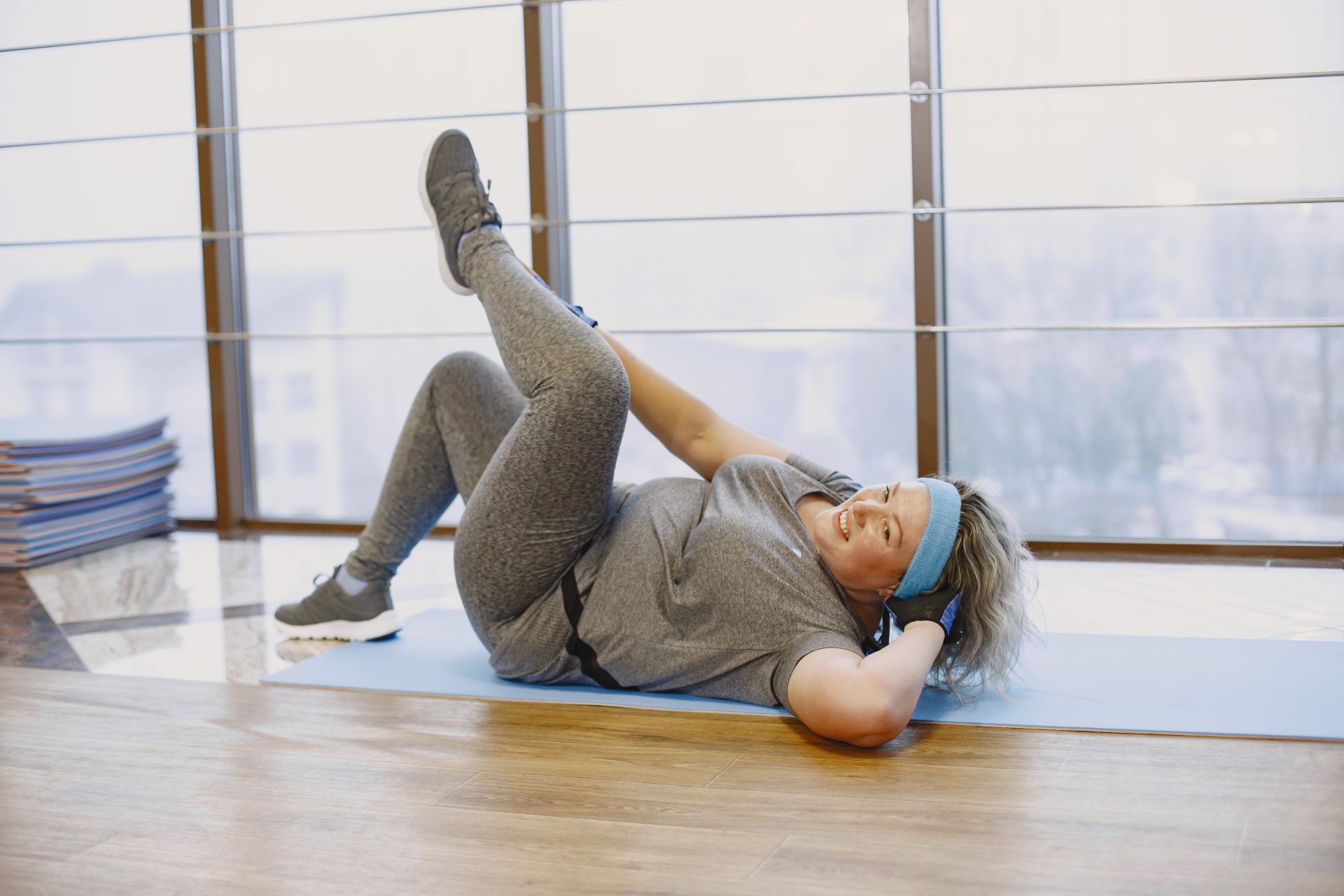
Supine Hip Rotations — Deep Hip Rotators and Hip Capsule — 2 × 10 reps per side
What it does: Lying on your back with knees bent and feet flat, you gently let one knee fall outward (external rotation) and then inward (internal rotation) in a controlled arc. This is one of the safest and most direct ways to train both rotational directions simultaneously. It lubricates the hip joint, warms up the deep rotators, and teaches the nervous system to accept movement at the end of range — which is exactly where most people feel restriction. It suits hip rotation training particularly well because there is no compressive load on the joint, making it appropriate for those with early hip stiffness or mild discomfort.
Dosage: 2 sets of 10 controlled reps per direction, per side. Move slowly — 3 seconds in each direction.
Beginner modification: Reduce the arc of movement. You do not need the full range on day one — move only as far as you can without the opposite hip lifting off the floor.
Clamshells — Gluteus Medius and External Hip Rotators — 3 × 15 reps per side
What it does: Lying on your side with knees stacked and hips bent at roughly 45 degrees, you lift the top knee upward like a clamshell opening while keeping the feet together. This isolates the gluteus medius and the short external rotators more directly than almost any other exercise. Weakness in these muscles is one of the most common findings in people with hip pain, IT band syndrome, and knee tracking issues. Clamshells build the external rotation strength that stabilises the pelvis during every weight-bearing activity. Comprehensive hip strength training typically uses clamshells as a foundational movement before progressing to loaded variations.
Dosage: 3 sets of 15 reps per side. Pause 1 second at the top of each rep.
Beginner modification: Place a folded towel under the waist to keep the spine neutral. Reduce to 10 reps if the glute fatigues before the set ends.
90/90 Hip Rotations — Internal and External Rotators, Hip Capsule — 2 × 8 reps per side
What it does: Seated on the floor with both legs positioned at 90-degree angles — front shin parallel to your body, back shin perpendicular — you shift your weight and rotate your hips to bring the opposite leg into the 90/90 position on the other side. This movement trains internal and external rotation together in a loaded, functional position — the closest floor-based exercise to how your hips actually rotate during walking, running, and sport. It also opens the hip capsule symmetrically and reveals asymmetries between sides that need corrective attention. Complement this with hip circles exercises as a warm-up pattern before your 90/90 sets.
Dosage: 2 sets of 8 rotations per side. Support yourself with hands behind you if needed.
Beginner modification: Use both hands on the floor behind you for full support and reduce the transition speed. Focus on the rotation happening at the hip, not at the lower back.
Mistake 1 — Rotating from the Lower Back Instead of the Hip — Correction: Anchor the Pelvis First
What it is: The most common error in hip rotation exercises is that the movement originates at the lumbar spine rather than the hip joint itself. This happens because the lower back is more mobile for most people than the restricted hip — so the body takes the path of least resistance. When this pattern becomes habitual, it reinforces the very restriction you are trying to address and adds unnecessary stress to the spine.
What to do instead: Before every rep, consciously engage your core to stabilise the pelvis. Think of the pelvis as a fixed bowl — only the femur should move. Practising in front of a mirror or filming a side-angle view can help you detect whether movement is happening at the hip or being borrowed from the back.
Mistake 2 — Training Only One Direction of Rotation — Correction: Balance Internal and External Work
What it is: Many programmes focus exclusively on external rotation — clamshells, band walks — while neglecting internal rotation, because external rotation weakness is more commonly discussed. However, internal rotation restriction is actually more prevalent in desk workers and is directly linked to anterior hip impingement, a flat-footed gait, and poor single-leg squat mechanics. Training only one direction creates a rotational imbalance that can worsen symptoms over time.
What to do instead: Structure every hip rotation session to include at least one dedicated internal rotation drill — supine internal rotation drops, seated internal rotation presses, or the 90/90 transition — alongside your external rotation work. Hip opening yoga poses are an excellent complement that naturally addresses both rotational directions within a single practice.
Mistake 3 — Progressing Too Fast Without Earning the Range — Correction: Build Active Range Before Load
What it is: A common mistake among motivated beginners is adding resistance bands or progressing to loaded rotational movements before they have established active control through their current range of motion. Passive flexibility — how far you can push a joint — is not the same as active mobility — how far you can control it. Loading a range you cannot actively stabilise places the joint capsule and labrum at risk.
What to do instead: Spend the first two to three weeks training with bodyweight only, focusing on slow, controlled movement and end-range holds. Only introduce a resistance band or added load once you can move through the full range with deliberate muscle control and no compensatory back movement. Exercises for hip bursitis follow this same principle of building active range before load, and the progression logic applies directly to rotation training.
50,000+ members already training with Habuild every morning. Live daily sessions · Expert instructor · Cancel anytime.
Hip Rotation training is not a one-size-fits-all programme — but it is far more broadly accessible than most people assume. Here is who benefits most.
Complete Beginners Starting from Zero
You do not need any prior fitness experience to begin hip rotation exercises. Every movement in a well-structured programme comes with easier modifications — for example, performing the exercise seated, with a reduced range of motion, or using a wall or chair for support. The only requirement is willingness to show up consistently; the strength and technique will follow.
People With Stiffness, Tight Muscles, or Restricted Range of Motion
This training is especially valuable for people managing Stiffness, Tight Muscles, or Restricted Range of Motion. Hip Rotation exercises specifically target the muscular imbalances and movement patterns that drive these conditions. Always begin at a reduced intensity and range, and increase gradually as your body adapts.
Office Workers and Sedentary Adults
Sedentary adults who spend 6–8 hours sitting daily experience progressive losses in hip rotation capacity — this training directly reverses that trend. A 20–30 minute morning session creates a positive hormonal and metabolic shift that persists throughout the working day. Even three sessions per week produce measurable improvements in energy levels, concentration, and posture.
Active Adults and Athletes
Active adults and athletes who train hard but neglect mobility work accumulate joint restrictions that eventually limit performance and cause injury. Incorporating hip rotation training 3–4 times per week restores range of motion, improves movement efficiency, and reduces recovery time between sessions. Many experienced athletes report that mobility work produces faster performance improvements than adding more conditioning volume.
Seniors Maintaining Functional Independence
Age-related loss of joint mobility is a primary contributor to falls, reduced independence, and chronic pain in older adults. Regular hip rotation practice maintains the range of motion needed for daily tasks — getting up from a chair, reaching overhead, and walking without pain. Gentle, consistent practice is safe for most older adults and produces meaningful functional improvements within 4–6 weeks.
Hip Rotation-Specific Programming — Not a Generic Fitness Class
Every exercise selection, sequence, and tempo in Habuild’s strength training sessions is chosen with a specific physiological purpose. Sessions open with joint mobilisation circuits — including controlled hip rotation warm-ups — that increase synovial fluid distribution and prepare the deep rotators before any loaded work begins. Sessions close with active mobility holds targeting the end-range of hip rotation, where adaptation is built. This open-to-close design ensures the body is primed for rotation work at the start and consolidates new range at the finish — a sequencing logic that generic group fitness classes rarely apply.
Live Daily Sessions with Real-Time Form Correction
The errors that most undermine hip rotation progress — lumbar compensation, asymmetrical loading, and insufficient end-range control — are almost impossible to self-correct from a pre-recorded video. Habuild’s live format means an expert instructor sees your movement in real time and can cue corrections specific to what you are doing in that moment. This matters most in the early weeks when motor patterns are still being established.
Progressive Overload Built into Every Session
Members do not need to self-programme progression. Habuild builds it in week by week — beginning with low-load, high-control rotational movements and gradually increasing complexity, duration of end-range holds, and resistance across the programme. Movement complexity, breath coordination, and session duration all increase systematically so the hip adapts without being overloaded.
Accountability, Streaks and Community
Hip rotation improvements are cumulative — they require weeks of consistent practice, not a single intense session. Habuild’s streak tracking, daily session reminders, and WhatsApp member community create the accountability structure that keeps members showing up on the days when motivation alone would not be enough. The community also surfaces what others are experiencing, making it easier to stay on track through normal training plateaus.
I have been with Habuild for 1,050 days. My energy has increased and I don't feel drained by work anymore. My patience has grown — things that used to stress me out don't affect me the same way. My kids at home have also picked up the yoga habit. Most importantly, my knowledge about breathing and how it affects the entire body has transformed. My nervous system feels calmer, my digestion is better, and there is a steadiness in my body and mind that I had never experienced before.

My homeopathy doctor suggested yoga and I found Habuild. In the free 14 days, I already felt changes. The biggest surprise: I used to be unable to get down from a pavement by myself. Now I can jump. My core and lower body strength have rebuilt themselves through consistent practice. Habuild is a complete package — it strengthens everything, not just flexibility.


Practice Strong Everyday with Trishala Bothra, an IIT-B and London School of Business alumni
Trishala is focused on making movement feel lighter, more engaging, and something you actually look forward to.
In just 3 years, over 50,000 people began their strength journey, and 10,000+ join every week to keep getting stronger.