Isometric core exercises are movements where your core muscles generate force without changing length — meaning no movement, just sustained contraction. Unlike dynamic exercises such as crunches or leg raises, isometric training asks you to brace, hold, and resist. This specificity makes them uniquely suited to building functional stability: the kind your spine actually needs during daily activities, lifting, and athletic performance. Not all core training achieves this. Exercises that rely on repeated spinal flexion can strengthen the superficial rectus abdominis but largely bypass the deep stabilising layers — transverse abdominis, multifidus, and the internal obliques — that isometric work directly targets. When you hold a plank or a hollow body position, your nervous system fires and sustains high-threshold recruitment of deep core fibres. This prolonged time-under-tension builds muscular endurance, inter-muscular coordination, and intra-abdominal pressure management — your body’s natural corset system and the foundation of a protected lower back.
Deeper Core Activation and Structural Stability
The most direct benefit of isometric core training is the recruitment of deep stabilising muscles that most people never train effectively. The transverse abdominis — your body’s deepest abdominal layer — wraps around your midsection like a natural weight belt. Every disc and vertebra in your lumbar spine depends on this layer being strong and responsive.
Research published in the Journal of Physical Therapy Science found that isometric core training significantly increased transverse abdominis thickness compared to dynamic training alone — a measurable structural adaptation that translates directly into spinal protection.
Reduced Lower Back Discomfort Through Core Bracing
Most people searching for core exercises are dealing with an aching lower back, poor posture, or a persistent feeling of weakness through the midsection. Isometric exercises directly address this. Movements like the plank, side plank, and dead bug train the pattern of bracing — actively stiffening your core to protect your spine under load.
These exercises counteract the lumbar instability that underlies most non-specific lower back discomfort. You can pair this work with a broader core strength programme to build on these foundations systematically.
Improved Posture and Everyday Load Management
Consistent isometric core training builds the endurance to maintain good posture through a full workday — not just during a 20-minute session. Over four to eight weeks of regular practice, members typically notice they sit taller, tire less on long walks, and carry loads with noticeably less strain.
The WHO recommends at least 150 minutes of moderate-intensity physical activity per week for functional health maintenance. Structured isometric core work counts directly toward that threshold while requiring no equipment.
Downstream Benefits: Energy, Focus, and Breathing Efficiency
A stable, well-recruited core frees up energy your body would otherwise spend compensating for instability. People who train their core isometrically often report feeling less fatigued by midday and breathing more easily during exertion.
The diaphragm is part of the core cylinder — when your core is strong and coordinated, breathing mechanics improve. This has a direct knock-on effect on focus and sustained energy levels throughout the day.
What you eat directly determines how fast you recover, how much you progress, and how consistently you can train. Here is what your nutrition plan should look like to support your isometric core training effectively.
Protein — Supporting Muscle Under Sustained Tension
Isometric training creates sustained muscular tension that demands repair — target 1.4–1.8 g of protein per kg of body weight. Distribute intake across 3–4 meals for optimal muscle protein synthesis rather than loading it all at once. Good sources include eggs, paneer, lentils, chicken, and low-fat curd.
Calcium and Vitamin D — Joint and Bone Health
Joint and connective tissue health depends heavily on calcium and Vitamin D working together. Aim for 1000–1200 mg of calcium daily from dairy (milk, curd, paneer), ragi, sesame seeds (til), and leafy greens. Get 15–20 minutes of morning sunlight on exposed skin to maintain Vitamin D levels and improve calcium absorption.
Anti-Inflammatory Foods — Faster Recovery
Recovery speed is directly influenced by your body’s inflammatory status. Turmeric with black pepper (curcumin + piperine), fresh ginger, and omega-3 fatty acids from flaxseeds, walnuts, and fatty fish all actively reduce exercise-induced inflammation. Include these consistently rather than only on hard training days.
Hydration — Performance and Joint Lubrication
Adequate hydration supports joint lubrication, muscle function, and nutrient transport — aim for 2.5–3 L of water daily. Drink at least 500 ml before your morning exercise session to prime circulation and joint mobility. Herbal teas and coconut water count toward your fluid intake and provide additional micronutrients.
Magnesium — Muscle Function and Sleep Quality
Magnesium governs over 300 enzymatic reactions including muscle contraction and relaxation — making it essential for any movement-based training. Include pumpkin seeds, bananas, dark chocolate (70%+), spinach, and whole grains in your daily diet. Many Indians are mildly deficient; if you experience frequent muscle cramps or poor sleep quality, a magnesium glycinate supplement may help.
Starting a new training programme is often the hardest part. Here is a clear, week-by-week plan to begin your isometric core training without injury or overwhelm.
Before You Begin — Setting Your Baseline
Before starting isometric training, note which movements or joint angles currently cause pain or significant discomfort. Isometric contractions can be performed at pain-free joint angles, making them ideal for working around existing injuries. Set a goal like holding each contraction for 45–60 seconds with full effort by the end of week 8.
Week 1–2: Foundation
Begin with hold durations of 15–20 seconds per contraction at moderate effort (60–70% of your maximum). Focus on maintaining perfect alignment — isometric exercises expose postural weaknesses very clearly. Initial muscle soreness will be mild compared to dynamic training because there is no eccentric component.
Week 3–4: Building Consistency
Progress hold durations to 30–40 seconds and begin increasing the effort level toward 75–80% of maximum. Practising at the same time each morning helps because joint stiffness (worst in the morning) gradually reduces through consistent isometric work. Add one new isometric variation per week as your form and endurance improve.
Week 5–8: Progression
Full-duration holds of 45–60 seconds at high effort become achievable for most people between weeks 5 and 7. You may notice improved joint stability and reduced discomfort during daily activities — this is the training transferring to real life. Consider adding dynamic work alongside isometrics to build through full ranges once your baseline strength has improved.
Isometric training rewards patience and precision — consistency at moderate effort outperforms sporadic maximum-effort sessions.

Plank Hold — Full Core and Spinal Stabilisers — 3 × 30–60 Second Holds
What it does: The plank is the foundational isometric core exercise because it simultaneously demands engagement from the transverse abdominis, obliques, glutes, and spinal erectors. It trains your core to resist extension — exactly what protects your lower back during lifting and daily movement. It is also the base movement on which most progressive core routines are built.
Dosage: 3 sets of 30–60 second holds, with 30 seconds rest between sets. Aim for 5 sessions per week.
Beginner modification: Perform the hold with knees on the floor, keeping hips in line with shoulders. Exhale fully and brace — do not hold your breath.
Dead Bug — Deep Abdominal Layer and Lumbar Spine — 3 × 8–10 Reps Per Side
What it does: The dead bug trains contralateral limb movement while keeping the lumbar spine completely flat. This isolates the transverse abdominis and internal obliques and builds the stability pattern that prevents your back from arching under load. It is one of the best isometric core exercises for beginners and advanced trainees alike.
Dosage: 3 sets of 8–10 controlled reps per side. Move slowly — 3–4 seconds per extension. The isometric tension comes from pressing your lower back into the floor throughout.
Beginner modification: Extend only one limb at a time before progressing to the full contralateral pattern.
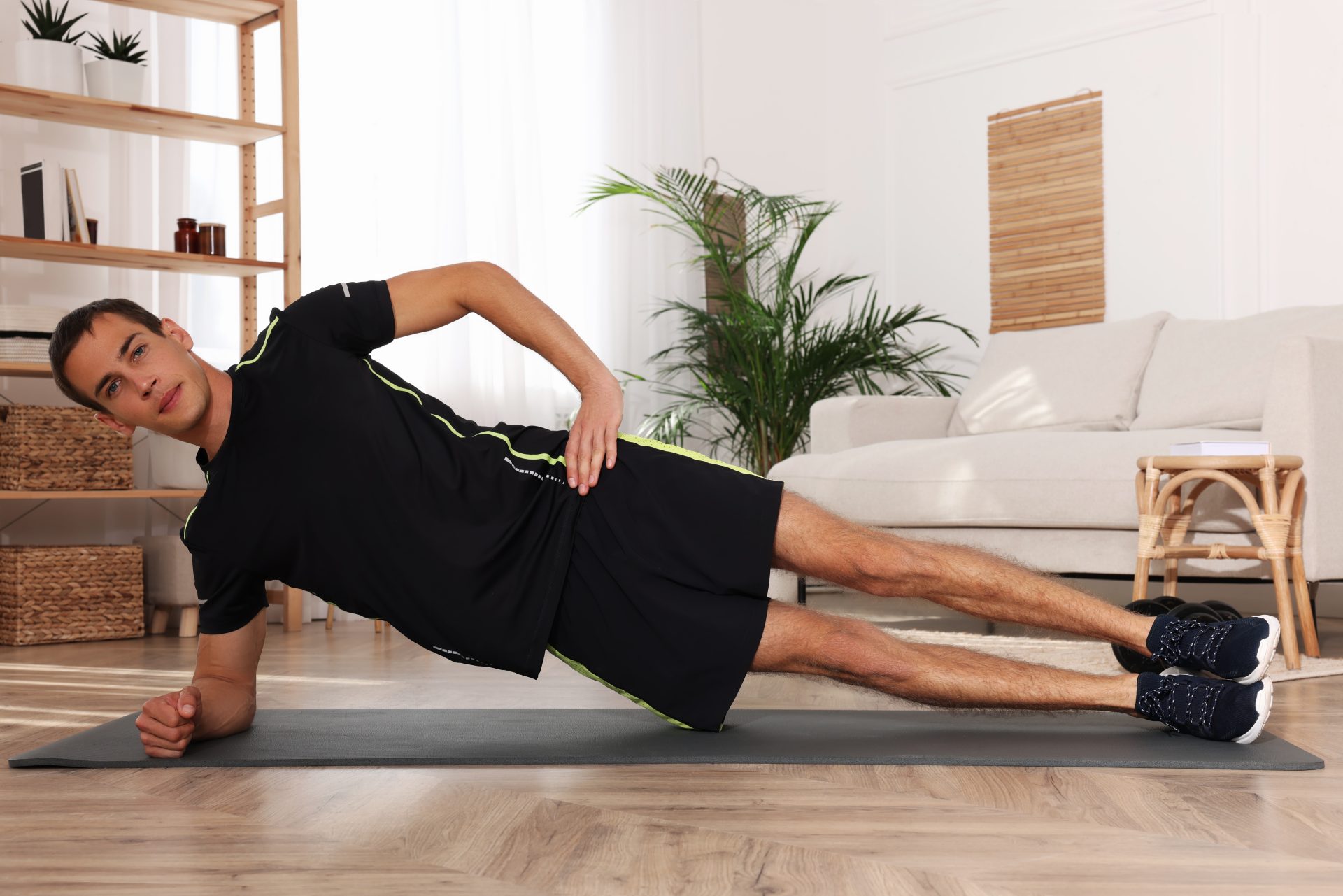
Side Plank — Lateral Core and Hip Stabilisers — 3 × 20–45 Second Holds Per Side
What it does: The side plank targets the quadratus lumborum and lateral obliques — muscles that resist lateral bending of the spine and stabilise the pelvis. These are often the weakest link in a person’s core, and their weakness is a primary driver of lower back pain and hip instability. Pair this with targeted plank variations for a complete lateral stability protocol.
Dosage: 3 sets of 20–45 seconds per side, resting 20 seconds between sides.
Beginner modification: Place your bottom knee on the floor. Progress to the full straight-leg version once you can hold 30 seconds without hip sag.
Mistake 1 — Holding Your Breath During Holds — Correction: Practise Exhale-Brace Breathing
What it is: The most common isometric core error is breath-holding. When people brace hard, they instinctively block their airway — spiking blood pressure, bypassing the diaphragm’s stabilising role, and making sets feel far harder than they should. This defeats the purpose of building functional core endurance.
What to do instead: Practise the exhale-brace pattern — breathe out fully, then brace your core around the empty lungs. Continue breathing in slow, controlled cycles throughout each hold. The ability to breathe under tension is what makes isometric core strength transfer to real life.
Mistake 2 — Allowing the Hips to Sag or Pike in the Plank — Correction: Use a Mirror or Video Yourself
What it is: Sagging hips overload the lumbar extensors and reduce transverse abdominis activation — turning a core exercise into a lower-back endurance test. Piking the hips too high shifts load to the shoulders and bypasses the abdominals entirely.
What to do instead: Shorten your hold duration to whatever allows a straight line from ears to heels. Film a 5-second side-view clip to check your position honestly. Quality of position always outweighs duration.
Mistake 3 — Training Only One Plane of Movement — Correction: Include Lateral and Rotational Holds
What it is: Most people default to front planks only, ignoring lateral and rotational demands. The obliques, quadratus lumborum, and multifidus resist forces in multiple planes simultaneously — training only the sagittal plane leaves these muscles underdeveloped and increases injury risk during real-world activity.
What to do instead: Include side planks and rotational holds (such as the Pallof press hold) alongside your standard plank. A structured programme distributes load across all three planes automatically.
Isometric Core training is not a one-size-fits-all programme — but it is far more broadly accessible than most people assume. Here is who benefits most.
Complete Beginners Starting from Zero
You do not need any prior fitness experience to begin isometric core exercises. Every movement in a well-structured programme comes with easier modifications — for example, performing the exercise seated, with a reduced range of motion, or using a wall or chair for support. The only requirement is willingness to show up consistently; the strength and technique will follow.
People With Back Pain or Poor Posture
This training is especially valuable for people managing Back Pain or Poor Posture. Isometric and low-impact variations allow you to build strength at pain-free joint angles without aggravating sensitive tissues. Always begin at a reduced intensity and range, and increase gradually as your body adapts.
Office Workers and Sedentary Adults
Prolonged sitting creates a predictable pattern: weakened glutes, tight hip flexors, and excessive lumbar loading — all of which this training directly counters. Even 20 minutes of targeted core and postural work each morning can measurably reduce the back pain and stiffness that accumulate over a working day. Office workers who train consistently report improved concentration and reduced fatigue by mid-afternoon.
Active Adults and Athletes
Isometric training is used by elite athletes for tendon strengthening, reactivating inhibited muscles, and maintaining strength during injury recovery. Adding isometric core work alongside dynamic training creates a more complete strength profile and improves force transmission through joints. It is particularly effective as a complement to weightlifting, running, and team sports.
Seniors Maintaining Functional Independence
Isometric training is ideal for seniors because it builds strength without placing dynamic stress on ageing joints. Joint-angle-specific strengthening improves stability during daily movements — standing up, navigating stairs, carrying groceries — reducing fall risk significantly. The absence of impact and eccentric loading makes isometric work particularly well-tolerated by older adults.
Core-Specific Programming — Not a Generic Fitness Class
Every exercise selection, sequence, and rest interval in Habuild’s strength sessions is chosen for core stability and functional strength — not calorie burn or aesthetics. Sessions open with diaphragmatic breathing and core activation drills to prime the transverse abdominis before load is introduced. They close with static hold finishers that consolidate the neural recruitment patterns built during the session.
This activation-first, consolidation-last design is what separates targeted isometric core programming from a generic fitness class. Explore the broader scope of this approach through Habuild’s mobility and strength integration programme.
Live Daily Sessions with Real-Time Form Correction
Habuild sessions are live, not pre-recorded. Your instructor can see and correct the exact errors — hip sag, breath-holding, asymmetric loading — that prevent core strength from developing. A cue delivered in the moment (“press your lower back into the floor”) produces an immediate neuromuscular response that watching a video replay never achieves.
Progressive Overload Built into Every Session
Members do not need to self-programme. Hold durations, rest periods, movement complexity, and breath control demands are progressively increased week by week. In week one, you might hold a plank for 20 seconds with knees down. By week eight, you are performing full-body tension drills with coordinated breathing for 60-second holds. The progression is built in — you simply show up.
Accountability, Streaks and Community
Consistency over weeks and months produces structural adaptation. Habuild’s streak tracking, daily live schedule, and WhatsApp community create the accountability architecture that keeps members showing up. Members who maintain a 30-day streak consistently report that the morning session becomes the anchor of their day — and that consistency is what produces lasting core strength.
I have been with Habuild for 1,050 days. My energy has increased and I don't feel drained by work anymore. My patience has grown — things that used to stress me out don't affect me the same way. My kids at home have also picked up the yoga habit. Most importantly, my knowledge about breathing and how it affects the entire body has transformed. My nervous system feels calmer, my digestion is better, and there is a steadiness in my body and mind that I had never experienced before.

My homeopathy doctor suggested yoga and I found Habuild. In the free 14 days, I already felt changes. The biggest surprise: I used to be unable to get down from a pavement by myself. Now I can jump. My core and lower body strength have rebuilt themselves through consistent practice. Habuild is a complete package — it strengthens everything, not just flexibility.


Practice Strong Everyday with Trishala Bothra, an IIT-B and London School of Business alumni
Trishala is focused on making movement feel lighter, more engaging, and something you actually look forward to.
In just 3 years, over 50,000 people began their strength journey, and 10,000+ join every week to keep getting stronger.