
Isometric exercises are specifically designed to build tension in a muscle without changing its length or moving the joint it crosses. Unlike traditional strength movements — where a muscle shortens during a bicep curl or lengthens during the lowering phase of a squat — isometric contractions hold the muscle at a fixed length under load. They recruit deep stabiliser muscles that dynamic movements often skip, making them uniquely valuable for joint health, postural strength, and rehabilitation contexts. When you apply force against an immovable resistance — a wall, the floor, your own opposing limb, or simply a sustained hold against gravity — your nervous system activates motor units across the muscle to maintain that tension. Because there is no movement to dissipate energy through range of motion, the muscle fibres must sustain maximal or near-maximal firing throughout the hold. This sustained neural recruitment drives adaptation in the tendons, the stabilising muscles around each joint, and the neuromuscular pathways that govern how quickly and fully you can generate force in dynamic movements too.
Genuine Strength Gains Without Joint Stress
The most direct benefit of isometric training is that it builds measurable strength — particularly at the specific joint angle where the contraction is held. For anyone dealing with joint sensitivity, post-injury caution, or mobility restrictions, this means you can continue loading and developing a muscle without putting it through a painful range of motion.
Research published in the Journal of Applied Physiology confirms that isometric training produces strength gains of 20–30% over an 8-week period at the trained angle, with carryover to adjacent angles. Every joint, tendon, and stabilising structure receives the stimulus it needs without the impact or shear force that dynamic lifting can create.
Relief from Chronic Tension and Muscular Fatigue
Many people searching for isometric contraction methods are dealing with persistent muscle tightness, postural fatigue, or the cumulative tension that builds from desk work and sedentary patterns. Targeted isometric holds — a doorframe chest press, a standing wall push, a seated glute squeeze — counteract this by activating underused muscles and releasing chronic low-level contraction in overworked ones.
Exercises like the isometric back extension, the standing hip abductor hold, and the isometric neck press directly address the tension patterns most commonly associated with poor posture and prolonged sitting. To understand what muscle training really means at a physiological level, it helps to see isometric work as targeted neuromuscular activation, not just static holding.
Long-Term Tendon and Connective Tissue Adaptation
One of the most underappreciated outcomes of consistent isometric training is what it does to tendons and connective tissue. Dynamic loading builds muscle but can outpace the slower adaptation rate of tendons — which is why overuse injuries are so common in purely dynamic programmes. Isometric contractions held for 30–45 seconds at 70–80% of maximum effort are among the most effective interventions for tendon loading, a principle well-established in sports rehabilitation.
The WHO recommends at least 150 minutes per week of moderate-intensity muscle-strengthening activity; isometric training counts toward this threshold and can be structured into daily sessions of 15–20 minutes without equipment. The result over 6–12 weeks is a stronger connective tissue matrix that supports every other form of training you do.
Improved Focus, Breath Control, and Mental Resilience
Holding an isometric contraction for 30–60 seconds demands genuine mental focus and controlled breathing in a way that rhythmic dynamic reps rarely do. This sustained effort trains the mind-muscle connection, improves breath regulation under load, and builds the kind of mental endurance that carries over into everyday performance — sustained concentration at work, stress tolerance, and recovery quality.
The immediate feedback of an isometric hold — you either maintain tension or you do not — creates a clarity of effort that builds confidence and consistency over time.
What you eat directly determines how fast you recover, how much you progress, and how consistently you can train. Here is what your nutrition plan should look like to support your isometric muscle contraction training effectively.
Protein — Supporting Muscle Under Sustained Tension
Isometric training creates sustained muscular tension that demands repair — target 1.4–1.8 g of protein per kg of body weight. Distribute intake across 3–4 meals for optimal muscle protein synthesis rather than loading it all at once. Good sources include eggs, paneer, lentils, chicken, and low-fat curd.
Calcium and Vitamin D — Joint and Bone Health
Joint and connective tissue health depends heavily on calcium and Vitamin D working together. Aim for 1000–1200 mg of calcium daily from dairy (milk, curd, paneer), ragi, sesame seeds (til), and leafy greens. Get 15–20 minutes of morning sunlight on exposed skin to maintain Vitamin D levels and improve calcium absorption.
Anti-Inflammatory Foods — Faster Recovery
Recovery speed is directly influenced by your body’s inflammatory status. Turmeric with black pepper (curcumin + piperine), fresh ginger, and omega-3 fatty acids from flaxseeds, walnuts, and fatty fish all actively reduce exercise-induced inflammation. Include these consistently rather than only on hard training days.
Hydration — Performance and Joint Lubrication
Adequate hydration supports joint lubrication, muscle function, and nutrient transport — aim for 2.5–3 L of water daily. Drink at least 500 ml before your morning exercise session to prime circulation and joint mobility. Herbal teas and coconut water count toward your fluid intake and provide additional micronutrients.
Magnesium — Muscle Function and Sleep Quality
Magnesium governs over 300 enzymatic reactions including muscle contraction and relaxation — making it essential for any movement-based training. Include pumpkin seeds, bananas, dark chocolate (70%+), spinach, and whole grains in your daily diet. Many Indians are mildly deficient; if you experience frequent muscle cramps or poor sleep quality, a magnesium glycinate supplement may help.
Starting a new training programme is often the hardest part. Here is a clear, week-by-week plan to begin your isometric muscle contraction training without injury or overwhelm.
Before You Begin — Setting Your Baseline
Before starting isometric training, note which movements or joint angles currently cause pain or significant discomfort. Isometric contractions can be performed at pain-free joint angles, making them ideal for working around existing injuries. Set a goal like holding each contraction for 45–60 seconds with full effort by the end of week 8.
Week 1–2: Foundation
Begin with hold durations of 15–20 seconds per contraction at moderate effort (60–70% of your maximum). Focus on maintaining perfect alignment — isometric exercises expose postural weaknesses very clearly. Initial muscle soreness will be mild compared to dynamic training because there is no eccentric component.
Week 3–4: Building Consistency
Progress hold durations to 30–40 seconds and begin increasing the effort level toward 75–80% of maximum. Practising at the same time each morning helps because joint stiffness (worst in the morning) gradually reduces through consistent isometric work. Add one new isometric variation per week as your form and endurance improve.
Week 5–8: Progression
Full-duration holds of 45–60 seconds at high effort become achievable for most people between weeks 5 and 7. You may notice improved joint stability and reduced discomfort during daily activities — this is the training transferring to real life. Consider adding dynamic work alongside isometrics to build through full ranges once your baseline strength has improved.
Isometric training rewards patience and precision — consistency at moderate effort outperforms sporadic maximum-effort sessions.
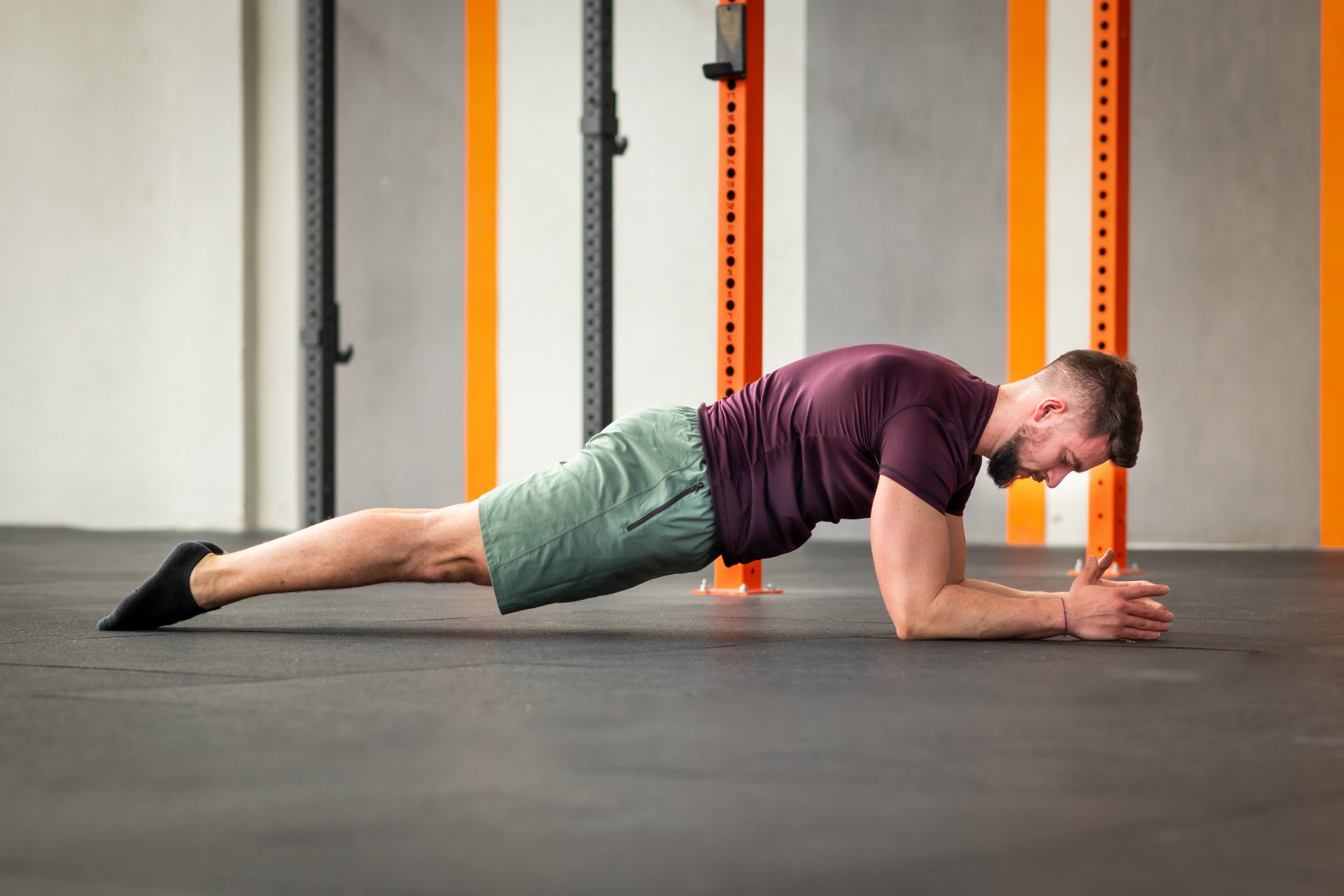
Isometric Plank Hold — Core, Shoulders, Glutes — 3 × 30–60 Seconds
What it does: The plank is the most complete isometric contraction example for full-body stabilisation. It simultaneously activates the deep abdominal stabilisers, the serratus anterior, the glutes, and the spinal erectors — all held at a functional length that mirrors the posture demands of real-life movement. It loads the anti-extension function of the core, which is what protects the lumbar spine during every compound lift you will ever do.
Dosage: 3 sets of 30–60 second holds. Rest 45 seconds between sets. Add 5 seconds per week as your capacity builds.
Beginner modification: Drop to the knees while keeping the hips in line with the shoulders and ankles. This reduces the load by approximately 30% while preserving the full-body tension pattern.
Wall Sit — Quadriceps, Glutes, Hip Flexors — 3 × 30–45 Seconds
What it does: The wall sit is one of the clearest isometric contraction examples for lower body strength. Holding the thigh parallel to the floor at a 90-degree knee angle maximally loads the quadriceps and glutes at the joint angle where most people are weakest — mid-range. This is the position where the knee is under the most mechanical demand during stairs, squats, and running. Regular wall sits build both the muscle and the tendon tolerance for this angle without any impact loading.
Building lean muscle through structured strength training becomes significantly more accessible when you include isometric work like this in your weekly routine.
Dosage: 3 sets of 30–45 second holds. Progress to 60 seconds over 3–4 weeks. Increase difficulty by lifting one heel slightly off the ground.
Beginner modification: Start with a shallower knee angle (60–70 degrees rather than 90) and hold for 20 seconds before building up.
Isometric Deadlift Pull — Posterior Chain, Traps, Grip — 3 × 6–8 Seconds at Maximum Effort
What it does: Set a barbell at mid-shin against fixed pins and pull with maximum effort for 6–8 seconds — the bar does not move. This is one of the most effective isometric strength stimuli available because it allows near-maximal force production against an immovable object, recruiting the highest-threshold motor units in the hamstrings, glutes, spinal erectors, and grip. Research on this overcoming isometric method shows it produces the greatest strength transfer to dynamic movements compared to yielding isometrics.
Learning how to systematically improve muscle strength requires understanding where overcoming isometrics fit in your overall programming.
Dosage: 3 sets of 6–8 second maximum pulls. Rest 2–3 minutes between sets. Use 3–4 different joint angles across your training week.
Beginner modification: Loop a towel around a table leg and pull horizontally while seated, holding for 6–8 seconds. Zero equipment, same principle.
Mistake 1 — Holding the Breath — Correction: Synchronise Breathing to the Hold
What it is: The most common error in isometric training is breath-holding. When a hold becomes difficult, most people instinctively stop breathing. This sharply raises blood pressure, reduces oxygen delivery to the working muscles, and shortens how long you can sustain quality tension. It also creates a habit that undermines every other strength movement you do.
What to do instead: Establish a nasal breathing rhythm before you begin the hold — a slow 4-count inhale and a controlled 4-count exhale. Maintain this pattern throughout. If you cannot breathe during a hold, you are either at too high an intensity or holding for too long. Scale back and build from a sustainable starting point.
Mistake 2 — Training Only One Joint Angle — Correction: Cycle Through Multiple Positions
What it is: Isometric strength is highly specific to the joint angle at which you train. A person who only ever holds a plank at one position or does wall sits at 90 degrees will build strength specifically at those positions — but that strength transfers only partially to adjacent angles. Many people plateau because they are developing a narrow band of isometric strength without addressing the full arc of a movement pattern.
What to do instead: Vary your hold position across training sessions. For the wall sit, train at 70, 80, and 90 degrees in different sessions. For isometric pressing, hold at the bottom, mid, and near-lockout positions. This multi-angle approach builds a more complete strength curve and produces broader carryover to dynamic movements.
Mistake 3 — Neglecting Progressive Overload — Correction: Increase Duration or Intensity Weekly
What it is: Because isometric training looks the same week after week, many people assume they are still progressing when they have actually plateaued. Without a systematic increase in either hold duration, applied intensity, or exercise difficulty, the body adapts fully within 3–4 weeks and further improvement stalls. This is the single biggest reason people report that isometric training stopped working.
Understanding how muscle gain actually works over time makes clear that progressive overload is non-negotiable in every training modality — isometric or otherwise.
What to do instead: Track your hold times and perceived effort weekly. Add 5 seconds to timed holds each week or increase applied force on overcoming isometrics by 5–10%. Every 4 weeks, introduce a more demanding variation — progressing from a standard plank to a plank with a leg lift, or from a bodyweight wall sit to a single-leg wall sit.
Isometric Muscle Contraction training is not a one-size-fits-all programme — but it is far more broadly accessible than most people assume. Here is who benefits most.
Complete Beginners Starting from Zero
You do not need any prior fitness experience to begin isometric muscle contraction exercises. Every movement in a well-structured programme comes with easier modifications — for example, performing the exercise seated, with a reduced range of motion, or using a wall or chair for support. The only requirement is willingness to show up consistently; the strength and technique will follow.
People With Joint Pain or Recovering from Injury
This training is especially valuable for people managing Joint Pain or Recovering from Injury. Isometric and low-impact variations allow you to build strength at pain-free joint angles without aggravating sensitive tissues. Always begin at a reduced intensity and range, and increase gradually as your body adapts.
Office Workers and Sedentary Adults
Sedentary adults who spend 6–8 hours sitting daily experience progressive losses in isometric muscle contraction capacity — this training directly reverses that trend. A 20–30 minute morning session creates a positive hormonal and metabolic shift that persists throughout the working day. Even three sessions per week produce measurable improvements in energy levels, concentration, and posture.
Active Adults and Athletes
Isometric training is used by elite athletes for tendon strengthening, reactivating inhibited muscles, and maintaining strength during injury recovery. Adding isometric muscle contraction work alongside dynamic training creates a more complete strength profile and improves force transmission through joints. It is particularly effective as a complement to weightlifting, running, and team sports.
Seniors Maintaining Functional Independence
Isometric training is ideal for seniors because it builds strength without placing dynamic stress on ageing joints. Joint-angle-specific strengthening improves stability during daily movements — standing up, navigating stairs, carrying groceries — reducing fall risk significantly. The absence of impact and eccentric loading makes isometric work particularly well-tolerated by older adults.
Isometric-Specific Programming — Not a Generic Fitness Class
Habuild’s strength sessions are structured around specific programming decisions — not random exercise selection. Isometric exercises are sequenced after a dynamic warm-up because the neuromuscular system needs to be primed before sustained isometric tension produces its full benefit. Sessions open with controlled mobility work to prepare joint angles, then move into isometric loading at the positions that most commonly limit functional strength. They close with active recovery movements that restore circulation to muscles that have been under static load.
Live Daily Sessions with Real-Time Form Correction
Isometric exercises look simple but fail in specific ways — the hips drop in a plank, the lower back rounds in a wall sit, or breath-holding creeps in under fatigue. In a pre-recorded video, these errors go uncorrected and become ingrained habits. Habuild sessions are live every morning, which means your instructor sees your positioning in real time and corrects the exact errors that prevent isometric training from producing results.
Progressive Overload Built into Every Session
Members do not need to design their own progression. Habuild builds overload into the weekly session structure — hold durations increase, intensity cues change, and movement complexity progresses as the training block advances. Breath control, applied force, and position difficulty are all managed for you across the 3-month programme. You show up; the progression is already planned.
Accountability, Streaks and Community
The single biggest predictor of whether isometric training produces results is consistency over 6–12 weeks. Habuild’s streak tracking, WhatsApp community, and daily live format are specifically designed to close the consistency gap — the gap between knowing what works and actually doing it every day. Members maintain streaks of 100, 200, and 300+ days not because they are unusually disciplined, but because the social and structural accountability makes showing up the path of least resistance.
I have completed 256 days and feel very good in all aspects. Even while traveling to Kashmir, I didn't miss a single day of yoga. Saurabh Sir's quiz messages and constant engagement keep me motivated. When he says 'Don't give up, do something' — I listen. I'm also doing the No Grains Challenge. Habuild has made healthy living something I genuinely enjoy.

I completed the Mount Kailash Yatra — a challenging high-altitude pilgrimage that tests both body and spirit. Habuild gave me the physical foundation and the mental strength to undertake and complete this journey.


Practice Strong Everyday with Trishala Bothra, an IIT-B and London School of Business alumni
Trishala is focused on making movement feel lighter, more engaging, and something you actually look forward to.
In just 3 years, over 50,000 people began their strength journey, and 10,000+ join every week to keep getting stronger.