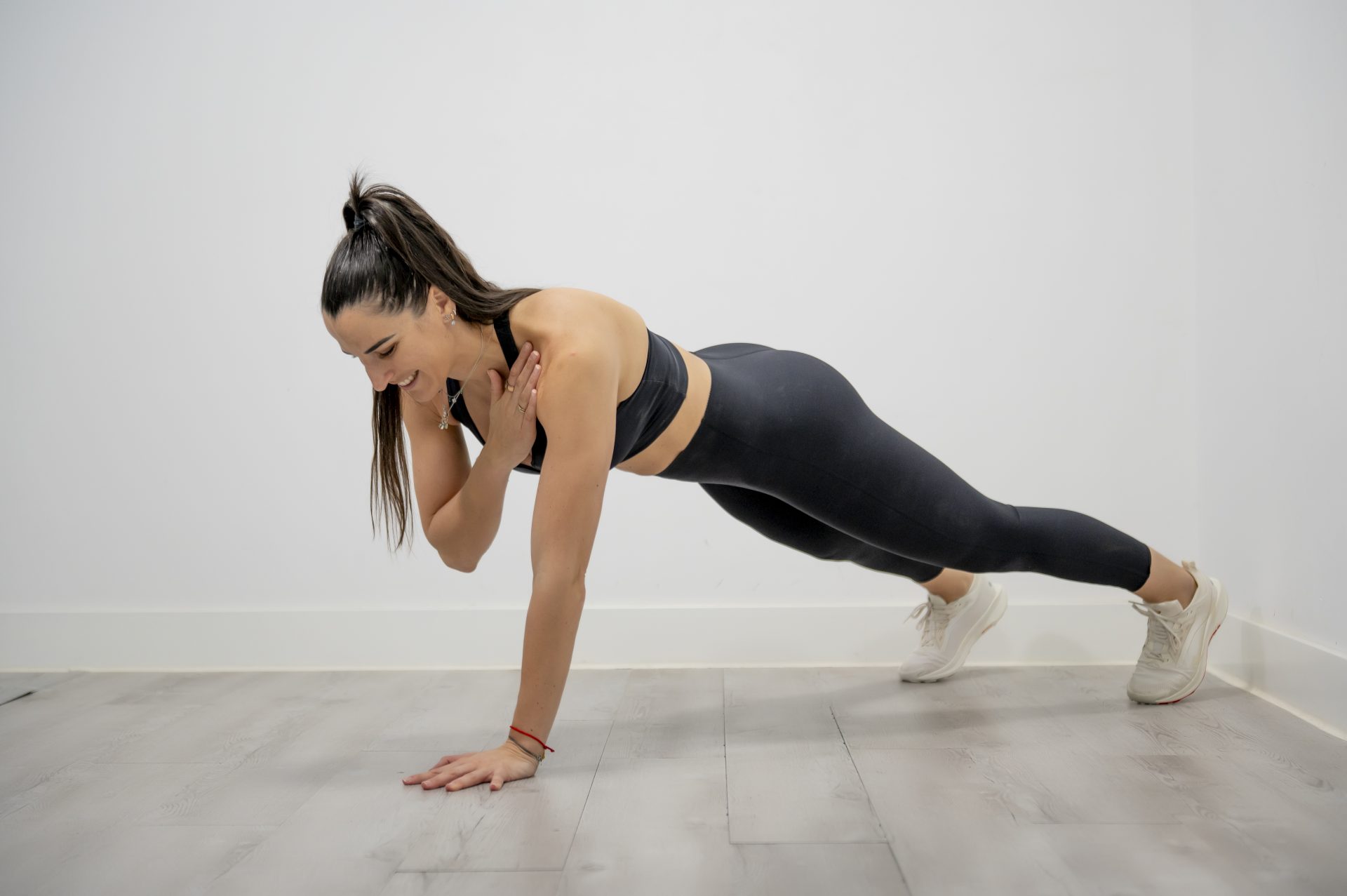
Plank shoulder taps are performed in the high plank position (hands directly below shoulders, body in a straight line from head to heel) with feet slightly wider than hip-width. Alternate lifting one hand to tap the opposite shoulder — right hand taps left shoulder, then left hand taps right shoulder — while maintaining the hips as level and still as possible throughout.
The mechanism is anti-rotation: the transversus abdominis, internal and external obliques, and gluteus medius must co-contract to prevent the hip from dropping or rotating during the single-arm support phase. This is the functional core stability pattern that protects the lumbar spine during all activities involving asymmetric arm loading — throwing, carrying, reaching, and every pulling movement that creates rotational torque through the trunk. Plank shoulder taps exercise type is specifically classified as anti-rotation training.
Builds Anti-Rotation Core Stability That Protects the Spine
The lumbar spine is most vulnerable to injury under rotation — disc injuries, facet joint strain and paraspinal tears predominantly occur during asymmetric loading with insufficient core stabilisation. Anti-rotation exercises like plank shoulder taps directly train the core’s resistance to rotation.
📊 Anti-rotation core training has been shown to reduce lower back injury incidence by up to 42% in occupational and athletic populations compared to flexion-only core training programmes.
Develops Shoulder Stability and Scapular Control
The single-arm support phase places the supporting shoulder in a demanding stabilisation position — activating the rotator cuff, serratus anterior and scapular stabilisers simultaneously. This makes plank shoulder taps one of the most effective closed-chain shoulder stability exercises available, particularly valuable for overhead athletes and those with rotator cuff weakness.
Improves Core Endurance and Full-Body Tension Maintenance
Plank shoulder taps require the entire posterior and anterior chains to remain under sustained tension throughout the set — a core endurance demand that exceeds the standard plank because the destabilising arm lifts continuously renew the stabilisation challenge.
📊 A 2020 study in the Journal of Human Kinetics found plank shoulder taps produced 34% greater oblique activation and 28% greater gluteus medius activation than standard planks.
Whole-Body Integration Without Equipment
Plank shoulder taps simultaneously train the core (anti-rotation and extension), shoulders (rotator cuff and scapular stability), triceps (single-arm support), and hip abductors (lateral hip stability) — one of the highest-value whole-body exercises available without any equipment.
Standard Plank Shoulder Tap — Anti-Rotation Core + Shoulder Stability — 3 x 20 reps (10 each side)
[Image for Standard Plank Shoulder Tap — Anti-Rotat]
High plank with feet wider than hip-width. Lift right hand, tap left shoulder, return to floor; lift left hand, tap right shoulder, return. Hips should not rotate or drop at any point. Pace: 1.5-2 seconds per tap. Sets/reps: 3 x 20. Modification: Drop to knee plank; the hip rotation demand is still present but load is reduced.
Slow Plank Shoulder Tap with Hold — Anti-Rotation Isometric — 3 x 12 reps with 2-sec holds
[Image for Slow Plank Shoulder Tap with Hold — Anti]
The same movement but with a 2-second hold in the single-arm support position before tapping and returning. The hold isolates the phase where the anti-rotation demand is maximum — producing significantly greater oblique and gluteus medius activation than the standard moving version. Sets/reps: 3 x 12 with 2-second holds each side.
Plank Shoulder Tap with Narrow Feet — Advanced Destabilisation — 3 x 16 reps
[Image for Plank Shoulder Tap with Narrow Feet — Ad]
Perform the standard shoulder tap with feet together rather than hip-width apart. The narrowed base of support dramatically increases the hip rotation tendency, making the anti-rotation demand substantially greater. Sets/reps: 3 x 16. If hips are rotating visibly, return to wider foot position.
Mistake 1: Hips Rocking Side to Side — Correction: Widen Feet and Slow Down
Hip rotation eliminates the anti-rotation training stimulus — the hips rocking means the obliques and hip stabilisers are not resisting the rotation. Widen the foot stance and reduce pace. If hips still rotate, drop to knee plank until the pattern is established.
Mistake 2: Sagging Hips — Correction: Squeeze Glutes and Brace the Core Before Each Rep
Hip sagging indicates the core and glutes have disengaged. Before each shoulder tap, actively brace the core (as if expecting a punch) and squeeze the glutes — then lift the hand. This re-engagement cue prevents the hip sag that transfers load from the core to the lower back.
Mistake 3: Looking Up — Correction: Maintain Neutral Neck with Eyes on the Floor
Looking forward or upward extends the cervical spine, creates neck tension, and pulls the shoulder blades forward. Eyes should look at the floor 30-45 cm in front of the hands, maintaining the straight-line head-to-heel alignment the plank position requires.
First 7 days for Rs.1 · Then Rs.1,999 for 3 months
Anti-Rotation Core Integrated Into Every Session
Habuild’s sessions progress from standard plank (anterior core endurance) to shoulder taps (anti-rotation stability) to rotational yoga sequences (dynamic stabilisation) in every session — covering all three core stability planes that complete functional core development requires.
Live Daily Sessions with Real-Time Hip Stability Correction
Hip rotation and hip sag — the two errors that eliminate the shoulder tap’s training value — are caught and corrected immediately in Saurabh Bothra’s live sessions.
Progressive Overload Built Into Every Session
Core progression advances from wide-foot standard to narrow-foot to holds to loaded variations within the programme’s structured timeline. Members never need to self-programme their core progression.
Accountability, Streaks and Community
Core stability is built through daily practice — the neuromuscular control that anti-rotation training develops requires consistent repeated exposure to be encoded as a movement pattern.
Complete Beginners Starting from Zero
Plank shoulder taps begin with a wide foot stance that minimises rotation, moving slowly between taps. Anyone who can hold a 20-second plank can start plank shoulder taps. No equipment is needed. The only requirement is showing up consistently — strength and technique follow from that.
Intermediate Trainees Looking to Fill a Gap
Plank shoulder taps specifically train anti-rotation core stability — the ability to resist the twisting forces that occur when one hand is lifted off the ground. This is the most functional form of core training, directly applicable to every sport and daily activity involving unilateral arm use. Adding plank shoulder taps to an existing routine addresses a specific conditioning gap that most general workouts miss.
Those Building Anti-Rotation Core Stability and Progressing Plank Variations
Plank shoulder taps specifically train anti-rotation core stability — the ability to resist the twisting forces that occur when one hand is lifted off the ground. This is the most functional form of core training, directly applicable to every sport and daily activity involving unilateral arm use.
Senior Citizens and Older Adults (50+)
Plank Shoulder Taps can be adapted for older adults by controlling tempo, reducing range of motion, and using supported variations. Habuild’s live instructors modify exercises in real time for different fitness levels and physical conditions in the same session.
Is Plank Shoulder Taps Good for Beginners?
Yes — absolutely. Plank Shoulder Taps begin at very low intensity with fully accessible entry-level variations. Habuild’s live instructor adapts the session in real time so beginners and experienced trainees can train together without either being left behind.
How Often to Do Plank Shoulder Taps — Frequency Guide
Train plank shoulder taps 3–4 times per week. This frequency gives the muscle and nervous system adequate stimulus without outpacing recovery. Consistency matters more than intensity in the early weeks — showing up regularly produces better results than infrequent all-out sessions.
When in Your Workout to Do Plank Shoulder Taps
Place plank shoulder taps in the core or upper-body session, after planks as the progression movement. Sequencing exercises correctly ensures you bring maximum quality to plank shoulder taps rather than performing them under accumulated fatigue from earlier work.
What to Pair Plank Shoulder Taps With
Combine plank shoulder taps with standard planks, push-ups, and dead bugs for a complete core stability and upper-body programme. This combination develops complementary muscle groups in the same session and builds the balanced strength that prevents compensation and injury.
How to Progress Plank Shoulder Taps Over Time
Once the base movement feels controlled and repeatable, narrow the foot width (significantly increases difficulty), increase pace, add light wrist weights, and finally progress to plank shoulder tap push-ups (adding a push-up between each tap). Progress only when form is consistent — adding difficulty before mastering the base movement reinforces poor mechanics and stalls long-term results.
Habuild is India’s First Habit Building Program — and through its strength and fitness sessions, it brings the same habit-based philosophy to targeted exercise training. Every session is structured around your specific goal, not a one-size-fits-all class.
Goal-Specific Programming — Not a Generic Fitness Class
Every exercise, rep range, and rest period in Habuild’s plank shoulder taps sessions is chosen because it produces results for plank shoulder taps specifically. Habuild does not run the same session for every goal — the programme is structured to drive your specific outcome with every session, not general fitness that happens to include plank shoulder taps.
Live Daily Sessions with Real-Time Form Correction
Unlike pre-recorded videos, Habuild’s live daily sessions allow the instructor to see and correct your form in real time — the specific errors that limit plank shoulder taps results and increase injury risk. This live correction is the difference between training that works and training that wastes effort and creates bad habits.
Progressive Overload Built into Every Session
Members do not need to design their own progressive overload for plank shoulder taps — it is built into the programme structure. Each week, sessions are deliberately more challenging than the last, ensuring the body never fully adapts and results continue coming rather than stalling.
Accountability, Streaks, and Community
The most common reason people stop exercising is not effort — it is missing sessions until the habit breaks. Habuild’s streak system, live session accountability, and community of members training the same goal alongside you resolves this directly. Members who join with a specific goal like plank shoulder taps and stay consistent for 30 days almost universally report that showing up has become automatic.
My homeopathy doctor suggested yoga and I found Habuild. In the free 14 days, I already felt changes. The biggest surprise: I used to be unable to get down from a pavement by myself. Now I can jump. My core and lower body strength have rebuilt themselves through consistent practice. Habuild is a complete package — it strengthens everything, not just flexibility.
I am a retired Army officer, 65 years old. I had undergone bypass surgery and was unsure what physical activity I could safely do. My doctor cleared me for yoga. After joining Habuild and completing 550 days, my muscle strength and mobility have improved, my stamina has increased, I started walking regularly, and my sugar levels stay in a healthy range. Flexibility and positivity have both increased. My wife is very active in Create Everyday — we are both truly grateful.


Practice Strong Everyday with Trishala Bothra, an IIT-B and London School of Business alumni
Trishala is focused on making movement feel lighter, more engaging, and something you actually look forward to.
In just 3 years, over 50,000 people began their strength journey, and 10,000+ join every week to keep getting stronger.