
Strength training for speed is a structured resistance programme specifically designed to achieve build explosive speed and athletic power — not just general fitness.
Every exercise selection, rep range, and progression is chosen because it directly drives speed results faster than generic workouts.
The mechanism is speed development.
By progressively overloading the target muscles and movement patterns over time, the body adapts specifically to the demands of speed training — producing measurable, sustainable results that general fitness classes are not structured to deliver.
Benefit 1: Improved Running and Movement Speed
Strength training improves the rate of force development — the speed at which muscles can produce force — directly translating to faster acceleration, higher maximum speed, and quicker direction changes in all sports and activities.
Benefit 2: Better Explosive Power and Jump Height
Strength-trained athletes produce greater ground reaction forces in less time — the physical basis of jumping, sprinting, and direction-change speed. Many athletes report improved jump height and sprint times within 8–10 weeks of targeted strength work.
Benefit 3: Improved Efficiency and Running Economy
Stronger muscles absorb impact more efficiently and produce greater elastic energy return — the mechanisms that make each stride faster and more economical. Strength-trained runners may use significantly less energy at the same pace.
Benefit 4: Reduced Injury Risk at High Speeds
High-speed movement places extreme demands on the muscles and connective tissue. Stronger muscles, tendons, and ligaments better tolerate the forces of sprinting and explosive movement — may reduce the sprint-speed injuries that undertrained athletes sustain.
Protein — The Foundation of Speed Training
Aim for 1.6–2.0g of protein per kg of bodyweight per day. Best sources include eggs, paneer, lentils (dal), chicken, Greek yoghurt, and whey protein. Distribute protein evenly across 3–4 meals and prioritise protein within 30–60 minutes after training. Adequate protein is non-negotiable — without it, training effort produces minimal adaptation regardless of programme quality.
Carbohydrates — Fuel for Performance and Recovery
Speed and explosive power training are anaerobic and highly carbohydrate-dependent. Adequate carbohydrate intake — especially around training sessions — fuels the explosive energy system that speed development requires.
Hydration and Micronutrients
Creatine (from meat and fish) supports the phosphocreatine energy system that explosive sprint efforts use — one of the most relevant nutritional factors for speed training adaptation. B vitamins support the rapid energy metabolism of high-intensity work.
Before You Begin — Setting Your Baseline
Before beginning, assess your current fitness level honestly. Set a specific, measurable goal — not just ‘get stronger’ but a clear speed outcome target in a defined timeframe. Identify your available space and equipment. If you have any existing injuries, medical conditions, or are over 50, please consult your doctor before starting.
Week 1–2: Foundation Phase
Two sessions per week. Focus entirely on movement quality — correct alignment, controlled tempo, and full range of motion. Use bodyweight only or very light resistance. The most important thing in this phase is NOT to push hard — it is to practise movement patterns correctly so that when you add resistance in weeks 3–4, your form is already solid.
Week 3–8: Progressive Loading Phase
Introduce resistance progressively — add one more rep or a small amount of load each week. The rep range varies by goal: for strength and hypertrophy, work in the 8–12 rep range; for endurance and toning, stay in the 15–25 rep range. Add a third session in weeks 5–6 if recovery allows. Track your sessions — a simple note of sets, reps, and load makes progression deliberate.
Week 9+: Goal-Specific Advancement
Introduce more advanced training variables: supersets (two exercises back-to-back), tempo manipulation (slower eccentrics for greater stimulus), and periodisation (heavier weeks alternating with deload weeks). At this stage the programme should be producing clear, measurable results. If you have stalled, review nutrition, sleep, and recovery before changing the programme.
Exercise 1: Single-Leg Squat or Step-Up (Explosive Finish) — Quadriceps, glutes, hip stabilisers | 4 sets × 6–8 reps each leg
Single-leg explosive loading replicates the ground contact mechanics of sprinting — the ability to produce force rapidly through one leg is the fundamental physical basis of speed. Targeted training may directly improve sprint acceleration. Beginner modification: Begin with slow, controlled step-ups; add the explosive finish only once base strength is established.
Exercise 2: Banded Hip Flexion Drill — Hip flexors, core, hip stabilisers | 3 sets × 12–15 reps each leg
Hip flexor power determines stride frequency — one of the two components (with stride length) of running speed. Banded hip flexion drills train the specific movement pattern and muscle that limits stride frequency. Beginner modification: Use a resistance band looped around a fixed point; drive the knee upward against resistance.
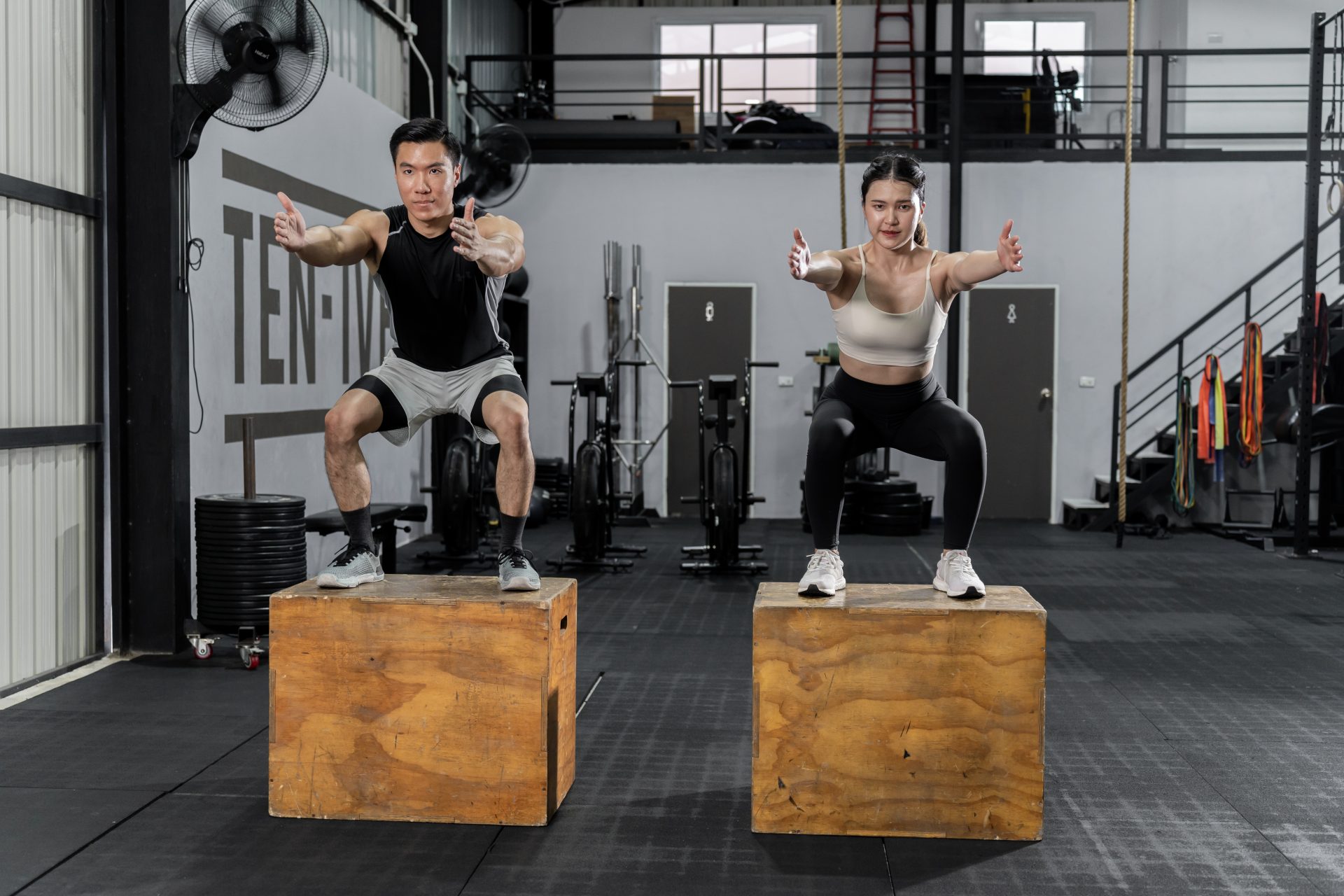
Exercise 3: Broad Jump or Squat Jump — Glutes, quadriceps, calves, core | 4 sets × 5–6 reps
Plyometric jumping exercises train the stretch-shortening cycle — the ability to rapidly store and release elastic energy that is the neurological basis of speed and explosiveness. These develop the specific quality that heavy strength training cannot produce alone. Beginner modification: Replace with a powerful squat to tiptoe if jumping is contraindicated; the hip drive quality matters more than air time.
Mistake 1: Only Doing Heavy Slow Lifts for Speed Goals
Maximum strength training improves the force ceiling but not the rate at which force is produced. Speed development requires explosive, fast-movement training — plyometrics and speed-specific exercises — not only heavy lifts.
Mistake 2: Neglecting Single-Leg Work
Sprinting is a series of single-leg actions — bilateral squats and deadlifts do not replicate the single-leg loading of running. Single-leg exercises are non-negotiable for speed development training.
Mistake 3: Skipping the Speed Training Itself
Strength training supports speed but does not replace it. Actual sprinting practice — accelerations, flying sprints, and speed drills — is essential alongside the strength work. Neither alone produces optimal speed development.
Complete Beginners Starting from Zero
This programme begins with bodyweight movements and progresses at each member’s own pace. Every exercise has a beginner modification, and the live instructor adapts in real time. No equipment or prior experience is required to start.
Intermediate Trainees Who Have Hit a Plateau
Goal-specific programming — the right exercises, the right rep ranges, and built-in progressive overload — is what breaks through the plateau that general fitness classes produce. When the training variable matches the speed goal specifically, results return.
Those Who Have Tried Speed Training Before Without Results
Most failed speed training attempts come from generic programmes without progressive overload, insufficient frequency, or no accountability. This programme addresses all three — with built-in progression, daily sessions, and community accountability.
Senior Citizens and Older Adults (50+)
Strength training for speed is particularly valuable for adults over 50. After 40, lean muscle mass decreases by approximately 1–2% per year without resistance training — affecting daily strength, balance, and independence. This programme provides modifications for every exercise making it safe and accessible regardless of current fitness level. If you have existing health conditions, please consult your doctor before starting.
Is Strength Training for Speed Good for Beginners?
Yes — with modifications for every exercise and live real-time guidance, this programme is specifically designed to be accessible from day one regardless of current fitness level.
Habuild is India’s First Habit Building Program for Yoga — and through its ‘Strong Everyday’ programme, it extends this same habit-building philosophy to structured strength and fitness training. Every session is designed for the specific goal rather than generic fitness.
Goal-Specific Programming — Not a Generic Fitness Class
Every exercise selection, rep range, and rest period in the speed programme is chosen because it produces speed results specifically — not because it is a popular gym exercise.
Live Daily Sessions with Real-Time Form Correction
Unlike pre-recorded videos, Habuild’s live sessions allow the instructor to see and correct form errors in real time — the specific errors that prevent speed progress and increase injury risk. This live feedback is the difference between training that works and training that wastes effort.
Progressive Overload Built into Every Session
Members do not need to design their own progression — it is built into the programme structure. Each week is deliberately more challenging than the last, ensuring the body continues adapting and results keep coming.
Accountability, Streaks, and Community
This was my first time trying strength sessions, and I absolutely loved it! I joined out of curiosity.
I joined this 7-day program to work on my strength and feel healthier. The exercises were simple yet effective.


Practice Strong Everyday with Trishala Bothra, an IIT-B and London School of Business alumni
Trishala is focused on making movement feel lighter, more engaging, and something you actually look forward to.
In just 3 years, over 50,000 people began their strength journey, and 10,000+ join every week to keep getting stronger.