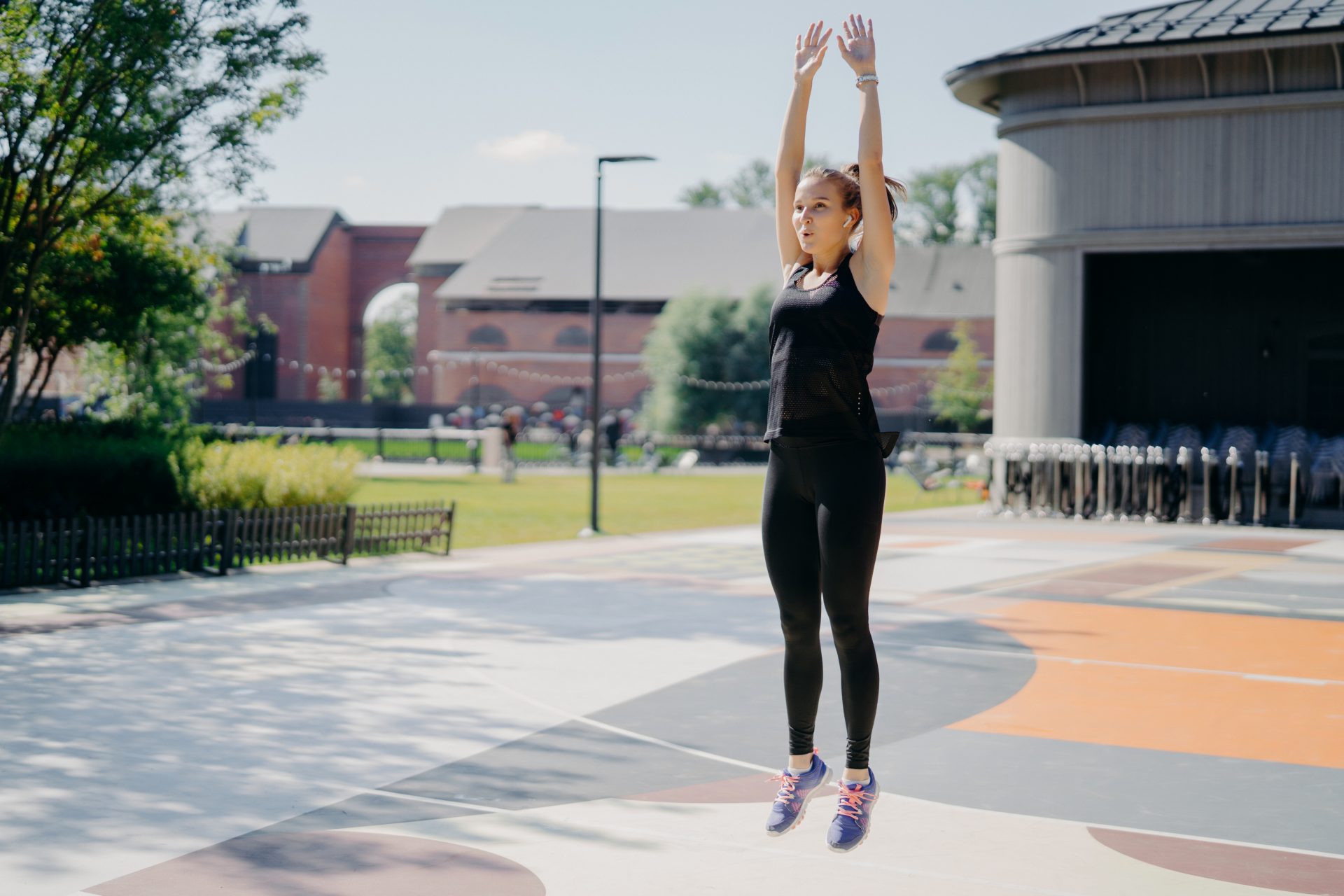
Vertical jump exercises are movements selected specifically to develop explosive lower-body power — not just leg strength in the general sense. Standard gym exercises like slow leg presses or long-rest hypertrophy sets build muscle size, but they do not train the rate of force development that determines how high you jump. Vertical jump training targets the speed at which your muscles can produce maximum force — the key variable separating a good jumper from a great one. The mechanism works through three movement patterns in sequence: rapid hip hinging to load the posterior chain, fast knee extension to drive force into the ground, and ankle plantar-flexion to complete the propulsion. When these three actions synchronise explosively, ground reaction force increases and you leave the floor higher. Training each pattern individually — and then combining them — is what makes vertical jump programming distinct from general leg work.
Greater Athletic Performance — In Every Sport That Involves Moving Fast
The most direct outcome of vertical jump training is raw explosiveness — and that carries over into sprinting, cutting, and reactive movement across almost every sport. When your muscles can produce force faster, you become quicker off the mark, not just higher off the ground. Research shows that athletes who follow plyometric-heavy programmes improve sprint times alongside vertical jump scores, because the neuromuscular pathway is shared.
Reduced Knee and Ankle Injury Risk — Through Stronger Landing Mechanics
Most knee and ankle injuries in jumping sports happen on landing, not take-off. Exercises like depth drops, squat jumps, and single-leg landing drills train your joints to absorb force efficiently. Building this eccentric strength means tendons, ligaments, and surrounding muscles share the load better — reducing the stress placed on any single structure during impact.
Stronger Posterior Chain — The Engine Behind Every Jump
Consistent vertical jump training develops the glutes, hamstrings, and calves in a way that translates directly to power output. The WHO recommends a minimum of 150 minutes of moderate-to-vigorous physical activity per week for general health — targeted strength-and-power work like vertical jump training satisfies that threshold while building sport-specific adaptation simultaneously. Over 8–12 weeks of regular training, measurable gains in both vertical height and lower-body strength are commonly observed.
Better Posture and Core Stability — The Secondary Cascade
Explosive jumping demands a braced, neutral spine at take-off. Training for that posture carries over into everyday movement — better hip alignment, a stronger mid-section, and reduced lower-back load during daily activities. These secondary benefits accumulate quietly alongside the primary jump gains. For a fuller picture of how lower-body training supports overall movement quality, exercises for mobility provide an excellent complement to any jumping programme.
What you eat directly determines how fast you recover, how much you progress, and how consistently you can train. Here is what your nutrition plan should look like to support your vertical jump training effectively.
Protein — Preventing Muscle Loss During Cardio
Cardio training breaks down muscle over time if protein intake is insufficient — aim for 1.4–1.8 g/kg/day. Prioritise fast-digesting sources like eggs or whey post-session, and slower sources like dal and paneer at other meals. Chicken, tofu, and low-fat curd are convenient everyday options.
Calcium and Vitamin D — Joint and Bone Health
Strong bones provide the structural foundation for all movement — include calcium-rich foods like milk, curd, paneer, ragi, and sesame seeds (til) daily. Vitamin D is essential for calcium absorption; aim for 15–20 minutes of morning sunlight alongside dietary sources like eggs and fatty fish. Deficiency in either nutrient accelerates joint wear over time.
Anti-Inflammatory Foods — Faster Recovery
Recovery speed is directly influenced by your body’s inflammatory status. Turmeric with black pepper (curcumin + piperine), fresh ginger, and omega-3 fatty acids from flaxseeds, walnuts, and fatty fish all actively reduce exercise-induced inflammation. Include these consistently rather than only on hard training days.
Hydration — Performance and Joint Lubrication
Cardio sessions drive significant fluid and electrolyte loss through sweat. Target 3–3.5 L of water daily, with at least 500 ml consumed before your morning session. On days exceeding 45 minutes of continuous cardio, consider adding a small pinch of rock salt and lemon to water to replace lost sodium and potassium.
Magnesium — Muscle Function and Sleep Quality
Magnesium governs over 300 enzymatic reactions including muscle contraction and relaxation — making it essential for any movement-based training. Include pumpkin seeds, bananas, dark chocolate (70%+), spinach, and whole grains in your daily diet. Many Indians are mildly deficient; if you experience frequent muscle cramps or poor sleep quality, a magnesium glycinate supplement may help.
Starting a new training programme is often the hardest part. Here is a clear, week-by-week plan to begin your vertical jump training without injury or overwhelm.
Before You Begin — Setting Your Baseline
Assess your current baseline with a simple test: walk briskly for 10 minutes and note your heart rate and breathlessness level. If you can hold a conversation throughout, your starting fitness is reasonable; if not, begin at a very gentle pace. Set a concrete goal — completing a 30-minute continuous session at moderate intensity — as your 8-week target.
Week 1–2: Foundation
Begin with 15–20 minute sessions at low-to-moderate intensity where you can still hold a full conversation. Focus on establishing a rhythm and learning to breathe through your nose during the easier portions. Do not worry about speed or distance in this phase — showing up consistently matters most.
Week 3–4: Building Consistency
Increase session duration by 5 minutes every week once you can complete your current duration without excessive fatigue. Commit to exercising at the same time each morning; your cardiovascular system responds strongly to consistent circadian-timed training. You should begin to notice better energy levels and lower resting heart rate around week 3.
Week 5–8: Progression
By weeks 5–8, you are ready to introduce interval-style work: 30 seconds at higher intensity followed by 60–90 seconds of easy pace. Most people see their first significant endurance milestone — completing a full session without stopping — somewhere between weeks 4 and 6. Track your progress by how you feel at the same intensity, not just by time or distance.
With cardio training, showing up every morning consistently matters infinitely more than occasional high-intensity efforts.
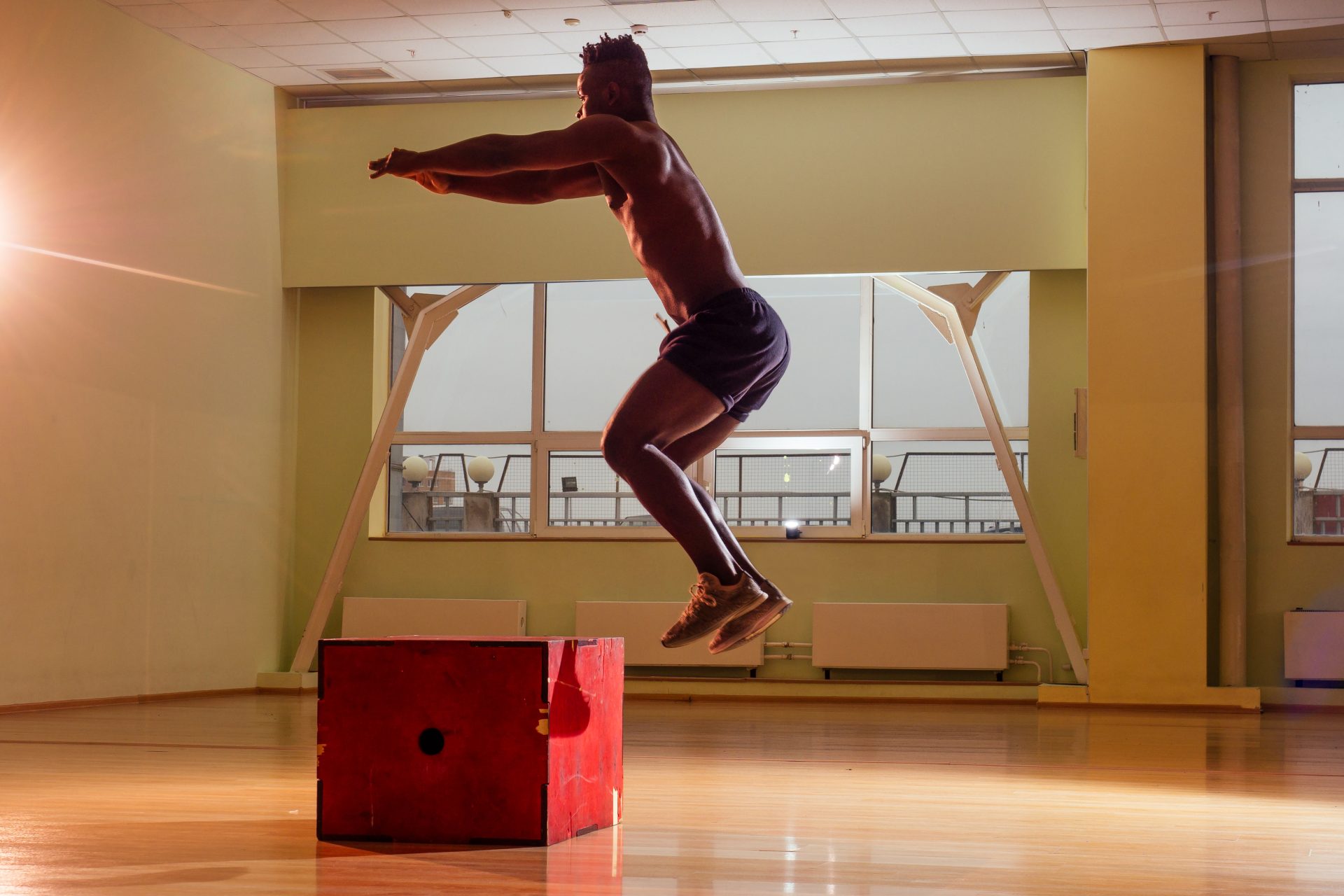
Box Jump — Full Lower Body — 4 × 6 Reps, 3× per Week
What it does: The box jump is the cornerstone of vertical jump training. You load through a partial squat, then explode upward and land softly on an elevated surface. This trains both the concentric power phase (take-off) and the eccentric absorption phase (landing) — the two components that determine jump height and joint safety simultaneously.
Dosage: 4 sets × 6 reps. Rest 90 seconds between sets. Use a box height that challenges you but allows a clean, quiet landing. Three sessions per week with a rest day between each.
Beginner modification: Start with a low step (20–25 cm) or simply perform a jump-and-stick onto flat ground — focus on sticking the landing with knees bent and weight balanced before progressing to a raised surface.
Jump Squat — Quads, Glutes, Calves — 3 × 10 Reps, 4× per Week
What it does: The jump squat removes the box and trains pure vertical force production from the squat position. It is one of the most studied exercises for improving vertical jump height because it directly mimics the mechanics of a maximum-effort jump. It also develops the quad-to-glute coordination that makes every jump more efficient. Pair this with targeted quad strength exercises on non-jump days to accelerate lower-body development.
Dosage: 3 sets × 10 reps. Bodyweight only to start. Add a light dumbbell (2–4 kg per hand) once form is consistent and you can reach full extension at take-off.
Beginner modification: Perform a sit-to-stand from a chair with an explosive last-inch push, omitting the jump until hip flexor and glute strength is sufficient to maintain a neutral spine throughout.
Depth Drop to Jump — Full Posterior Chain — 3 × 5 Reps, 2× per Week
What it does: Step off a low box, absorb the landing in a controlled partial squat, then immediately explode into a vertical jump. This is a reactive strength drill — it trains the stretch-shortening cycle, the elastic energy rebound that elite jumpers use to add height beyond what raw muscle alone can produce. Consistent glute strength training accelerates depth drop results: the stronger the posterior chain, the faster the rebound.
Dosage: 3 sets × 5 reps. Long rest (2 minutes) between sets — this is a neural exercise, not a conditioning drill. Twice per week maximum.
Beginner modification: Replace the drop with a standing jump to a controlled landing, holding for 2 seconds before the next jump. Build reactive ability gradually before introducing drop height.
Mistake 1 — Training for Volume Instead of Velocity — Correction: Prioritise Speed of Movement Over Rep Count
What it is: Many people treat jump training like conventional hypertrophy work — high reps, short rests, chasing the burn. Vertical jump improvement is a power adaptation, not a size adaptation. Fatiguing your fast-twitch fibres with 20-rep sets trains endurance, not explosiveness, and actively blunts the neural drive responsible for jump height.
What to do instead: Keep jump-specific sets to 5–8 reps maximum. Rest fully between sets (90 seconds to 2 minutes). Every rep should be performed with maximum intent — if the last rep is slower than the first, your set is already too long.
Mistake 2 — Skipping Single-Leg Training — Correction: Include Unilateral Work in Every Session
What it is: Bilateral jump exercises are easy to default to, but most sporting jumps involve a dominant push leg. Bilateral training can mask and reinforce strength asymmetries — and those asymmetries both limit jump height and increase injury risk on landings. Neglecting unilateral work is one of the most common reasons vertical jump height plateaus after initial gains.
What to do instead: Add Bulgarian split squats or single-leg box step-ups to at least two sessions per week. These pair well with comprehensive leg strength work to ensure balanced development from ankle to hip.
Mistake 3 — Neglecting Ankle and Calf Stiffness Training — Correction: Add Calf Raises and Ankle Hops
What it is: The ankle is the final contact point with the ground. Weak or slow ankle plantar-flexion costs you centimetres on every single jump — yet calf and ankle work is almost always the last priority in jump training plans. Soft, slow ankle push-off means ground contact time is longer and energy is wasted rather than returned.
What to do instead: End every session with 3 sets of single-leg calf raises (slow up, slow down) and 2 sets of rapid ankle hops (20 per foot). Stiff, fast ankles are trainable — but only if you train them directly.
50,000+ members already training with Habuild every morning. Live daily sessions · Expert instructor · Cancel anytime.
Vertical Jump training is not a one-size-fits-all programme — but it is far more broadly accessible than most people assume. Here is who benefits most.
Complete Beginners Starting from Zero
You do not need any prior fitness experience to begin vertical jump exercises. Every movement in a well-structured programme comes with easier modifications — for example, performing the exercise seated, with a reduced range of motion, or using a wall or chair for support. The only requirement is willingness to show up consistently; the strength and technique will follow.
People With Low Cardiovascular Fitness or High Resting Heart Rate
This training is especially valuable for people managing Low Cardiovascular Fitness or High Resting Heart Rate. Vertical Jump exercises specifically target the muscular imbalances and movement patterns that drive these conditions. Always begin at a reduced intensity and range, and increase gradually as your body adapts.
Office Workers and Sedentary Adults
Sedentary desk-based work dramatically reduces daily energy expenditure and cardiovascular fitness. A structured morning cardio routine provides the cardiovascular stimulus that the workday eliminates, improving energy, mood, and metabolic health. Studies consistently show that morning exercisers maintain better adherence than those who train in the evening.
Active Adults and Athletes
Experienced gym-goers and recreational athletes use vertical jump training to address specific movement gaps and build functional capacity. This style of training bridges the gap between general fitness and sport-specific performance, reducing injury risk in the process. It works well as a primary programme or as targeted supplementary work alongside your existing routine.
Seniors Maintaining Functional Independence
Cardiovascular fitness declines with age but responds strongly to consistent training at any age. Low-to-moderate intensity vertical jump sessions maintain heart health, improve circulation, and sustain the energy levels needed for an active daily life. The key for seniors is maintaining consistency over years, not pushing intensity — steady daily movement produces compounding benefits.
Vertical-Jump-Specific Programming — Not a Generic Fitness Class
Every exercise selection, sequencing decision, and rest period in Habuild’s strength sessions is chosen for a specific physiological outcome. Sessions open with neural activation — glute bridges, hip hinges, and ankle prep — to prime the fast-twitch pathways before any explosive work begins. They close with eccentric strength work and mobility, where landing safety and long-term jump development are actually built. Nothing is random. Nothing is filler.
Live Daily Sessions with Real-Time Form Correction
Pre-recorded videos cannot see you. Habuild’s live format means your instructor watches your mechanics and corrects the specific form errors — a forward knee cave on landing, a slow arm swing, insufficient hip hinge depth — that are silently capping your jump progress. Real-time corrections on real movement patterns are why live training produces results that self-directed video workouts rarely sustain.
Progressive Overload Built into Every Session
Members do not need to design their own periodisation. Habuild builds progression across every week — increasing movement complexity, load, and reactive intensity at the right intervals so the body is always adapting without being overloaded. You show up. The programme does the thinking.
Accountability, Streaks and Community
Jump height improvements require weeks of consistent training — not one or two good sessions. Habuild’s streak tracking, daily live check-ins, and WhatsApp community create the accountability layer that keeps members showing up on the days they would otherwise skip. Consistency is where the results live, and the community structure is built specifically to protect it.
I have been with Habuild for 1,050 days. My energy has increased and I don't feel drained by work anymore. My patience has grown — things that used to stress me out don't affect me the same way. My kids at home have also picked up the yoga habit. Most importantly, my knowledge about breathing and how it affects the entire body has transformed. My nervous system feels calmer, my digestion is better, and there is a steadiness in my body and mind that I had never experienced before.

My homeopathy doctor suggested yoga and I found Habuild. In the free 14 days, I already felt changes. The biggest surprise: I used to be unable to get down from a pavement by myself. Now I can jump. My core and lower body strength have rebuilt themselves through consistent practice. Habuild is a complete package — it strengthens everything, not just flexibility.


Practice Strong Everyday with Trishala Bothra, an IIT-B and London School of Business alumni
Trishala is focused on making movement feel lighter, more engaging, and something you actually look forward to.
In just 3 years, over 50,000 people began their strength journey, and 10,000+ join every week to keep getting stronger.