
What Is CrossFit Workout? A Complete Beginner’s Guide
A CrossFit workout combines weightlifting, gymnastics, and cardio conditioning into constantly varied sessions, with every movement scaled to fit any fitness level. See the complete beginner's guide.
Key Takeaways
- Combines weightlifting, gymnastics, and cardio conditioning into constantly varied sessions.
- Every movement can be scaled, making it accessible to beginners and experienced athletes alike.
- ‘MetCon’ pushes both aerobic and anaerobic systems in short, intense bursts.
- Group-training culture creates accountability that helps people stay consistent longer.
- Most foundational movements need only bodyweight, a mat, and clear floor space.
A CrossFit workout is a high-intensity functional fitness program that combines weightlifting, gymnastics, and cardiovascular conditioning into constantly varied daily sessions. It is designed to build broad, general fitness — not specialisation — and every movement can be scaled to suit any fitness level, making it accessible to complete beginners and experienced athletes alike.
If you've ever wondered what is crossfit workout and whether it's right for you, you're not alone. CrossFit is built around the idea that showing up consistently to varied, structured sessions produces more durable results than any single training style alone. Whether you're returning to exercise or starting for the first time, this guide covers everything you need to know before you begin.
6 Key Benefits of CrossFit Training
- Builds Functional Strength CrossFit movements — squats, deadlifts, pull-ups — are drawn from real-life motion patterns. Regular practice gradually strengthens the muscles you use every day, making routine tasks feel easier over time. A complementary approach worth exploring is Functional Strength Training, which shares many of the same foundational principles.
- Supports Fat Loss Through Mixed-Intensity Work CrossFit sessions combine strength and cardio in a single workout, keeping your heart rate elevated throughout. This sustained effort may gradually support body composition when practiced consistently alongside a balanced diet.
- Improves Cardiovascular Fitness The metabolic conditioning component — commonly called “MetCon” — pushes your aerobic and anaerobic systems in short, intense bursts. Over weeks of consistent practice, most people notice meaningful improvements in endurance and breathing capacity.
- Increases Bone Density Weight-bearing and resistance-based movements place controlled stress on bones. Practiced regularly, this type of loading supports bone density over time — a benefit that becomes especially significant as you age.
- Enhances Overall Mobility and Flexibility Every CrossFit session typically includes mobility work — hip openers, ankle drills, thoracic rotations. Done consistently, this keeps joints healthy and reduces stiffness that accumulates from sedentary routines.
- Builds Mental Resilience Through Community CrossFit classes are known for their group-training culture. Working alongside others — even virtually — creates accountability that helps most people stay consistent far longer than solo workouts tend to.
How to Get Started with CrossFit Training
What You Need to Begin
You don't need a fully equipped gym to start. Most foundational CrossFit movements require nothing more than your bodyweight. A yoga mat, clear floor space, and comfortable shoes are sufficient for the first several weeks. As you progress, light dumbbells or resistance bands can be added — but equipment is not the barrier. Consistency is.
Setting Realistic Goals
Most beginners see noticeable improvement in energy and movement quality within four to six weeks of consistent practice — not days. Set process-based goals (show up three times a week) rather than outcome-based ones (lose 5 kg in a month). Progress compounds quietly, and chasing fast results usually leads to overtraining and burnout.
Start with the Basics
Before attempting benchmark workouts (WODs), spend two to three weeks mastering foundational movements: the air squat, the push-up, the deadlift with a light load, and a basic pull variation. Correct form at low intensity will serve you better than sloppy reps at high intensity every time.
Best CrossFit Exercises for Beginners
Air Squats
The foundation of lower-body CrossFit work. Stand hip-width apart, keep your chest up, and lower until your thighs are parallel to the floor. Drive through your heels to stand. Aim for 3 sets of 15 reps with a 2-second pause at the bottom to build control.
Push-Ups
A full-body pressing movement that builds chest, shoulder, and tricep strength while demanding core stability. Keep your body in a straight line from heel to crown. Beginners can start on their knees and progress to full push-ups over two to three weeks. Target 3 sets of 10–12 reps.
Burpees
The quintessential CrossFit conditioning movement. A squat thrust combined with a jump, burpees train the full body and spike the heart rate quickly. Start with 5–8 reps per set and focus on a controlled chest-to-floor descent before worrying about speed.
Deadlifts (Bodyweight or Light Load)
Deadlifts teach you to hinge at the hips — one of the most important and most neglected movement patterns. With a neutral spine and engaged core, lower a light barbell or pair of dumbbells to mid-shin and drive back up. Three sets of 8 reps at a manageable weight beats one heavy set with poor form every time.
Box Jumps (or Step-Ups)
Explosive lower-body power work. If jumping feels too intense initially, step-ups onto a sturdy surface build the same muscles with lower impact. Progress to jumps when your landing mechanics are consistent. Three sets of 6–8 reps is a solid starting point.
Pull-Ups or Ring Rows
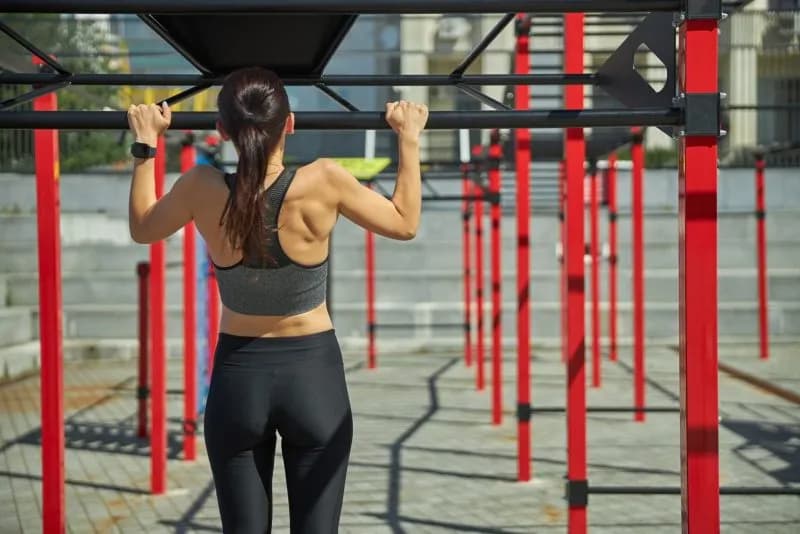
Upper-body pulling strength is central to CrossFit. Ring rows — where you pull your chest to a lowered bar while your feet remain on the floor — are an excellent scaled version. Work toward 3 sets of 8 ring rows before attempting full pull-ups.
Double-Unders (or Jump Rope)
Rope skipping builds coordination, timing, and cardio fitness simultaneously. Start with single-unders (one skip per jump) and build rhythm before attempting double-unders. Three rounds of 30 seconds on, 30 seconds rest is a beginner-friendly structure.
Common Mistakes to Avoid in CrossFit Workouts
- Poor Form Under Fatigue CrossFit's competitive culture can tempt beginners to keep moving even when form breaks down. A rounded back on a deadlift or collapsing knees in a squat under fatigue is how injuries happen. The rule: slow down or stop before technique fails — not after.
- Skipping the Warm-Up A proper warm-up isn't optional — it's the difference between a productive session and an injury that sidelines you for weeks. Spend at least 8–10 minutes on joint mobilisation, dynamic stretches, and light movement before any high-intensity work begins.
- Overtraining Too Soon Enthusiasm in the first two weeks often leads to training every day, then burning out or getting hurt by week three. Three well-structured sessions per week with rest days in between is more effective than six back-to-back intense workouts. Recovery is where adaptation happens.
- Inconsistency The single biggest reason people don't see results from CrossFit training isn't program design — it's inconsistency. Showing up irregularly for three months produces far less than showing up three times a week without exception. Structure and habit matter more than any individual workout.
Who Should Try CrossFit Training?
- Beginners CrossFit's scalability makes it genuinely beginner-friendly. Every movement can be modified — reduced range of motion, lighter loads, substituted exercises — so that someone who has never trained before can participate in the same session as an experienced athlete. The barrier to entry is low; the ceiling for progress is high.
- Women One of the most persistent myths around what crossfit training involves is that it will make women “too bulky.” Building significant muscle mass requires specific conditions — caloric surplus, years of progressive overload — that a standard CrossFit program does not produce. What most women experience instead is improved muscle tone, better posture, and stronger joints.
- Older Adults For adults over 50, scaled CrossFit practice supports the bone density and functional mobility that naturally decline with age. Lower-impact modifications — step-ups instead of jumps, ring rows instead of pull-ups — make the program accessible. Always consult your doctor before beginning any new exercise program, particularly if you have pre-existing joint or cardiovascular conditions.
- Working Professionals CrossFit workouts are typically 45–60 minutes in total, including warm-up. The high-intensity format delivers a meaningful training stimulus in a short window — relevant for anyone whose schedule makes longer gym sessions impractical. The posture and core work embedded in most sessions also directly addresses stiffness that builds from desk work. Understanding Strength Training Vs Cardio can help you structure your week intelligently alongside CrossFit sessions.
Build Strength with a Routine That Actually Works
Building strength and fitness isn't about doing random workouts whenever motivation strikes. It's about having a structured plan, the right guidance, and a consistent habit you can maintain for months — not just days. That's the gap most fitness programs fail to close, and it's exactly what Habuild's Strong Everyday program is built around.
If you want to understand how structured resistance training drives real results, Why Strength Training Is Important is a useful place to deepen your understanding before you begin.
What you get with Habuild's Strong Everyday Program:
- Daily live guided strength and conditioning sessions
- Beginner to advanced progression — no experience required
- No-equipment and home-friendly workout options
- Expert coaching to ensure correct form throughout
- Community support that makes consistency far easier
Related reads: Beginner Bodyweight Workout: The Complete No-Equipment Guide · What is a Calisthenics Workout? the Complete Beginner's Guide
CrossFit's constantly varied format builds broad fitness, but that variety only compounds into real progress when it's guided and scaled deliberately rather than pieced together session by session. Structure is what keeps varied training from becoming directionless. Habuild's Strong Everyday program takes a similarly guided, progressive approach — built to keep your training purposeful and consistent.
Frequently Asked Questions
Related Articles
Crossfit Workouts at Home: Benefits, Exercises, Mistakes & More
Home CrossFit-style training combines bodyweight strength and cardio conditioning, scalable to any fitness level in 20-30 minutes, no gym required. See the benefits, exercises, and common mistakes.
What Is Tabata Workout? Everything You Need to Know
A Tabata workout is 20 seconds of maximum effort, 10 seconds rest, repeated eight times — four minutes per round, developed by Dr. Izumi Tabata in the 1990s. See why it's one of the most time-efficient training formats.
Beginner Bodyweight Exercises: Build Strength at Home Without Equipment
Bodyweight exercises are the most accessible way to start building real strength — no gym membership, no equipment, no experience required. See 8 key benefits and how to begin.
Beginner Fat Loss Workout: The Complete Guide to Getting Started at Home
A beginner fat loss workout doesn't need to be complicated to be effective — the right starting point, done consistently, makes all the difference. See the benefits, best exercises, and common mistakes.
What Is Strength Training? Benefits, Exercises & How to Get Started
Strength training uses resistance — bodyweight, dumbbells, or bands — to challenge muscles and stimulate growth, building lean muscle and raising metabolism for all ages and experience levels. See the benefits and how to start.