Archer Push Up: Build One-Arm Push-Up Strength
An archer push up progression that builds one-arm push-up strength through unilateral chest loading.

Key Takeaways
- Shifts most bodyweight onto one working arm
- 3 sets of 6-10 reps per side, 3 days a week
- Requires rest days to avoid shoulder injury risk
- Guided by senior instructor Saurabh Bothra's live classes
- Far harder than the standard push-up
What Is an Archer Push Up?
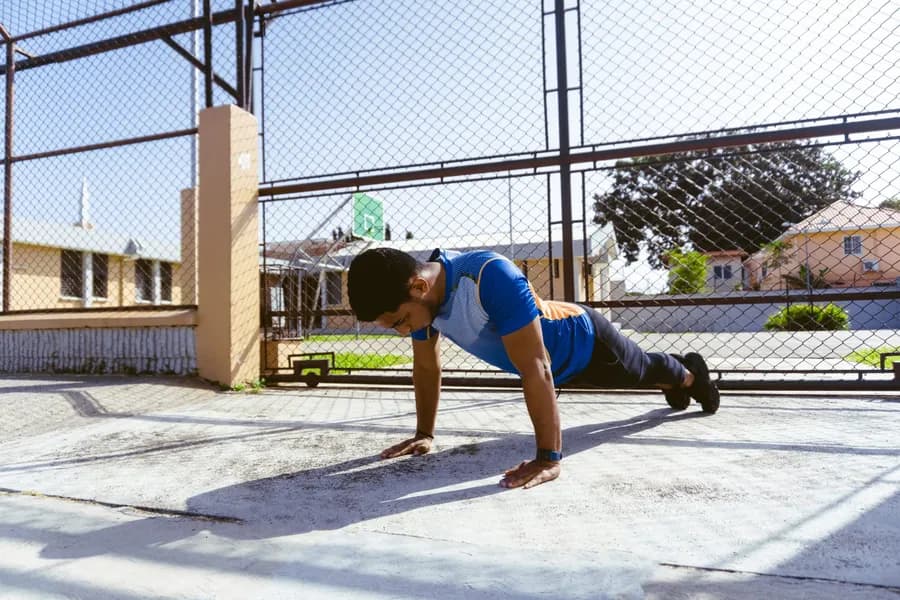
The archer push up is an advanced bodyweight exercise where you assume a wide-grip push-up position and lower your body toward one arm — the working arm bending while the other extends out to the side like an archer drawing a bow. It’s a unilateral chest exercise, meaning one side of your body works at a time. This makes it dramatically harder than the standard push-up. Where a regular push-up splits the load 50/50 between your arms, the archer push up shifts roughly 70–80% of the load onto the working arm. It is the most reliable progression between standard push-ups and the elusive one-arm push-up — a movement most home-trainers chase but never reach. As an advanced movement, it sits inside a broader programme that builds the foundational pressing patterns first.
The mechanism is leverage. By extending one arm to the side, you remove most of its ability to push, forcing the working arm’s chest, shoulder, and triceps to handle the lion’s share of bodyweight. The extended arm acts as a lever for stability, but contributes minimally to the actual press. Over 8–12 weeks of consistent practice, you build the unilateral pressing strength that prepares the body for the one-arm push-up — and you fix the strength asymmetries between left and right that standard push-ups quietly hide.
Benefits of Archer Push Up
Builds the Strength to Eventually Achieve a One-Arm Push-Up
Archer push up benefits primarily from being the missing intermediate step. Per Steven Low’s Overcoming Gravity calisthenics progression standard, 8–12 quality archer push-ups per side is the typical strength threshold for one-arm push-up attempts. Without archer push-ups in the progression, the gap from standard to one-arm is essentially uncrossable.
Fixes Side-to-Side Strength Asymmetries
Standard push-ups hide imbalances — the stronger arm compensates without you noticing. Archer push-ups force each arm to handle 70–80% of bodyweight independently, exposing — and fixing — the imbalances most lifters carry for years.
Develops Maximum Chest, Shoulder, and Tricep Strength Without Equipment
Archer push up muscles worked include the pectoralis major, anterior deltoid, triceps, and rotator cuff — at near-maximum bodyweight loads. At 70–80% bodyweight per arm, archer push-ups produce strength gains comparable to a moderate bench press for the average untrained-to-intermediate adult. For a complete picture of how each pressing muscle is recruited and which related exercises pair best, see our deep-dive on . Beyond intermediate level, weighted variations become more efficient than bodyweight progressions.
Builds Core Stability and Anti-Rotation Strength
Holding your hips level during a unilateral press requires significant core engagement — particularly the obliques and transverse abdominis. The carryover to other rotational sports and lifts is substantial.
How to Do Archer Push Ups — 3 Variations
Shoulder Safety Note: If you have a shoulder impingement, rotator-cuff issue, or a recent shoulder injury, build shoulder mobility and rotator cuff strength first — archer push-ups load the shoulder asymmetrically and can aggravate existing issues. Work with a physiotherapist to clear the shoulder before attempting.
Variation 1: Knee Archer Push Up — Chest, Triceps, Shoulders — 3 sets × 6 reps each side
How to perform: Drop to your knees in a wide push-up position, hands placed wide. Lower toward your right hand while extending the left arm out to the side. Push back up. Why it suits this goal: Reduces load while teaching the movement pattern. The single best archer push up for beginners. Modification: Reduce hand width slightly and start with 3–4 reps per side.
Variation 2: Standard Archer Push Up — Chest, Shoulders, Core — 3 sets × 6–10 reps each side
How to perform: Wide-grip push-up position with feet planted, arms wider than shoulders. Lower toward one hand, keeping the other arm straight out to the side. Push back to the starting position. Why it suits this goal: The benchmark variation. Building to 8–10 quality reps per side here is the threshold for one-arm push-up attempts. The archer push up sits inside a broader framework that sequences pressing, pulling, and core movements for balanced upper-body development. Modification: Slightly bend the extended arm if straight-arm form isn’t possible yet.
Variation 3: Sliding Archer Push Up — Chest, Shoulders, Lats — 3 sets × 5 reps each side
How to perform: Place a small towel under one hand on a smooth floor. Lower toward the planted hand while sliding the towel-hand out to the side, then push back. Why it suits this goal: Maximises range of motion and adds a stretching component to the chest. Hardest variation. For trainers wanting maximum tension at minimum joint stress, this variation also pairs well with — using a 6-second descent and 2-second drive to amplify the unilateral load. Modification: Knee version first; build standard archer push-ups to 10 clean reps before attempting.
Common Mistakes to Avoid in Archer Push Ups
Mistake 1: Hands Too Close Together — Correction: Wider Than Push-Up Width
What it is + why it undermines results: Standard push-up width doesn’t allow enough lateral travel for true unilateral loading. The exercise becomes a slightly tilted regular push-up. What to do instead: Hands placed roughly 1.5x shoulder-width apart at minimum. The wider the stance, the more load shifts to the working arm.
Mistake 2: Sagging or Piking the Hips — Correction: Squeeze Glutes and Brace the Core
What it is + why it undermines results: Hip sag transfers load away from the chest. Hip pike makes the movement easier and bypasses the unilateral challenge. Either way, the exercise stops working. What to do instead: Brace the core and squeeze the glutes hard before each rep. Hold a perfect plank line throughout.
Mistake 3: Progressing Too Fast — Correction: Master 10 Knee Archers Before Standard
What it is + why it undermines results: Most people attempt the standard archer push up before they can do clean reps on knees, leading to broken form and shoulder strain. What to do instead: Build 10 clean reps per side on knees before progressing to standard. The form patterning at this stage determines everything. In a live Habuild class, the coach catches hip sag on rep 3 — the silent failure that turns a strength exercise into shoulder strain.
How Habuild Trains You to Master the Archer Push Up
Calisthenics-Specific Programming With Clear Progressions
Habuild’s upper-body sessions follow a structured progression: standard push-up → diamond push-up → knee archer → full archer → one-arm. Each variation is held until benchmarks are hit. No skipping steps, no plateauing for months. The progression is built on the same principle as — measurable rep benchmarks decide when you advance, not arbitrary calendar weeks.
Live Daily Sessions With Real-Time Form Correction
The two invisible archer push-up failures — hip sag and hand-width compromise — are caught immediately by a live coach. A pre-recorded video can’t tell you your hips dropped on rep 5.
Progressive Overload Built Into Every Session
Members progress from knees to feet to sliding variations on a structured schedule based on rep benchmarks, not arbitrary timeframes. You move forward when your strength says you’re ready.
Accountability, Streaks, and Community
Calisthenics goals like the one-arm push-up require months of daily work. Streaks and community accountability are the structural difference between members who reach the goal and those who quit at week 6.
Who Is Archer Push-Up Best For?
Complete Beginners Starting from Zero
Archer push-ups require no equipment and can be done on any flat floor surface. The entry-level version uses a wide hand position with the extended arm providing significant support — this is accessible to anyone who can do at least 10 standard push-ups with good form. The only requirement is showing up consistently — strength and technique follow from that.
Intermediate Trainees Looking to Fill a Gap
The archer push-up is the most direct progression toward the single-arm push-up — it shifts the weight predominantly to one arm while the other provides minimal support, building the unilateral chest and tricep strength required for the full single-arm movement. Adding archer push-ups to an existing routine addresses a specific conditioning gap that most general workouts miss.
Intermediate Trainees Working Toward Single-Arm Push-Up Strength
The archer push-up is the most direct progression toward the single-arm push-up — it shifts the weight predominantly to one arm while the other provides minimal support, building the unilateral chest and tricep strength required for the full single-arm movement.
Senior Citizens and Older Adults (50+)
Archer Push-Up can be adapted for older adults by controlling tempo, reducing range of motion, and using supported variations. Habuild’s live instructors modify exercises in real time for different fitness levels and physical conditions in the same session.
Is Archer Push-Up Good for Beginners?
Yes — absolutely. Archer Push-Up begin at very low intensity with fully accessible entry-level variations. Habuild’s live instructor adapts the session in real time so beginners and experienced trainees can train together without either being left behind.
How to Add Archer Push-Up to Your Training Routine
How Often to Do Archer Push-Up — Frequency Guide
Train archer push-ups 3–4 times per week. This frequency gives the muscle and nervous system adequate stimulus without outpacing recovery. Consistency matters more than intensity in the early weeks — showing up regularly produces better results than infrequent all-out sessions.
When in Your Workout to Do Archer Push-Up
Place archer push-ups after warming up with standard push-ups, as the main strength movement of a push-focused session. Sequencing exercises correctly ensures you bring maximum quality to archer push-ups rather than performing them under accumulated fatigue from earlier work.
What to Pair Archer Push-Up With
Combine archer push-ups with pike push-ups, diamond push-ups, and dips for a complete bodyweight pressing programme. This combination develops complementary muscle groups in the same session and builds the balanced strength that prevents compensation and injury.
How to Progress Archer Push-Up Over Time
Once the base movement feels controlled and repeatable, gradually reduce the support from the extended arm, working toward performing the movement with fingertips, then the back of the hand, until the full single-arm push-up is achievable. Progress only when form is consistent — adding difficulty before mastering the base movement reinforces poor mechanics and stalls long-term results.
How Habuild Teaches Archer Push-Up
Habuild is India’s First Habit Building Program — and through its strength and fitness sessions, it brings the same habit-based philosophy to targeted exercise training. Every session is structured around your specific goal, not a one-size-fits-all class.
Goal-Specific Programming — Not a Generic Fitness Class
Every exercise, rep range, and rest period in Habuild’s archer push-ups sessions is chosen because it produces results for archer push-ups specifically. Habuild does not run the same session for every goal — the programme is structured to drive your specific outcome with every session, not general fitness that happens to include archer push-ups.
Live Daily Sessions with Real-Time Form Correction
Unlike pre-recorded videos, Habuild’s live daily sessions allow the instructor to see and correct your form in real time — the specific errors that limit archer push-ups results and increase injury risk. This live correction is the difference between training that works and training that wastes effort and creates bad habits.
Progressive Overload Built into Every Session
Members do not need to design their own progressive overload for archer push-ups — it is built into the programme structure. Each week, sessions are deliberately more challenging than the last, ensuring the body never fully adapts and results continue coming rather than stalling.
Accountability, Streaks, and Community
The most common reason people stop exercising is not effort — it is missing sessions until the habit breaks. Habuild’s streak system, live session accountability, and community of members training the same goal alongside you resolves this directly. Members who join with a specific goal like archer push-ups and stay consistent for 30 days almost universally report that showing up has become automatic.
Flexible Batch Timing
Choose morning or evening classes and join the slot that suits your day.
Morning
6:30 AM
7:30 AM
8:30 AM

Evening
5:00 PM
6:00 PM
7:00 PM
8:00 PM

Choose Your Membership Plan
Continue after the trial with membership options designed for long-term consistency support.
Continue your habit on the Habuild app
Use the Habuild app for reminders, live access, progress support, and habit tracking.