6 Arm Circles Exercises
A 6-variation arm circles routine that builds shoulder mobility and deltoid endurance over time.

Key Takeaways
- Improves shoulder mobility with measurable range gains
- Builds deltoid endurance through sustained movement
- Range increase typically measurable over 8-12 weeks
- Guided by senior instructor Saurabh Bothra's live classes
- 6 variations suit posture correction and upper-body training
What Are Arm Circles Exercises?
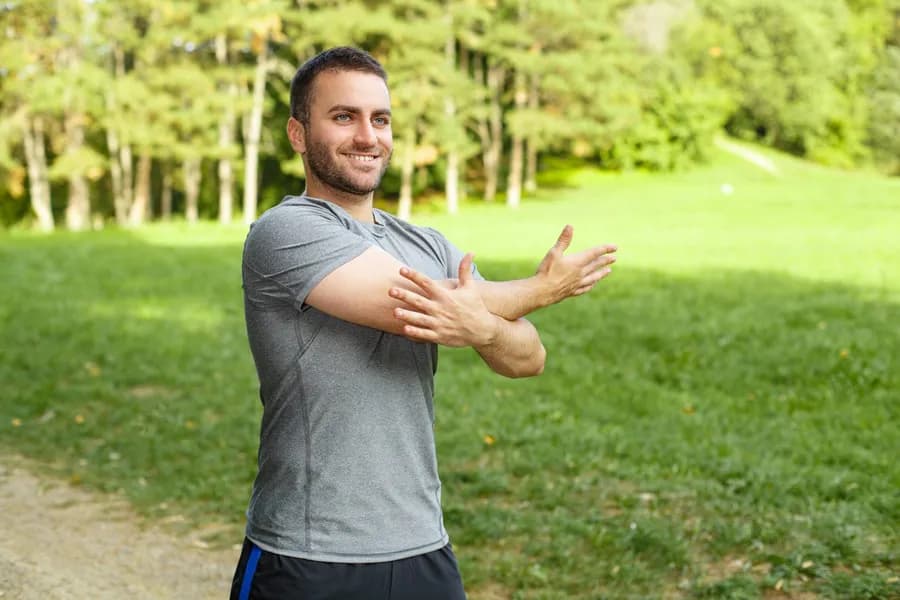
Arm circles exercises are one of the simplest and most accessible upper-body movements in any fitness toolkit — a bodyweight mobility exercise where you stand tall with the arms extended straight out to the sides at shoulder height and rotate them in controlled circular motions, forward for one set then backward for the next. Despite the simplicity, arm circles are surprisingly versatile. They serve three distinct fitness purposes simultaneously: a dynamic warm-up before lifting or any upper-body work; a deltoid-endurance challenge in their own right when held at high volume; and a posture-correction tool that opens the chest and reverses the forward-rolled-shoulder position created by hours of desk work. The “arm circles type of exercise” question that searchers ask reflects this versatility — arm circles are categorised as a dynamic mobility exercise, a calisthenics-warm-up, AND a low-load endurance move depending on how they’re programmed.
The mechanism is what makes arm circles uniquely effective despite their humble appearance. The shoulder is the most mobile joint in the human body — capable of full 360° circumduction (rotation through all planes). When you perform arm circles correctly, every muscle group surrounding the shoulder fires in sequence: anterior deltoid (front), lateral deltoid (side), posterior deltoid (back), trapezius (upper neck and shoulder), rhomboids (between shoulder blades), and the rotator cuff group (deep stabilisers). This is why arm circle muscles worked spans the entire shoulder complex — far broader than any single isolation exercise. Adding arm circles before and after upper-body sessions also improves blood flow to the joint capsule, accelerating warm-up and recovery. For broader upper-body programming that pairs arm circles with progressive strength work, the programme covers them as part of an integrated upper-body strength routine.
Benefits of Arm Circles Exercises
Improves Shoulder Mobility and Joint Range of Motion
Daily arm circle practice systematically restores the full range of motion in the shoulder joint — particularly important for adults who lose mobility through prolonged desk work and cell phone use. Stat: research on dynamic mobility protocols (e.g., Behm & Chaouachi review of warm-up modalities) shows daily mobility work meaningfully increases shoulder range over 8–12 week protocols in sedentary office workers.
Builds Deltoid Endurance Without Equipment
Two minutes of continuous arm circles produces a deltoid burn most lifters underestimate — the deltoids fatigue at sustained low load surprisingly fast. This builds shoulder endurance that translates into better push-up performance, longer overhead carries, and reduced fatigue during any sustained arm-elevated activity.
Corrects Forward-Rolled-Shoulder Posture
Reverse-direction arm circles (the often-skipped half) directly engage the rear deltoids and rhomboids — the two muscle groups most weakened by hours of computer work. Building strength in these muscles pulls the shoulders back into neutral position. Stat: a substantial proportion of office workers show measurable forward-shoulder posture (postural epidemiology research consistently reports prevalence above 50%), and daily upper-back work corrects this within 6–8 weeks.
Excellent Warm-Up That Reduces Injury Risk
30 seconds of arm circles before any upper-body workout increases shoulder joint temperature, lubricates the synovial fluid, and primes the rotator cuff for heavier loading. This single warm-up component reduces shoulder strain and tear risk significantly compared to lifting cold.
Best Arm Circles Variations
Exercise 1: Standard Forward and Reverse Arm Circles — Full Shoulder Complex — 3 sets × 30 seconds each direction
Stand tall, feet shoulder-width apart, arms extended straight out to the sides at shoulder height (forming a T-shape). Rotate both arms forward in small-to-medium circles for 30 seconds, then reverse direction for 30 seconds. Rest, repeat for 3 sets total. The foundational variation — covers all major shoulder muscle groups when both directions are performed. Modification: reduce the size of the circles if shoulders fatigue early; perform seated if standing balance is challenging.
Exercise 2: Big Arm Circles — Increased Range of Motion — 3 sets × 20 reps each direction
Same starting position, but expand the circle size dramatically — arms tracing the largest possible circle from full overhead position down to thigh-level. 1 rep = one full revolution. 3 sets × 20 reps each direction. Targets shoulder mobility through full range; far more demanding than small arm circles. Modification: reduce the range if shoulders click painfully; build to full range over 2–3 weeks. Skip if you have current shoulder injury.
Exercise 3: Weighted Arm Circles — Loaded Deltoid Endurance — 3 sets × 30 seconds each direction
Hold a 1–2 kg dumbbell or water bottle in each hand. Perform standard arm circles. 3 sets × 30 seconds each direction. The added weight transforms arm circles from a warm-up into a genuine deltoid-endurance exercise — one of the highest deltoid time-under-tension exposures available without equipment beyond light dumbbells. Save for week 4+ once bodyweight version is locked. Modification: start with no weight or lightweight (water bottle works); add weight progressively only after form stays clean throughout the full set.
Common Mistakes to Avoid With Arm Circles Exercises
Mistake 1: Hunching the Shoulders Up Toward the Ears — Correction: Pull Shoulders Down and Back
The most common arm circles error: as fatigue sets in, the shoulders shrug up toward the ears — engaging the upper trapezius instead of the deltoids. This produces neck tension, not shoulder development. What to do instead: consciously pull the shoulders down and back before each set begins, and re-cue this position every 15 seconds during the set. The deltoids should burn — the upper traps should not.
Mistake 2: Skipping the Reverse Direction — Correction: Always Match Forward and Backward Volume
The forward arm circle direction emphasises the front and side deltoids; the reverse direction targets the rear deltoids and rhomboids. Skipping reverse circles (the more boring half) is exactly why so many lifters develop forward-rolled-shoulder posture. What to do instead: always match volume between the two directions. If you do 30 seconds forward, you do 30 seconds backward. The reverse direction is where the posture-correction benefit lives — making it the more important half for desk workers. The deep-dive explains why both directions matter for full shoulder development.
Mistake 3: Going Too Fast With Sloppy Form — Correction: Controlled Tempo, Full Engagement
Speed-doing arm circles by whipping the arms in fast loose circles trains nothing — momentum carries the arms, the deltoids barely engage. What to do instead: moderate, deliberate pace. Each circle should take roughly 1 second to complete. Feel the deltoid engaging at every point of the circle. 30 controlled seconds beat 60 sloppy ones for muscle development. The programme reinforces the same form-first principle for all upper-arm work.
How Habuild Trains You for Shoulder Mobility and Upper-Body Strength
Mobility-Plus-Strength Programming, Not Just Random Arm Circles
Most home workouts treat arm circles as 10 seconds of warm-up before the “real” exercise begins. Habuild’s daily sessions give arm circles a proper place — used as warm-up before strength work, AND programmed as an endurance component within sessions where deltoid stamina is the goal. The same exercise, two different roles, integrated intelligently into the programme.
Live Daily Sessions With Real-Time Form Correction
The shrugged-shoulder error, the speed-circle error, the skipped-reverse error — all corrected within seconds on the live call. Arm circles done badly are useless; arm circles done well are foundational. The difference is form, and form requires live coaching.
Progressive Overload Built Into Every Session
Week 1: small arm circles, 30 seconds each direction. Week 4: bigger circles with longer holds, 45 seconds each direction. Week 6: weighted arm circles introduced. Week 10: weighted big arm circles for advanced deltoid endurance. Members don’t programme this — duration, complexity and load build progressively within the live class flow.
Accountability, Streaks and Community
Shoulder mobility and posture correction take 6–8 weeks of unbroken practice. Daily streak tracking, the WhatsApp community and live morning sessions keep members on the mat through the slow window where the rear delts and rhomboids are rebuilding silently before posture visibly changes.
Who Is Arm Circles Exercises Best For?
Complete Beginners Starting from Zero
Arm circles require no equipment, no space, and no fitness level to start. Standing in a doorway is sufficient. They are one of the very first exercises recommended after shoulder surgery or injury. The only requirement is showing up consistently — strength and technique follow from that.
Intermediate Trainees Looking to Fill a Gap
Arm circles are appropriate for literally everyone — from complete beginners to advanced athletes. As a shoulder warm-up, they prepare the rotator cuff and glenohumeral joint for loaded movements and help prevent the shoulder impingement that commonly develops from skipping warm-ups. Adding arm circles exercises to an existing routine addresses a specific conditioning gap that most general workouts miss.
Anyone Starting an Upper-Body Workout or Recovering from Shoulder Issues
Arm circles are appropriate for literally everyone — from complete beginners to advanced athletes. As a shoulder warm-up, they prepare the rotator cuff and glenohumeral joint for loaded movements and help prevent the shoulder impingement that commonly develops from skipping warm-ups.
Senior Citizens and Older Adults (50+)
Arm Circles Exercises can be adapted for older adults by controlling tempo, reducing range of motion, and using supported variations. Habuild’s live instructors modify exercises in real time for different fitness levels and physical conditions in the same session.
Is Arm Circles Exercises Good for Beginners?
Yes — absolutely. Arm Circles Exercises begin at very low intensity with fully accessible entry-level variations. Habuild’s live instructor adapts the session in real time so beginners and experienced trainees can train together without either being left behind.
How to Add Arm Circles Exercises to Your Training Routine
How Often to Do Arm Circles Exercises — Frequency Guide
Train arm circles exercises daily, as part of every upper-body warm-up. This frequency gives the muscle and nervous system adequate stimulus without outpacing recovery. Consistency matters more than intensity in the early weeks — showing up regularly produces better results than infrequent all-out sessions.
When in Your Workout to Do Arm Circles Exercises
Place arm circles exercises at the very start of any upper-body session — before push-ups, presses, or rows. Sequencing exercises correctly ensures you bring maximum quality to arm circles exercises rather than performing them under accumulated fatigue from earlier work.
What to Pair Arm Circles Exercises With
Combine arm circles exercises with shoulder rolls, band pull-aparts, and wrist circles for a comprehensive upper-body mobility warm-up. This combination develops complementary muscle groups in the same session and builds the balanced strength that prevents compensation and injury.
How to Progress Arm Circles Exercises Over Time
Once the base movement feels controlled and repeatable, increase circle size, increase speed, add light wrist weights, and progress to dynamic arm swings and windmills. Progress only when form is consistent — adding difficulty before mastering the base movement reinforces poor mechanics and stalls long-term results.
How Habuild Teaches Arm Circles Exercises
Habuild is India’s First Habit Building Program — and through its strength and fitness sessions, it brings the same habit-based philosophy to targeted exercise training. Every session is structured around your specific goal, not a one-size-fits-all class.
Goal-Specific Programming — Not a Generic Fitness Class
Every exercise, rep range, and rest period in Habuild’s arm circles exercises sessions is chosen because it produces results for arm circles exercises specifically. Habuild does not run the same session for every goal — the programme is structured to drive your specific outcome with every session, not general fitness that happens to include arm circles exercises.
Live Daily Sessions with Real-Time Form Correction
Unlike pre-recorded videos, Habuild’s live daily sessions allow the instructor to see and correct your form in real time — the specific errors that limit arm circles exercises results and increase injury risk. This live correction is the difference between training that works and training that wastes effort and creates bad habits.
Progressive Overload Built into Every Session
Members do not need to design their own progressive overload for arm circles exercises — it is built into the programme structure. Each week, sessions are deliberately more challenging than the last, ensuring the body never fully adapts and results continue coming rather than stalling.
Accountability, Streaks, and Community
The most common reason people stop exercising is not effort — it is missing sessions until the habit breaks. Habuild’s streak system, live session accountability, and community of members training the same goal alongside you resolves this directly. Members who join with a specific goal like arm circles exercises and stay consistent for 30 days almost universally report that showing up has become automatic.
Flexible Batch Timing
Choose morning or evening classes and join the slot that suits your day.
Morning
6:30 AM
7:30 AM
8:30 AM

Evening
5:00 PM
6:00 PM
7:00 PM
8:00 PM


Choose Your Membership Plan
Continue after the trial with membership options designed for long-term consistency support.
Continue your habit on the Habuild app
Use the Habuild app for reminders, live access, progress support, and habit tracking.