Bicycle Crunch — Form, Muscles Worked and Why It Beats Sit-Ups
A bicycle crunch routine that outperforms sit-ups through the most EMG-validated core activation available.
Key Takeaways
- Most EMG-validated core exercise for abs research
- Activates rectus abdominis and obliques strongly
- Also engages hip flexors and spinal stabilisers
- Guided by senior instructor Saurabh Bothra's live sessions
- Outperforms standard crunches for core activation
What Is the Bicycle Crunch Exercise?
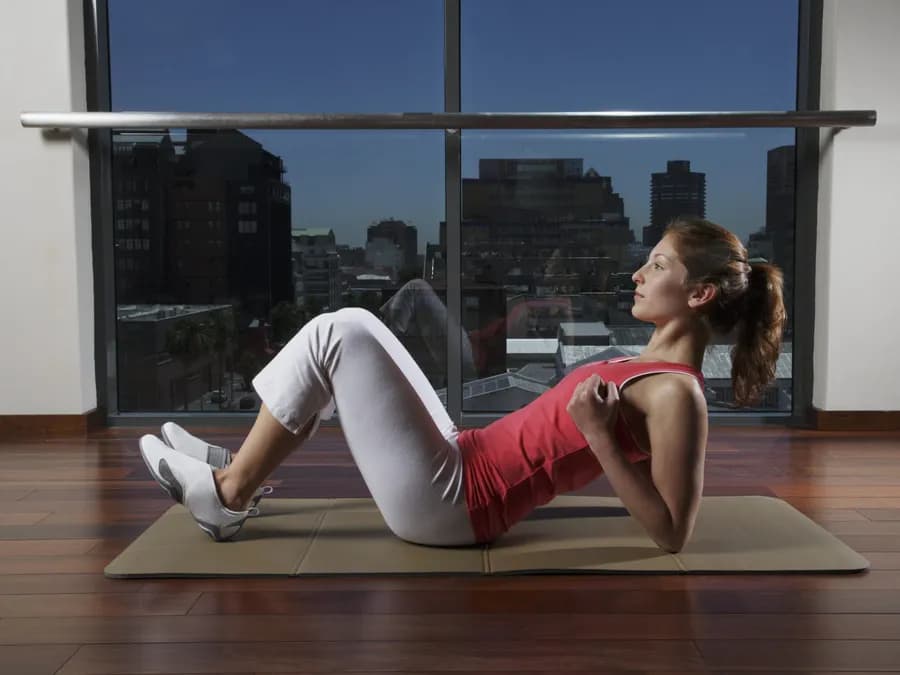
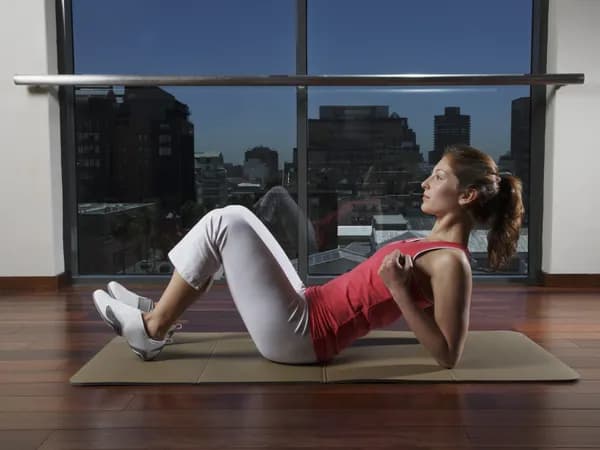
The bicycle crunch is performed lying supine with hands behind the head, knees bent at 90 degrees, lower back pressed into the floor. Alternate bringing the right elbow to the left knee while extending the right leg, then the left elbow to the right knee while extending the left leg — in a continuous pedalling motion that combines spinal flexion, rotation and anti-extension simultaneously.
The mechanism is multi-muscle simultaneous activation: the rotating crunch produces both concentric rectus abdominis contraction and concurrent oblique contraction, while the extending leg requires hip flexor isometric activation to control the descent. The bicycle crunch also prevents momentum patterns — each rep requires a fresh neural activation to initiate the rotation, maintaining muscle engagement throughout the set. Bicycle crunches muscles worked: all four layers of the abdominal wall, plus hip flexors and stabilising paraspinals.
Benefits
Highest Abdominal Muscle Activation of Any Floor Exercise
The ACE-commissioned EMG study found bicycle crunches produced 148% greater rectus abdominis activation than standard crunches and 190% greater oblique activation — making it the highest-return abdominal exercise available without equipment.
📊 ACE-sponsored EMG research found bicycle crunches produced 148% greater rectus abdominis activation than standard crunches — the highest of all 13 exercises tested, including captain’s chair, ab roller and vertical leg crunch.
Develops Both Rectus Abdominis and Obliques Simultaneously
Most ab exercises develop either the rectus abdominis (forward flexion: crunches) or the obliques (rotation: Russian twists) but not both together. The bicycle crunch uniquely combines both in each rep — making it the only single floor exercise that fully develops all abdominal muscle groups simultaneously.
Functional Core Stability for Sport and Daily Life
Rotational core strength is the most sport-specific type of abdominal strength. Every throw, kick, swing, twist and change of direction requires the obliques to transfer force between lower and upper body. Bicycle crunch training develops this rotational capacity in a way that standard crunches do not.
📊 A 2018 study in the Journal of Sport Rehabilitation found that rotational core training (including bicycle crunches) reduced lower back pain recurrence by 32% more effectively than flexion-only training.
No Equipment Required — Complete Ab Training Anywhere
The bicycle crunch requires nothing beyond a flat surface. It produces a comprehensive ab training stimulus — flexion, rotation, anti-extension — that most gym-goers achieve only through multiple exercises and multiple pieces of equipment.
Best Exercises
Standard Bicycle Crunch — Rectus Abdominis + Obliques — 3 x 20 reps (10 each side)
[Image for Standard Bicycle Crunch — Rectus Abdomin]
Supine, hands lightly at temples (not pulling the neck), lower back pressed to floor. Right elbow toward left knee as right leg extends; rotate back; left elbow toward right knee as left leg extends. Rotation from the torso, not from pulling the head. Pace: slow and controlled, 2 seconds per rotation. Modification: Reduce range of motion; keep extended leg higher off the floor.
Slow Bicycle Crunch — Time Under Tension — 3 x 12 reps with 3-sec holds
[Image for Slow Bicycle Crunch — Time Under Tension]
Same movement but with a 3-second hold at peak rotation (elbow closest to knee) before returning. The hold eliminates momentum entirely, forces the obliques into sustained isometric contraction, and dramatically increases the hypertrophic stimulus of each rep. How to do bicycle crunch for maximum results: the slow variation is the answer. Sets/reps: 3 x 12 with 3-second holds.
Weighted Bicycle Crunch — Progressive Overload — 3 x 15 reps
[Image for Weighted Bicycle Crunch — Progressive Ov]
Holding a light weight plate (2-5 kg) behind the head replaces the hand support with added resistance — increasing the flexion load throughout the set. Maintain the same strict form: no momentum, 2-second rotation, lower back pressed to the floor. Sets/reps: 3 x 15.
Common Mistakes to Avoid
Mistake 1: Pulling the Neck — Correction: Lightly Touch the Head, Drive with the Elbow
Neck pulling produces cervical strain and shifts the movement driver from the torso to the arms, bypassing the abdominal muscles. Fix: lightly touch the temples with fingertips (do not interlace fingers) and drive the rotation from the elbow and ribcage rather than pulling the head forward.
Mistake 2: Rushing Through Reps — Correction: 2 Seconds Per Rotation, No Momentum
Fast bicycle crunches produce a swinging momentum that allows hip flexors and neck to dominate while abdominals receive minimal load. Deliberate pacing — 2 full seconds per rotation — prevents momentum from developing. If abdominals are not working, the speed is too fast.
Mistake 3: Allowing the Lower Back to Arch — Correction: Press the Floor Throughout
Lower back arching during the extending leg phase loads the lumbar paraspinals rather than the abdominals. Before every rep, actively press the lower back into the floor — this retroversion of the pelvis activates the transversus abdominis and maintains abdominal engagement throughout.
14-day free trial
How Habuild Trains You
Rotational Core Integrated Into Every Session
Habuild’s sessions include rotational core work — bicycle crunches, yoga twists, oblique activation — in every class, structured to complement the spinal extension and lateral stability work that other sections provide.
Live Daily Sessions with Real-Time Form Correction
Neck pulling and lower back arching — the two errors that turn a productive bicycle crunch into a neck strain — are caught and corrected immediately in Saurabh Bothra’s live sessions.
Progressive Overload Built Into Every Session
Core progression moves from standard to slow holds to weighted variations over weeks, with the daily session delivering the appropriate progression stimulus automatically.
Accountability, Streaks and Community
Abdominal development requires daily core training over months. Habuild’s streak structure and live morning community provide the daily consistency that produces the progressive core development that visible results require.
Who Is Bicycle Crunches Best For?
Complete Beginners Starting from Zero
Bicycle crunches begin lying on the floor with no equipment. The pace and range of rotation are entirely self-controlled — a slow bicycle crunch is appropriate even for those with very little core strength. The only requirement is showing up consistently — strength and technique follow from that.
Intermediate Trainees Looking to Fill a Gap
The bicycle crunch consistently ranks among the most effective exercises for both the rectus abdominis and obliques — it trains both the straight-line and rotational components of the core simultaneously, making it one of the most efficient ab exercises available. Adding bicycle crunches to an existing routine addresses a specific conditioning gap that most general workouts miss.
Those Training Obliques and Looking for the Most Complete Ab Exercise
The bicycle crunch consistently ranks among the most effective exercises for both the rectus abdominis and obliques — it trains both the straight-line and rotational components of the core simultaneously, making it one of the most efficient ab exercises available.
Senior Citizens and Older Adults (50+)
Bicycle Crunches can be adapted for older adults by controlling tempo, reducing range of motion, and using supported variations. Habuild’s live instructors modify exercises in real time for different fitness levels and physical conditions in the same session.
Is Bicycle Crunches Good for Beginners?
Yes — absolutely. Bicycle Crunches begin at very low intensity with fully accessible entry-level variations. Habuild’s live instructor adapts the session in real time so beginners and experienced trainees can train together without either being left behind.
How to Add Bicycle Crunches to Your Training Routine
How Often to Do Bicycle Crunches — Frequency Guide
Train bicycle crunches 4–5 times per week. This frequency gives the muscle and nervous system adequate stimulus without outpacing recovery. Consistency matters more than intensity in the early weeks — showing up regularly produces better results than infrequent all-out sessions.
When in Your Workout to Do Bicycle Crunches
Place bicycle crunches in the core block after planks, as a primary rotational ab movement. Sequencing exercises correctly ensures you bring maximum quality to bicycle crunches rather than performing them under accumulated fatigue from earlier work.
What to Pair Bicycle Crunches With
Combine bicycle crunches with planks, crunches, and Russian twists for a complete core programme covering stability, straight-line, and rotational strength. This combination develops complementary muscle groups in the same session and builds the balanced strength that prevents compensation and injury.
How to Progress Bicycle Crunches Over Time
Once the base movement feels controlled and repeatable, slow the pace (slower increases difficulty), extend the leg further out, add a pause at full rotation, then progress to weighted bicycle crunches or a decline position. Progress only when form is consistent — adding difficulty before mastering the base movement reinforces poor mechanics and stalls long-term results.
How Habuild Teaches Bicycle Crunches
Habuild is India’s First Habit Building Program — and through its strength and fitness sessions, it brings the same habit-based philosophy to targeted exercise training. Every session is structured around your specific goal, not a one-size-fits-all class.
Goal-Specific Programming — Not a Generic Fitness Class
Every exercise, rep range, and rest period in Habuild’s bicycle crunches sessions is chosen because it produces results for bicycle crunches specifically. Habuild does not run the same session for every goal — the programme is structured to drive your specific outcome with every session, not general fitness that happens to include bicycle crunches.
Live Daily Sessions with Real-Time Form Correction
Unlike pre-recorded videos, Habuild’s live daily sessions allow the instructor to see and correct your form in real time — the specific errors that limit bicycle crunches results and increase injury risk. This live correction is the difference between training that works and training that wastes effort and creates bad habits.
Progressive Overload Built into Every Session
Members do not need to design their own progressive overload for bicycle crunches — it is built into the programme structure. Each week, sessions are deliberately more challenging than the last, ensuring the body never fully adapts and results continue coming rather than stalling.
Accountability, Streaks, and Community
The most common reason people stop exercising is not effort — it is missing sessions until the habit breaks. Habuild’s streak system, live session accountability, and community of members training the same goal alongside you resolves this directly. Members who join with a specific goal like bicycle crunches and stay consistent for 30 days almost universally report that showing up has become automatic.
Flexible Batch Timing
Choose morning or evening classes and join the slot that suits your day.
Morning
6:30 AM
7:30 AM
8:30 AM

Evening
5:00 PM
6:00 PM
7:00 PM
8:00 PM

Choose Your Membership Plan
Continue after the trial with membership options designed for long-term consistency support.
Continue your habit on the Habuild app
Use the Habuild app for reminders, live access, progress support, and habit tracking.