A bodyweight squat routine that builds strong legs using gravity and coordinated compound movement.
1. Uses bodyweight and gravity as the only load
2. Early leg strength and mobility gains in 2-4 weeks
3. Visible shape change and strength typically in 8-12 weeks
4. Guided by senior instructor Saurabh Bothra's live classes
5. Engages the body's largest muscle groups together

Body weight squats are not the same as generic leg workouts or random “lower-body” routines. They are a foundational compound movement that uses gravity and your own bodyweight as load — squatting down until the hips drop below the knees, then driving back up through the heels — engaging the largest muscle groups in the body in a single coordinated pattern. Most casual squat content focuses on rep counts (“100 squats a day”) without addressing depth, foot position, or knee tracking — the exact factors that determine whether the movement builds strength and protects joints, or quietly produces wear and dysfunction over time. The right body weight squat practice combines correct mechanics for safety, full range of motion for stimulus, and progressive overload for continued adaptation even without external weights.
The mechanism is more powerful than most people realise. The body weight squat activates the quadriceps, hamstrings, glutes, hip flexors, calves, and deep core stabilisers simultaneously — making it the single most efficient lower-body movement per unit of time. The squat-as-foundational-pattern principle was systematically codified by Mel Siff and Yuri Verkhoshansky in Supertraining (1999), which remains the most cited reference in strength science for compound-movement programming. Beyond muscle activation, full-depth squatting maintains hip and ankle mobility that sedentary life systematically destroys, supports bone density through axial loading, and triggers the testosterone and growth hormone responses that drive total-body adaptation. Combined with a structured weekly progression, body weight squats build the lower-body foundation every other strength practice depends on.
Benefit 1: Stronger Legs, Bigger Glutes, and Better Lower-Body Composition
The most direct benefit — what daily body weight squats actually deliver. Quadriceps, hamstrings, and glutes adapt rapidly to consistent squat training, producing visible muscle growth and lower-body shape change within 6–8 weeks of consistent practice. Stat: A 2019 systematic review in the Journal of Strength and Conditioning Research by Schoenfeld et al., analysing data across multiple compound-movement studies, confirmed that high-frequency squat training produces 15–25% greater lower-body muscle gains compared to single-weekly sessions when total volume is matched.
Benefit 2: Reduced Knee Pain, Better Hip Mobility, and Functional Movement Quality
The symptomatic relief benefit — what most people training squats are actually experiencing alongside aesthetic goals. Properly executed body weight squats restore the deep hip and ankle mobility that prolonged sitting destroys, strengthen the muscles that stabilise the knee joint, and counteract the postural patterns that drive lower-back tension. Members managing existing knee tightness or stiffness often pair their squat work with our programme to address the full lower-body chain that protects the knees through compound movement.
Benefit 3: Higher Resting Metabolism and Improved Body Composition
The physiological adaptation benefit. Building lean muscle in the largest muscle groups raises resting metabolic rate more efficiently than any other single exercise — which is why squat-focused training drives sustained fat loss while pure cardio plateaus. Stat: The American College of Sports Medicine’s 2021 position stand on resistance training establishes that adding 1 kg of lean muscle through compound movements like squats raises resting metabolic rate by approximately 10–15 calories per day, compounding into meaningful long-term metabolic adaptation.
Benefit 4: Better Posture, Stronger Core, and Long-Term Joint Health
The secondary-but-significant benefit. Squats engage the deep core canister — diaphragm, transverse abdominis, multifidus, and pelvic floor — that pressurises and stabilises the spine during all movement. Daily squat practice also stimulates bone density, supports healthy testosterone and growth hormone production, and prevents the lower-body muscle loss that accelerates after age 30. Members managing the cortisol and stress response from intense training often pair their work with our programme to address recovery and balanced load distribution across the whole body.
Exercise 1: Standard Body Weight Squat — Quadriceps, Hamstrings, Glutes, Core — 3 sets × 15 reps
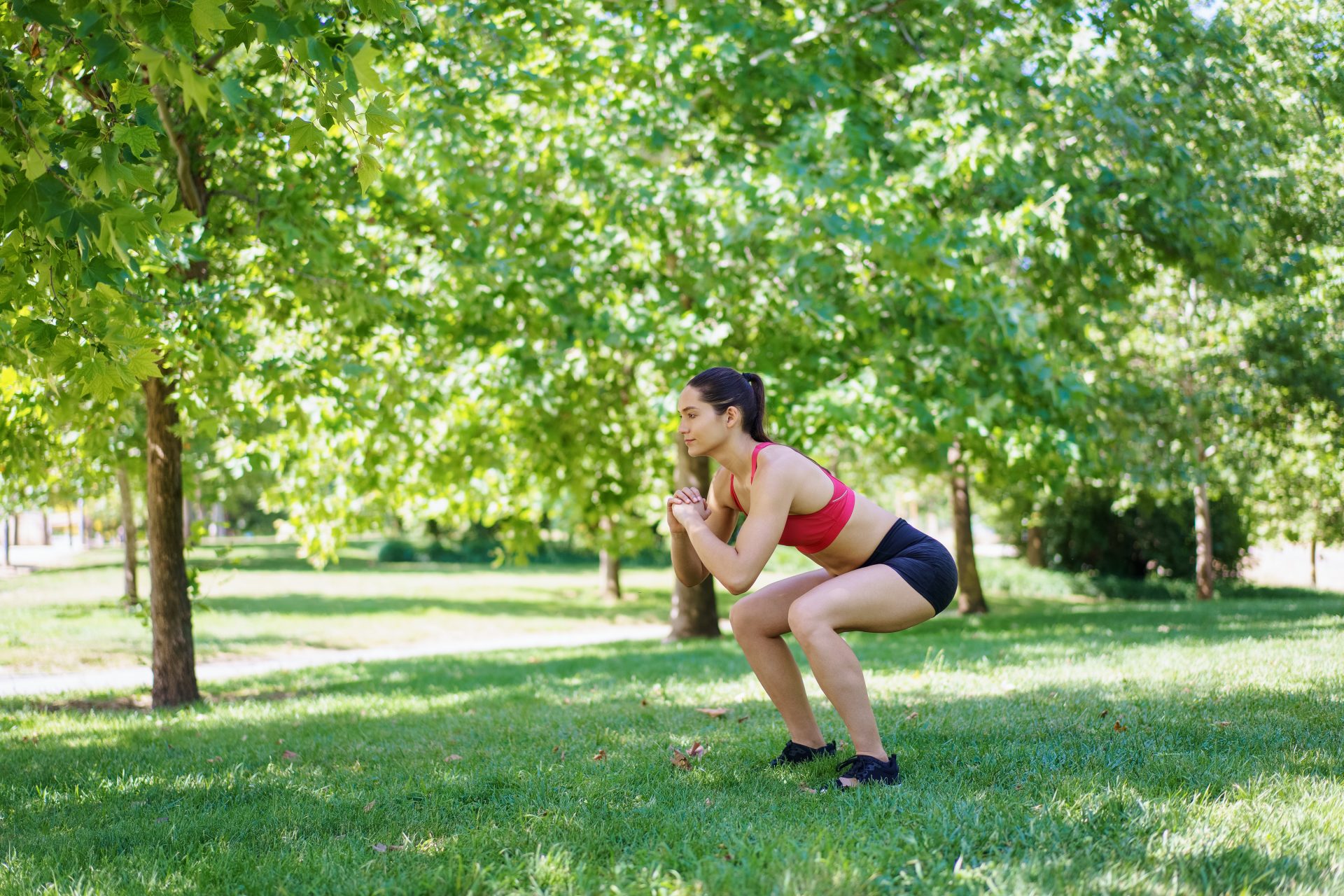
What it does and why it suits this goal: The standard body weight squat is the foundational pattern every other variation builds from — feet shoulder-width apart, toes slightly turned out, hips dropping below knee level, knees tracking over toes, chest staying upright. It engages the largest muscle groups simultaneously and produces maximum lower-body stimulus per minute of effort. Sets and reps: 3 sets of 15 reps with 60 seconds rest, performed 3–4 times per week. Modification: Chair-assisted squats for absolute beginners — sit fully onto a chair, then stand without using hands. Build to unassisted body weight squats over 2–4 weeks of consistent practice.
Exercise 2: Pause Squat — Increased Time Under Tension — 3 sets × 10 reps with 3-second hold
What it does and why it suits this goal: The pause squat adds a 3-second hold at the bottom of each rep, dramatically increasing time under tension and removing the bounce that masks weak positions. This variation is one of the most effective ways to build genuine strength and mobility from body weight loading alone — a principle systematically validated in research summarised by Boyle in Advances in Functional Training (2010). Sets and reps: 3 sets of 10 reps with 3-second pause at the bottom, 90 seconds rest, performed 2–3 times per week. Modification: Reduce the pause to 1 second initially and build duration as bottom-position strength improves.
Exercise 3: Bulgarian Split Squat — Single-Leg Unilateral Strength — 3 sets × 12 reps per leg
What it does and why it suits this goal: The Bulgarian split squat (rear foot elevated on a chair or bench) trains each leg independently, exposing and correcting the strength imbalances most lifters develop. It also delivers significantly higher per-leg loading than standard squats — making it the most effective body weight progression once standard squats become easy. Sets and reps: 3 sets of 12 reps per leg with 60 seconds rest, performed 2 times per week. Modification: Begin with shallow range of motion and progress depth gradually. Hold a wall or doorframe for balance support during early weeks.
Mistake 1: Squatting Without Reaching Full Depth — Correction: Hips Below Knees Every Rep
What it is and why it undermines body weight squat progress: Half-squats — common in casual squat challenges — train only the upper portion of the movement, producing little muscle growth, limited mobility benefit, and reinforcing the shortened range that prolonged sitting already creates. The deep hip flexion at the bottom of the squat is precisely what builds glute and posterior-chain strength most lifters miss. What to do instead: Drop hips below knee level on every rep. If full depth is currently inaccessible, use a low chair or bench as a depth marker, and gradually lower the target as mobility improves. Quality of depth always beats quantity of reps.
Mistake 2: Knees Caving Inward Under Load — Correction: Drive Knees Out, Track Over Toes
What it is and why it undermines body weight squat progress: Knee valgus (knees collapsing inward) is the single most common form error in body weight squats — driven by weak glute medius muscles and poor proprioceptive awareness. It loads the medial knee structures dangerously and prevents proper glute activation, which means the squat trains quads at the expense of glutes. What to do instead: Actively press the knees outward in line with the toes throughout every rep. Members building broader glute development often pair body weight squat work with our programme to address the glute-medius weakness that drives knee valgus directly.
Mistake 3: Doing Only High Rep Counts Without Progression — Correction: Add Tempo, Pauses, or Single-Leg Variations
What it is and why it undermines body weight squat progress: Performing 100 daily body weight squats without progression hits a ceiling within weeks — the body adapts to repeated identical stimulus and stops growing. This is the single most common reason members report “doing squats every day but seeing no change.” What to do instead: Add progressive overload through slower tempo (4-second descent), longer pauses at the bottom, single-leg variations, or elevated rear-foot work. Squat exercises only continue producing results when the stimulus continues advancing.
Ready to start? Here’s how Habuild structures body weight squat training every day:
Squat-Specific Programming — Not a Generic Fitness Class
Every exercise selection, sequencing decision, and rest period is chosen for squat-specific benefit. Sessions open with hip and ankle mobility work that primes the depth body weight squats demand, build through compound squat patterns at progressive tempo and depth, and close with single-leg variations that address the unilateral imbalances most lifters develop. This sequencing is the exact opposite of typical home workouts that throw squats into a random circuit — the structured progression is what locks in genuine strength rather than fatigue accumulation.
Live Daily Sessions with Real-Time Form Correction
The live format catches the specific errors that prevent body weight squat progress — half-depth reps, knee valgus, forward lean from weak core, and the reflexive bounce out of the bottom that masks weak positions. Real-time correction is something pre-recorded content cannot deliver, and these are the exact errors that undermine squat work even in members training consistently.
Progressive Overload Built into Every Session
Members do not need to programme their own progression. Each week, depth, tempo, pause duration, and single-leg complexity are adjusted upward so the lower body keeps adapting — preventing the plateau that derails most home routines after 4–6 weeks. The same habit-building structure that drives our ensures consistent attendance over the months meaningful squat progression actually requires.
Accountability, Streaks and Community
Complete Beginners Starting from Zero
Bodyweight squats begin from a high-chair-height position for those with joint discomfort, scaling to full depth over time. No fitness prerequisite, no equipment, and no special space required. The only requirement is showing up consistently — strength and technique follow from that.
Intermediate Trainees Looking to Fill a Gap
Bodyweight squats are the most accessible lower-body strength exercise — requiring nothing but floor space, they build quad, glute, and core strength from the very first session. They also maintain the hip and ankle mobility that desk-based lifestyles progressively erode. Adding bodyweight squats to an existing routine addresses a specific conditioning gap that most general workouts miss.
Beginners, Travellers, and Anyone Building Lower-Body Strength Without Equipment
Bodyweight squats are the most accessible lower-body strength exercise — requiring nothing but floor space, they build quad, glute, and core strength from the very first session. They also maintain the hip and ankle mobility that desk-based lifestyles progressively erode.
Senior Citizens and Older Adults (50+)
Bodyweight Squats can be adapted for older adults by controlling tempo, reducing range of motion, and using supported variations. Habuild’s live instructors modify exercises in real time for different fitness levels and physical conditions in the same session.
Is Bodyweight Squats Good for Beginners?
Yes — absolutely. Bodyweight Squats begin at very low intensity with fully accessible entry-level variations. Habuild’s live instructor adapts the session in real time so beginners and experienced trainees can train together without either being left behind.
How Often to Do Bodyweight Squats — Frequency Guide
Train bodyweight squats daily, or 5 times per week. This frequency gives the muscle and nervous system adequate stimulus without outpacing recovery. Consistency matters more than intensity in the early weeks — showing up regularly produces better results than infrequent all-out sessions.
When in Your Workout to Do Bodyweight Squats
Place bodyweight squats at the start of any lower-body session as the primary compound movement, or as a daily standalone habit. Sequencing exercises correctly ensures you bring maximum quality to bodyweight squats rather than performing them under accumulated fatigue from earlier work.
What to Pair Bodyweight Squats With
Combine bodyweight squats with glute bridges, lunges, and calf raises for a complete lower-body conditioning circuit. This combination develops complementary muscle groups in the same session and builds the balanced strength that prevents compensation and injury.
How to Progress Bodyweight Squats Over Time
Once the base movement feels controlled and repeatable, add a pause at the bottom, increase reps, progress to sumo squats and jump squats, then to single-leg progressions (pistol squat regressions). Progress only when form is consistent — adding difficulty before mastering the base movement reinforces poor mechanics and stalls long-term results.
Habuild is India’s First Habit Building Program — and through its strength and fitness sessions, it brings the same habit-based philosophy to targeted exercise training. Every session is structured around your specific goal, not a one-size-fits-all class.
Goal-Specific Programming — Not a Generic Fitness Class
Every exercise, rep range, and rest period in Habuild’s bodyweight squats sessions is chosen because it produces results for bodyweight squats specifically. Habuild does not run the same session for every goal — the programme is structured to drive your specific outcome with every session, not general fitness that happens to include bodyweight squats.
Live Daily Sessions with Real-Time Form Correction
Unlike pre-recorded videos, Habuild’s live daily sessions allow the instructor to see and correct your form in real time — the specific errors that limit bodyweight squats results and increase injury risk. This live correction is the difference between training that works and training that wastes effort and creates bad habits.
Progressive Overload Built into Every Session
Members do not need to design their own progressive overload for bodyweight squats — it is built into the programme structure. Each week, sessions are deliberately more challenging than the last, ensuring the body never fully adapts and results continue coming rather than stalling.
Accountability, Streaks, and Community
The most common reason people stop exercising is not effort — it is missing sessions until the habit breaks. Habuild’s streak system, live session accountability, and community of members training the same goal alongside you resolves this directly. Members who join with a specific goal like bodyweight squats and stay consistent for 30 days almost universally report that showing up has become automatic.
My homeopathy doctor suggested yoga and I found Habuild. In the free 14 days, I already felt changes. The biggest surprise: I used to be unable to get down from a pavement by myself. Now I can jump. My core and lower body strength have rebuilt themselves through consistent practice. Habuild is a complete package — it strengthens everything, not just flexibility.
I am 82 years old. I have arthritis with worn-out knees and cannot sit cross-legged. I also have water in my lungs. My orthopaedic doctor, after seeing my X-ray, said I would be in a wheelchair for the rest of my years. Today, 99% of my knee pain is gone. I do only 25% of the movements Saurabh Sir teaches, but I do them consistently. I am now visiting old temples and climbing the steps to enter them — holding support, but climbing. Leg exercises have strengthened my muscles enough to support my joints. I am walking with confidence.


Practice Strong Everyday with Trishala Bothra, an IIT-B and London School of Business alumni
Trishala is focused on making movement feel lighter, more engaging, and something you actually look forward to.
In just 3 years, over 50,000 people began their strength journey, and 10,000+ join every week to keep getting stronger.