Bodyweight Strength Training Classes Online: Exercise Ladders, Weekly Plans and Progress Tests
Bodyweight strength training classes online: exercise ladders, weekly plans and progress tests.
Key Takeaways
- Bodyweight training uses your own body as resistance, so you need no equipment and little space.
- Every movement can be made easier or harder in steps, called an exercise ladder.
- Climb one step on a ladder only when you can do the current step with control for the target reps.
- Full-body sessions most days suit beginners; experienced exercisers can split upper and lower body.
- Test progress once a month with simple rep tests rather than relying on how you feel.
- Wrists, knees and shoulders take more load in some bodyweight moves, so build up gradually.
Bodyweight strength training is the simplest way to get stronger at home. There are no machines to learn, no weights to buy and no gym fees. Your body is the equipment.
The challenge is knowing how to keep it challenging. This guide gives you clear exercise ladders, a weekly structure and simple tests to track progress, so bodyweight classes keep working for you month after month.
Why Bodyweight Training Works
- Muscles respond to effort, not equipment. A hard set of push-ups challenges the chest just as real resistance does.
- It trains movement, not just muscles. Bodyweight exercises use many muscles together, which carries over to daily life.
- Balance and control improve because you have to stabilise your own body.
- It's portable. The same routine works at home, in a hotel room or at a park.
Its limit is load. Eventually, very strong people need added weight to keep progressing. For most people's goals, that point is a long way off.
Exercise Ladders: How to Make Every Move Easier or Harder
Start on the step where you can do 8 to 12 controlled reps. Move up only when the current step feels comfortable for 12 to 15 reps.
Legs
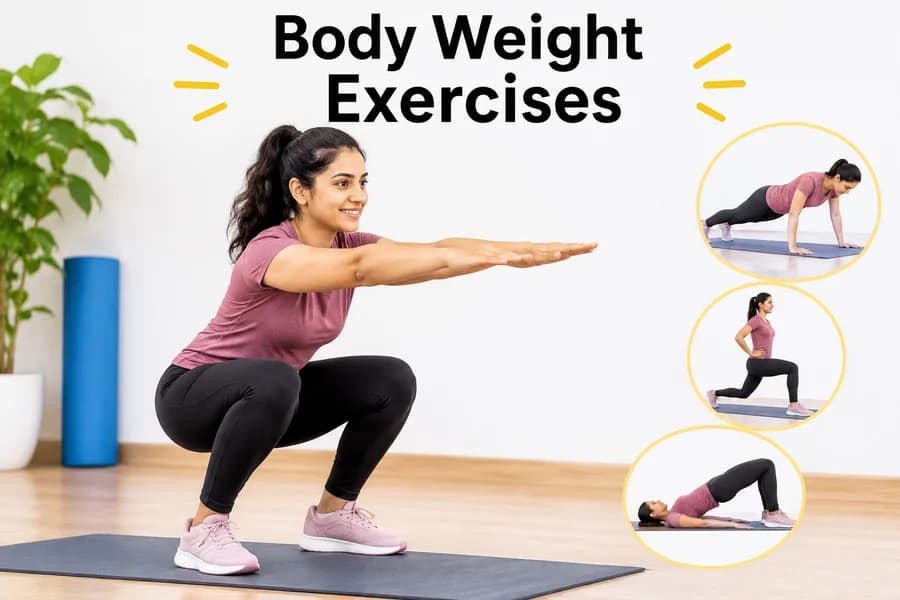
- Chair squat (sit down to a chair and stand up)
- Bodyweight squat
- Reverse lunge
- Split squat, back foot on the floor
- Bulgarian split squat, back foot on a sofa or bed
- Slow-tempo single-leg squat to a chair
Push (chest, shoulders, triceps)
- Wall push-up
- Kitchen-counter push-up
- Knee push-up
- Full push-up
- Slow-lowering push-up (three to four seconds down)
- Feet-raised push-up
Pull (upper back)
Pulling is the hardest pattern to train without equipment, so progress here may be slower.
- Lying arm lifts, face down (Y, T and W shapes)
- Reverse snow angels
- Towel rows, pulling against a towel looped around a sturdy door handle
- Under-table rows, only on a heavy, stable table that can't tip
- Slow, paused versions of the above
Hips and glutes
- Glute bridge
- Glute bridge with a two-second hold at the top
- Single-leg glute bridge
- Shoulders-on-sofa hip thrust
- Single-leg hip thrust
Core
- Dead bug
- Knee plank
- Full plank
- Side plank from knees, then from feet
- Plank with shoulder taps
How to Structure Your Week
If you're a beginner
Do a full-body session four to six days a week, at an easy-to-moderate effort. Cover legs, push, pull, hips and core each time with one or two exercises each.
If you've been training for a few months
You can alternate:
- Day A: legs, hips and core
- Day B: push, pull and core
This lets each area recover while you train most days.
Always include
- A warm-up of five to eight minutes
- A cool-down with stretches
- At least one lighter or rest day each week
Test Your Progress Every Month
Pick three simple tests and record your results on the first day of each month:
- Push test: the most push-ups you can do with good form, at your current ladder step.
- Leg test: the most bodyweight squats in 60 seconds with full control.
- Core test: your longest plank hold with a straight body.
Progress means more reps, a longer hold, or moving up a ladder step. These numbers keep you motivated when the mirror changes slowly.
Common Myths About Bodyweight Training
- "You can't get strong without weights." You can get significantly stronger, especially as a beginner or after a long break.
- "It's only cardio." Slow, controlled bodyweight exercises are genuine strength training.
- "More reps is always better." Once you can do 20 or more easy reps, a harder variation builds more strength than adding reps.
- "It's only for beginners." Advanced bodyweight skills challenge even very fit people.
Protecting Your Joints
- Wrists: in push-ups and planks, spread your fingers and press through your palms. Do these on your forearms or on fists if wrists hurt.
- Knees: keep knees in line with your toes during squats and lunges. Reduce depth if knees ache.
- Shoulders: avoid shrugging during push-ups; keep shoulders away from your ears.
- Lower back: in planks, avoid letting your hips sag. Drop to your knees if you can't hold the position.
Health Disclaimer
This article is for general information only and is not medical advice. If you have pain or an injury, please consult a doctor or physiotherapist before starting.
Flexible Batch Timing
Choose morning or evening classes and join the slot that suits your day.
Morning
6:30 AM
7:30 AM
8:30 AM

Evening
5:00 PM
6:00 PM
7:00 PM
8:00 PM

Choose Your Membership Plan
Continue after the trial with membership options designed for long-term consistency support.
Continue your habit on the Habuild app
Use the Habuild app for reminders, live access, progress support, and habit tracking.