5 Butt Kicks Exercises
A 5-variation butt kicks routine that activates the hamstrings while building cardiovascular fitness.
Key Takeaways
- Dynamic running-in-place movement activates hamstrings
- Builds cardiovascular fitness through repeated cycles
- 5 variations suit different fitness levels
- Guided by senior instructor Saurabh Bothra's live sessions
- Doubles as an effective dynamic warm-up
What Are Butt Kicks Exercises?
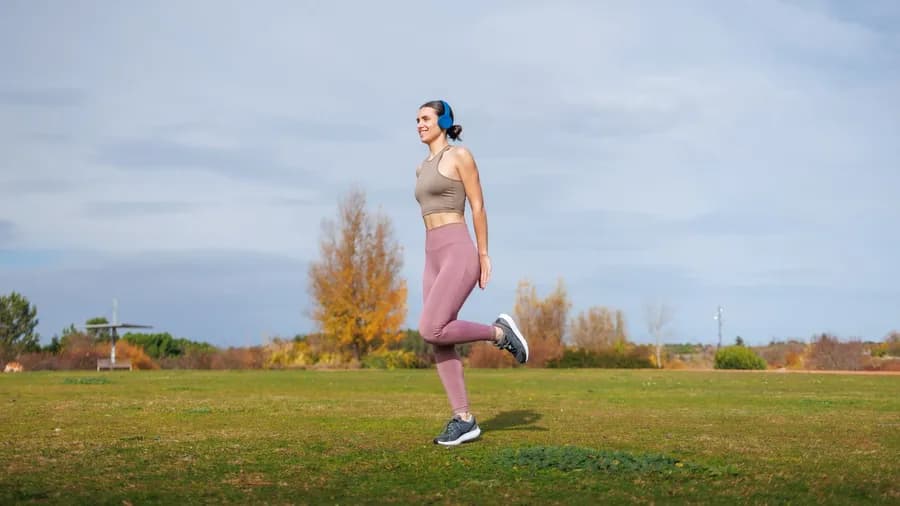
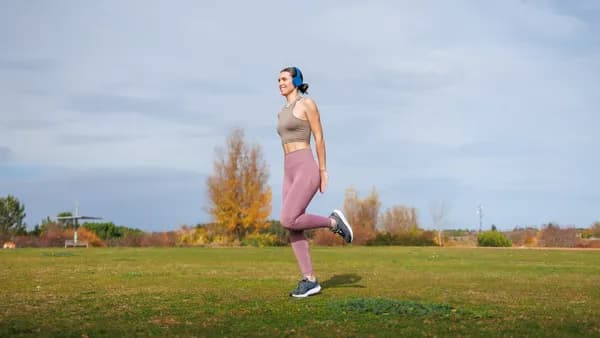
What is butt kicks exercise: a dynamic running-in-place bodyweight movement performed by standing tall with the arms in a running position and rapidly alternating heel-to-glute kicks — left heel kicks up to touch (or come close to) the left glute, then right heel kicks up to the right glute. The motion looks exactly like running in slow motion, except the knee flexes much more dramatically than during normal running, sending the heel up almost to the glute. The exercise is one of the most common dynamic warm-up movements used by sprinters, footballers, and any athlete preparing for explosive lower-body work. What type of exercise is butt kicks: it’s classified primarily as a dynamic warm-up exercise (preparing the hamstrings for harder work), secondarily as a low-impact cardio drill (heart rate climbs into the cardio zone within 30 seconds), and tertiarily as a hamstring-activation movement that drills the running motor pattern.
The mechanism is what makes butt kicks deceptively valuable. The exaggerated heel-to-glute motion forces hamstring activation through full range — the same hamstring contraction used during the swing phase of running. For office workers and adults whose hamstrings have weakened from prolonged sitting, butt kicks “wake up” the muscle group quickly, which is why they’re a standard pre-run warm-up for runners. The cardiovascular component is real too: 30 seconds of butt kicks elevates heart rate to 60–70% of max, making them a useful HIIT component in home workouts. Note: searchers occasionally confuse butt kicks (the running-in-place movement) with butt kicks the static glute-isolation exercise (a kneeling rear-leg-kickback move). This page covers the dynamic running-in-place variant, which is the dominant search intent. For broader integrated lower-body programming that pairs butt kicks with strength work, the programme covers them as part of a complete warm-up-and-strength toolkit.
Benefits of Butt Kicks Exercises
Activates the Hamstrings Quickly Before Heavier Work
The exaggerated heel-to-glute motion drives hamstring activation through full knee flexion range — the same pattern used in running and sprinting. 30 seconds of butt kicks effectively “wakes up” the posterior chain before squats, deadlifts or running. Butt kicks exercise benefits in this warm-up role include reduced injury risk during subsequent heavier work and improved performance from properly primed muscles.
Elevates Heart Rate Fast (HIIT-Compatible Cardio)
Unlike steady-state cardio that takes 5–8 minutes to elevate heart rate, butt kicks push heart rate into the cardio training zone within 30–45 seconds. This makes them ideal as the cardio component of HIIT intervals or as a finisher to a strength session. Stat: research on HIIT and aerobic capacity (Milanović et al, 2015 meta-analysis on HIIT vs continuous training) shows meaningful VO2 max improvements with consistent HIIT practice over 8–12 week protocols.
Improves Running Form and Stride Efficiency
Butt kicks drill the running motor pattern at exaggerated range — training the brain-body connection that produces efficient stride mechanics. Recreational runners who add butt kicks to their pre-run warm-up frequently report measurable pace improvements within 3–4 weeks, driven by better hamstring engagement during the running stride.
Highly Time-Efficient and Equipment-Free
One of the most equipment-free, no-learning-curve exercises that exists. 2 minutes of butt kicks daily provides measurable cardio and hamstring-activation benefit. No gym, no equipment, no skill development. Particularly valuable for time-pressed working professionals and parents training in small home spaces.
Best Butt Kicks Variations
Exercise 1: Standard Butt Kicks — Hamstrings + Cardio — 3 sets × 30 seconds
Stand tall, feet hip-width apart, arms in a running position (elbows bent 90°). Run in place, but with exaggerated knee flexion — alternately kick each heel up toward the glute on the same side. Keep the upper body upright, arms swinging in opposition to legs. 3 sets × 30 seconds with 30-second rest between. The foundational variation. Modification: reduce pace; reduce kick height (heel doesn’t need to fully touch glute) if hamstring tightness limits range.
Exercise 2: Slow Butt Kicks (Warm-Up Focus) — Hamstring Mobility — 3 sets × 30 seconds
Same pattern as standard butt kicks, but executed slowly — deliberate heel-to-glute kicks at roughly half the speed of standard butt kicks. 3 sets × 30 seconds. The slow variant focuses on hamstring activation and mobility rather than cardio — useful as a pre-workout warm-up specifically before hamstring-intensive training (squats, deadlifts, sprint work). Modification: reduce pace further if hamstring tightness limits range; build to standard speed over 2 weeks.
Exercise 3: Fast Butt Kicks With Arm Drive — HIIT Cardio — 3 sets × 20 seconds
Standard butt kicks pattern, but at maximum sustainable pace AND with deliberately strong arm drive (fast pumping motion in opposition to leg cycling). 3 sets × 20 seconds with 40-second rest. Pushes heart rate to 80–90% of max within 15 seconds — used as the cardio component of HIIT intervals. Save for week 4+ once standard butt kicks feel easy. Modification: reduce duration to 15 seconds initially; build to 20 then 30 seconds over 3–4 weeks.
Common Mistakes to Avoid With Butt Kicks Exercises
Mistake 1: Leaning Forward Excessively — Correction: Tall Posture, Eyes Forward
The most common butt kicks error: as fatigue sets in, the upper body leans forward like sprinting position, the lower back rounds, and the glutes can’t fully connect with the heels. What to do instead: consciously maintain tall posture throughout — chest up, shoulders back, eyes forward (not down). The lean creates the illusion of speed but reduces the kick range and the actual hamstring engagement. Better to be slightly slower with tall posture than fast with poor form.
Mistake 2: Half-Kicks Without Reaching Glutes — Correction: Aim Heel Toward Glute Each Rep
Many at-home butt kick attempts barely lift the heel above the calf — calling 6-inch knee flexion “butt kicks.” This bypasses the full hamstring activation that makes the exercise valuable. What to do instead: aim each heel toward the same-side glute. The heel should travel up nearly to the glute on each rep (or as close as hamstring flexibility allows). If the heel doesn’t get within 6 inches of the glute, you’re doing high-knees with an unusual leg position, not butt kicks.
Mistake 3: Doing Butt Kicks on Hard Surfaces Without Cushioning — Correction: Use Mat or Cushioned Surface
Although butt kicks are lower-impact than jumping movements, the constant heel-strike on hard floors can flare the knees, ankles or shins over time. What to do instead: use a yoga mat, exercise mat or carpeted surface for daily butt kick practice. Outdoor butt kicks work fine on grass; indoor on hard tile or concrete requires cushioning to prevent overuse irritation. The deep-dive reinforces broader fat-loss training principles where joint-friendly cardio choices matter for long-term consistency.
How Habuild Trains You for Cardio Fitness and Hamstring Activation
Cardio-Plus-Strength Programming, Not Just Endless Running-in-Place Drills
Most home HIIT routines hammer cardio movements (butt kicks, jumping jacks, mountain climbers) without addressing strength. Members lose initial fat then plateau because resting metabolic rate doesn’t rise. Habuild’s daily sessions integrate butt kicks as one of multiple cardio components alongside strength work — the combination produces sustained fat loss past the initial 6-week plateau.
Live Daily Sessions With Real-Time Form Correction
The forward-lean error, the half-kick error, the speed-without-form error — all corrected within seconds on the live call. Butt kicks done badly are mostly cardio with no real hamstring activation; butt kicks done well are a complete warm-up + cardio + activation movement. The difference is form, and form requires live coaching.
Progressive Overload Built Into Every Session
Week 1: slow butt kicks at 20-second intervals. Week 4: standard butt kicks at 30-second intervals. Week 8: fast butt kicks with arm drive introduced. Week 12: combined butt kick HIIT circuits with jumping jacks and high knees. Members don’t programme this — duration, intensity and pace build progressively within the live class flow.
Accountability, Streaks and Community
Cardio progress requires consistency more than intensity. Daily streak tracking, the WhatsApp community and live morning sessions get members through the first 4 weeks where the cardiovascular adaptation happens — after which butt kicks transition from feeling demanding to feeling energising.
Who Is Butt Kicks Exercises Best For?
Complete Beginners Starting from Zero
Butt kicks require no equipment and no coordination — the movement is simply jogging in place with an exaggerated heel kick. The pace can be slowed to a walk-in-place version for complete beginners or those with joint sensitivity. The only requirement is showing up consistently — strength and technique follow from that.
Intermediate Trainees Looking to Fill a Gap
Butt kicks are a fundamental running drill that activates the hamstrings and trains the fast leg-cycling pattern used in running. They are equally valuable as a warm-up drill for runners and as a cardio exercise for beginners building aerobic base without high impact. Adding butt kicks exercises to an existing routine addresses a specific conditioning gap that most general workouts miss.
Runners, Cardio Beginners, and Those Activating the Hamstrings
Butt kicks are a fundamental running drill that activates the hamstrings and trains the fast leg-cycling pattern used in running. They are equally valuable as a warm-up drill for runners and as a cardio exercise for beginners building aerobic base without high impact.
Senior Citizens and Older Adults (50+)
Butt Kicks Exercises can be adapted for older adults by controlling tempo, reducing range of motion, and using supported variations. Habuild’s live instructors modify exercises in real time for different fitness levels and physical conditions in the same session.
Is Butt Kicks Exercises Good for Beginners?
Yes — absolutely. Butt Kicks Exercises begin at very low intensity with fully accessible entry-level variations. Habuild’s live instructor adapts the session in real time so beginners and experienced trainees can train together without either being left behind.
How to Add Butt Kicks Exercises to Your Training Routine
How Often to Do Butt Kicks Exercises — Frequency Guide
Train butt kicks exercises daily, as a warm-up, or 4–5 times per week as a cardio movement. This frequency gives the muscle and nervous system adequate stimulus without outpacing recovery. Consistency matters more than intensity in the early weeks — showing up regularly produces better results than infrequent all-out sessions.
When in Your Workout to Do Butt Kicks Exercises
Place butt kicks exercises at the start of a running session or workout to activate the hamstrings and raise the heart rate, or as an active recovery movement between sets. Sequencing exercises correctly ensures you bring maximum quality to butt kicks exercises rather than performing them under accumulated fatigue from earlier work.
What to Pair Butt Kicks Exercises With
Combine butt kicks exercises with high knees, jumping jacks, and carioca steps for a complete dynamic warm-up or cardio circuit. This combination develops complementary muscle groups in the same session and builds the balanced strength that prevents compensation and injury.
How to Progress Butt Kicks Exercises Over Time
Once the base movement feels controlled and repeatable, increase pace, extend duration, add a resistance band just above the knees, or progress to high-knee-to-butt-kick combinations. Progress only when form is consistent — adding difficulty before mastering the base movement reinforces poor mechanics and stalls long-term results.
How Habuild Teaches Butt Kicks Exercises
Habuild is India’s First Habit Building Program — and through its strength and fitness sessions, it brings the same habit-based philosophy to targeted exercise training. Every session is structured around your specific goal, not a one-size-fits-all class.
Goal-Specific Programming — Not a Generic Fitness Class
Every exercise, rep range, and rest period in Habuild’s butt kicks exercises sessions is chosen because it produces results for butt kicks exercises specifically. Habuild does not run the same session for every goal — the programme is structured to drive your specific outcome with every session, not general fitness that happens to include butt kicks exercises.
Live Daily Sessions with Real-Time Form Correction
Unlike pre-recorded videos, Habuild’s live daily sessions allow the instructor to see and correct your form in real time — the specific errors that limit butt kicks exercises results and increase injury risk. This live correction is the difference between training that works and training that wastes effort and creates bad habits.
Progressive Overload Built into Every Session
Members do not need to design their own progressive overload for butt kicks exercises — it is built into the programme structure. Each week, sessions are deliberately more challenging than the last, ensuring the body never fully adapts and results continue coming rather than stalling.
Accountability, Streaks, and Community
The most common reason people stop exercising is not effort — it is missing sessions until the habit breaks. Habuild’s streak system, live session accountability, and community of members training the same goal alongside you resolves this directly. Members who join with a specific goal like butt kicks exercises and stay consistent for 30 days almost universally report that showing up has become automatic.
Flexible Batch Timing
Choose morning or evening classes and join the slot that suits your day.
Morning
6:30 AM
7:30 AM
8:30 AM

Evening
5:00 PM
6:00 PM
7:00 PM
8:00 PM

Choose Your Membership Plan
Continue after the trial with membership options designed for long-term consistency support.
Continue your habit on the Habuild app
Use the Habuild app for reminders, live access, progress support, and habit tracking.