Diamond Push Ups
A diamond push up routine that builds defined triceps and inner chest through a narrow, targeted hand position.

Key Takeaways
- Diamond hand shape shifts load to triceps and inner pecs
- Most effective bodyweight triceps builder available
- 3 sets of 8-12 reps per session
- Guided by senior instructor Saurabh Bothra's live classes
- Requires keeping elbows tracked, not flared, for safety
What Are Diamond Push Ups?
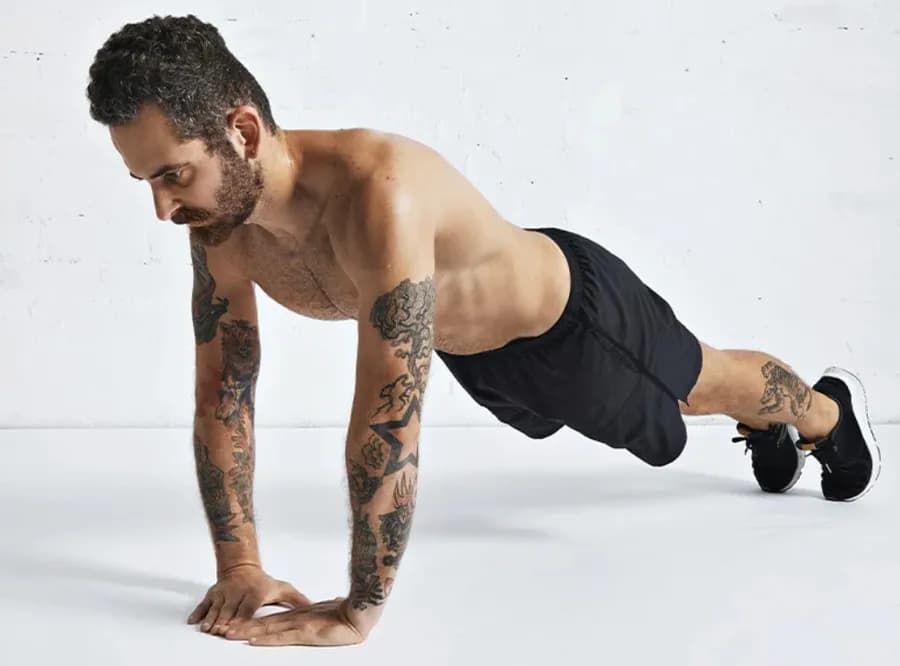
Diamond push ups are a bodyweight pressing exercise where the hands are placed close together, directly under the chest, with the thumbs and index fingers touching to form a triangle (or “diamond”) shape. This narrow hand position fundamentally changes the mechanics of the push-up: where standard shoulder-width push-ups load the chest as the primary mover, the diamond hand position shifts most of the work onto the triceps and the inner portion of the chest. They are widely considered the single most effective bodyweight triceps exercise available — comparable in triceps activation to skull crushers and close-grip bench press, but with zero equipment required. Olympic gymnasts, calisthenics athletes, and military training programmes all rely on diamond push-ups for triceps development.
The mechanism is leverage and angle. With hands shoulder-width apart, the elbows bend out to the sides, allowing the chest’s largest muscle fibres to do the pressing. With hands together in the diamond position, the elbows must travel back along the body — putting the triceps in their primary line of pull. The result: every rep delivers near-maximum tension to the triceps. The narrow position also forces greater core engagement to maintain a straight body line, since instability is higher than in wide-grip variations. Done correctly, diamond push-ups produce visible triceps development within 6–8 weeks of consistent training and improve performance on every other pressing movement — push-ups, bench press, overhead press, and dips.
Benefits of Diamond Push Ups
Builds Maximum Triceps Definition Without Equipment
EMG research consistently places diamond push-ups among the higher peak-activation triceps exercises — comparable to cable pushdowns and significantly higher than standard push-ups. They are the most efficient bodyweight triceps builder — and triceps make up two-thirds of the upper arm’s size, making them critical for visible arm development.
Targets the Inner Chest That Wide Push-Ups Miss
The narrow hand position activates the sternal (inner) fibres of the pectoralis major. Combined with regular wider push-ups, diamond push ups complete chest development by hitting the inner section that bench press and standard push-ups under-recruit.
Strengthens Pressing Performance Across All Movements
Dedicated triceps work is one of the strongest drivers of pressing-strength improvement. Coaches consistently report measurable bench press and overhead press gains within 8–12 weeks of focused triceps training — the triceps are the limiting muscle in most pressing lockouts.
Builds Greater Core Engagement Than Standard Push-Ups
The narrow hand base creates instability that recruits the core, transverse abdominis, and shoulder stabilisers — adding a meaningful core component to upper-body training.
How to Do Diamond Push Ups — 3 Variations
⚠️ Wrist Note: The narrow hand position loads the wrists more than standard push-ups. If you have wrist pain, carpal tunnel, or a recent wrist injury, perform on closed fists, push-up handles, or with dumbbells held vertically. Avoid entirely if you have an active wrist injury.
Variation 1: Knee Diamond Push-Up — Triceps, Inner Chest — 3 sets × 8 reps
How to perform: Drop to your knees in a push-up position. Place your hands together directly under your chest, thumbs and index fingers touching to form a diamond. Lower your chest toward the diamond, keeping elbows close to the body. Press back up. Why it suits this goal: The starting variation. Master 12 quality reps before progressing to standard. Modification: Reduce reps to 5–6 initially; widen the diamond slightly if 100% touching feels too narrow.
Variation 2: Standard Diamond Push Up — Triceps, Inner Chest, Core — 3 sets × 8–12 reps
How to perform: Standard push-up position with feet planted. Place hands together under the chest in the diamond shape. Lower chest to hands, keeping elbows tracked along the body (not flared). Press back up. Why it suits this goal: The benchmark variation. Building to 15 quality reps is the strength threshold for advanced triceps variations. Modification: Slightly widen the diamond (2–3 cm gap between hands) to reduce difficulty if standard form fails.
Variation 3: Diamond Push Up With Pause — Triceps Maximum Tension — 3 sets × 6 reps
How to perform: Standard diamond push-up form, but pause for 2 seconds at the bottom (chest near hands) before pressing up. Why it suits this goal: Maximises time-under-tension at peak triceps stretch. Half the reps, double the strength gain. Modification: Start with 1-second pauses; build to 2 seconds over 2–3 weeks.
Common Mistakes to Avoid in Diamond Push Ups
Mistake 1: Elbows Flaring Out to the Sides — Correction: Elbows Track Along the Body
What it is + why it undermines results: Elbow flare turns the diamond push-up into a narrow standard push-up — putting strain on the shoulders and reducing triceps activation. What to do instead: Throughout each rep, keep elbows close to the rib cage. If they drift outward, regress to knee variations until you can hold the line.
Mistake 2: Hands Too Far Forward of the Chest — Correction: Diamond Directly Under Sternum
What it is + why it undermines results: When the diamond is placed forward of the chest, the shoulders take the load and the triceps disengage. What to do instead: Place the diamond directly under your sternum (chest centre). Your nose should descend to touch (or come close to) the diamond, not above it.
Mistake 3: Skipping the Bottom Range — Correction: Chest Touches the Diamond Every Rep
What it is + why it undermines results: Many lifters stop the descent partway, missing the full triceps stretch where most growth happens. What to do instead: Lower until your chest lightly touches the diamond on every rep. Half-reps build half the result. In a live Habuild class, the coach catches elbow flare on rep 3 — invisible to the lifter, every time, and the silent reason most home triceps work produces no visible change.
How Habuild Trains You to Master Diamond Push Ups
Push-Up Progression Programming, Not Random Bodyweight Workouts
Habuild’s upper-body sessions follow a structured push-up progression: standard → wide → diamond → archer → one-arm. Each variation is held until rep benchmarks are hit. No skipping steps, no plateaus from random exercise selection.
Live Daily Sessions With Real-Time Form Correction
The two invisible diamond push-up failures — elbow flare and shallow depth — are caught immediately by a live coach. Without correction, most home trainers default to flared elbows within 4–5 reps.
Progressive Overload Built Into Every Session
Members progress from knee variations to standard to paused to elevated-feet variations on a structured schedule. The progression is built in.
Accountability, Streaks, and Community
Visible triceps change takes 6–8 weeks of consistent direct training. Daily streaks and live cohort accountability bridge the gap between “I should train” and “I’m training” on the days motivation drops.
Who Is Diamond Push-Ups Best For?
Complete Beginners Starting from Zero
Diamond push-ups begin from the knees for those who cannot yet perform the full variation. The hand position is the only modification — a knee-supported diamond push-up is genuinely accessible for anyone with basic push-up ability. The only requirement is showing up consistently — strength and technique follow from that.
Intermediate Trainees Looking to Fill a Gap
Diamond push-ups place the hands directly under the sternum in a diamond shape, creating maximum tricep loading and inner chest activation — the region that creates the visible line of definition down the centre of the chest. They are one of the most effective no-equipment exercises for anyone serious about upper-body development. Adding diamond push-ups to an existing routine addresses a specific conditioning gap that most general workouts miss.
Intermediate to Advanced Trainees Targeting Triceps and Inner Chest
Diamond push-ups place the hands directly under the sternum in a diamond shape, creating maximum tricep loading and inner chest activation — the region that creates the visible line of definition down the centre of the chest. They are one of the most effective no-equipment exercises for anyone serious about upper-body development.
Senior Citizens and Older Adults (50+)
Diamond Push-Ups can be adapted for older adults by controlling tempo, reducing range of motion, and using supported variations. Habuild’s live instructors modify exercises in real time for different fitness levels and physical conditions in the same session.
Is Diamond Push-Ups Good for Beginners?
Yes — absolutely. Diamond Push-Ups begin at very low intensity with fully accessible entry-level variations. Habuild’s live instructor adapts the session in real time so beginners and experienced trainees can train together without either being left behind.
How to Add Diamond Push-Ups to Your Training Routine
How Often to Do Diamond Push-Ups — Frequency Guide
Train diamond push-ups 3–4 times per week. This frequency gives the muscle and nervous system adequate stimulus without outpacing recovery. Consistency matters more than intensity in the early weeks — showing up regularly produces better results than infrequent all-out sessions.
When in Your Workout to Do Diamond Push-Ups
Place diamond push-ups after standard and wide push-ups in a push session, as the tricep-emphasis advanced movement. Sequencing exercises correctly ensures you bring maximum quality to diamond push-ups rather than performing them under accumulated fatigue from earlier work.
What to Pair Diamond Push-Ups With
Combine diamond push-ups with standard push-ups, dips, and overhead tricep extensions for a complete pressing programme. This combination develops complementary muscle groups in the same session and builds the balanced strength that prevents compensation and injury.
How to Progress Diamond Push-Ups Over Time
Once the base movement feels controlled and repeatable, increase reps before adding difficulty, then slow the eccentric phase, add a pause at the bottom, and progress to weighted diamond push-ups with a plate on the back. Progress only when form is consistent — adding difficulty before mastering the base movement reinforces poor mechanics and stalls long-term results.
How Habuild Teaches Diamond Push-Ups
Habuild is India’s First Habit Building Program — and through its strength and fitness sessions, it brings the same habit-based philosophy to targeted exercise training. Every session is structured around your specific goal, not a one-size-fits-all class.
Goal-Specific Programming — Not a Generic Fitness Class
Every exercise, rep range, and rest period in Habuild’s diamond push-ups sessions is chosen because it produces results for diamond push-ups specifically. Habuild does not run the same session for every goal — the programme is structured to drive your specific outcome with every session, not general fitness that happens to include diamond push-ups.
Live Daily Sessions with Real-Time Form Correction
Unlike pre-recorded videos, Habuild’s live daily sessions allow the instructor to see and correct your form in real time — the specific errors that limit diamond push-ups results and increase injury risk. This live correction is the difference between training that works and training that wastes effort and creates bad habits.
Progressive Overload Built into Every Session
Members do not need to design their own progressive overload for diamond push-ups — it is built into the programme structure. Each week, sessions are deliberately more challenging than the last, ensuring the body never fully adapts and results continue coming rather than stalling.
Accountability, Streaks, and Community
The most common reason people stop exercising is not effort — it is missing sessions until the habit breaks. Habuild’s streak system, live session accountability, and community of members training the same goal alongside you resolves this directly. Members who join with a specific goal like diamond push-ups and stay consistent for 30 days almost universally report that showing up has become automatic.
Flexible Batch Timing
Choose morning or evening classes and join the slot that suits your day.
Morning
6:30 AM
7:30 AM
8:30 AM

Evening
5:00 PM
6:00 PM
7:00 PM
8:00 PM

Choose Your Membership Plan
Continue after the trial with membership options designed for long-term consistency support.
Continue your habit on the Habuild app
Use the Habuild app for reminders, live access, progress support, and habit tracking.