7 Exercises for Cervical Pain
A 7-move daily routine for cervical pain that strengthens deep neck flexors and relieves stiffness at its source.

Key Takeaways
- Targets weak deep neck flexors and overworked trapezius
- Less stiffness noticeable within 3-7 days
- Meaningful pain reduction typically in 2-3 weeks
- Guided by senior instructor Saurabh Bothra's live sessions
- Full resolution often within 6-8 weeks of daily practice
What Are Exercises for Cervical Pain?

Exercises for cervical pain are movements specifically chosen to address the cervical spine — the seven vertebrae running from the base of the skull to the top of the shoulders. These exercises differ from generic neck stretches because they target the actual mechanical problem: weak deep neck flexors (the muscles in front of the spine), overworked upper trapezius muscles, and a forward head position from screen use.
The mechanism is simple. Modern life loads the neck wrong. We sit hunched, head jutted forward by 4–6 cm, for 8–12 hours a day. The deep neck flexors switch off; the upper traps and suboccipitals scream from compensating. Effective exercises for cervical pain wake up the silent muscles, calm the screaming ones, and restore the natural cervical curve. For a complementary practice that reaches the same area through breath and stillness, see our .
Benefits of Exercises for Cervical Pain
Benefit 1: Immediate Reduction in Stiffness and Pain
Gentle, structured neck movement increases blood flow to muscles and synovial fluid in the joints. Most people feel a 30–50% reduction in stiffness in a single session. A Cochrane review on exercises for chronic neck pain found structured exercise consistently outperforms passive treatments like rest or massage alone over 6–8 weeks.
Benefit 2: Better Posture and Reduced Headache Frequency
Tension headaches are often referred pain from the suboccipital muscles at the base of the skull, per the National Institute of Neurological Disorders and Stroke. By strengthening deep neck flexors and stretching the suboccipitals, headache frequency drops within 4–6 weeks for most chronic sufferers.
Benefit 3: Restored Range of Motion
Cervical pain quietly steals range — most people can no longer fully turn the head to check a blind spot or look up. Daily exercise restores 90%+ of lost range in 6–8 weeks. Combine with our program for compound results.
Benefit 4: Prevention of Long-Term Cervical Spondylosis
Untreated cervical pain often progresses to cervical spondylosis (degenerative changes in the joints) by the late 40s or 50s. Daily exercise dramatically slows this progression and is the only intervention shown to do so consistently in long-term studies.
Best Exercises for Cervical Pain
Exercise 1: Chin Tuck — Deep Neck Flexors — 3 sets × 10 reps
Sit tall, draw the chin straight back (creating a “double chin”), hold 2 seconds, release. The single most important exercise. Modification: lying on the floor for full support.
Exercise 2: Neck Rotation — Cervical Mobility — 10 each side
Slowly turn the head left, hold 3 seconds, return; repeat right. Stop before pain. Restores rotational range stolen by static screen work.
Exercise 3: Lateral Neck Tilt — Upper Trap Stretch — 30 sec each side
Tilt the right ear toward the right shoulder; gently pull with the right hand if needed. Releases the most overworked muscle in the modern body.
Exercise 4: Scapular Squeeze — Mid-Back Posture — 3 sets × 12 reps
Sit or stand tall, squeeze shoulder blades together as if pinching a pencil between them. Builds the mid-back support that holds the head over the spine.
Exercise 5: Wall Angels — Posture Pattern + Neck Position — 2 sets × 10 reps
Stand against a wall, arms in a “W” position against the wall, slowly slide them up to a “Y” while keeping contact. Restores upper-back extension and pulls the head back over the spine.
Exercise 6: Levator Scapulae Stretch — Side Neck and Upper Back — 30 sec each side
Sit, drop the right arm behind, look down toward the left armpit, gently pull with the left hand. Targets the muscle most responsible for that “knot” between the neck and shoulder.
Exercise 7: Suboccipital Release — Base of Skull — 1 minute
Lie down with two tennis balls in a sock placed under the base of the skull. Relax for 60 seconds. Releases the muscles responsible for tension headaches.
Common Mistakes With Exercises for Cervical Pain
Mistake 1: Pushing Through Pain — Correction: Move to the Edge of Comfort, Not Pain
Sharp neck pain is a stop signal. Working through it inflames the joints and sets back recovery by days. Move to the first hint of restriction, then stop. Sharp arm pain, numbness, or tingling means stop entirely and see a doctor — these are nerve symptoms, not muscle ones.
Mistake 2: Doing Too Much in One Session — Correction: Little, Often
Twenty minutes once a week does almost nothing for cervical pain. Five minutes, three times a day, transforms it. The neck responds to frequency, not duration.
Mistake 3: Ignoring the Mid-Back — Correction: Always Train Both
Cervical pain almost always has a mid-back component. Strengthening only the neck without strengthening the upper back is half the work. Scapular squeezes and wall angels are non-negotiable.
How Habuild Trains You to End Cervical Pain
Cervical-Specific Programming, Not a Generic Class
Every neck-focused Habuild yoga session sequences the four blocks above: deep neck flexor activation → cervical mobility → upper-trap release → mid-back strengthening. The order matters; a generic class skips half of it.
Live Daily Sessions With Real-Time Form Correction
The instructor watches in real time for the most common errors — chin jutting forward during chin tucks, holding breath, over-rotating into pain. Self-led video can’t catch any of it.
Progressive Daily Practice
Week 1 is gentle range-of-motion work. By week 4, isometric holds are added. By week 8, mid-back strengthening is the focus. Members don’t program their own progression.
Accountability and Streaks
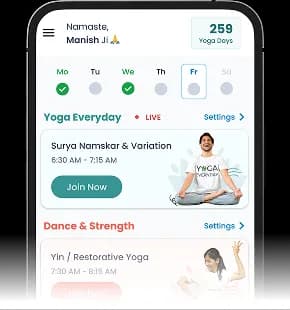
A daily morning slot, a streak counter, and a community group. Cervical pain only stays gone with daily consistency — that’s the layer Habuild solves first.
Who Is Exercises for Cervical Pain Best For?
Complete Beginners Starting from Zero
Cervical pain exercises begin with the gentlest, most pain-free movements — small-range chin tucks, shoulder rolls, and neck retraction — all done seated with no equipment. The entry point is safe even for those with active cervical discomfort. The only requirement is showing up consistently — strength and technique follow from that.
Intermediate Trainees Looking to Fill a Gap
Cervical pain from spondylosis, muscle tension, and postural loading responds to targeted neck and upper-back exercises that reduce compression, restore range of motion, and strengthen the muscles that support the cervical spine — providing lasting relief where pain medication alone cannot. Adding cervical pain exercises to an existing routine addresses a specific conditioning gap that most general workouts miss.
Office Workers, Drivers, and Anyone with Neck Pain or Cervical Spondylosis
Cervical pain from spondylosis, muscle tension, and postural loading responds to targeted neck and upper-back exercises that reduce compression, restore range of motion, and strengthen the muscles that support the cervical spine — providing lasting relief where pain medication alone cannot.
Senior Citizens and Older Adults (50+)
Exercises for Cervical Pain can be adapted for older adults by controlling tempo, reducing range of motion, and using supported variations. Habuild’s live instructors modify exercises in real time for different fitness levels and physical conditions in the same session.
Is Exercises for Cervical Pain Good for Beginners?
Yes — absolutely. Exercises for Cervical Pain begin at very low intensity with fully accessible entry-level variations. Habuild’s live instructor adapts the session in real time so beginners and experienced trainees can train together without either being left behind.
How to Add Exercises for Cervical Pain to Your Training Routine
How Often to Do Exercises for Cervical Pain — Frequency Guide
Train cervical pain exercises daily, 5–10 minutes. This frequency gives the muscle and nervous system adequate stimulus without outpacing recovery. Consistency matters more than intensity in the early weeks — showing up regularly produces better results than infrequent all-out sessions.
When in Your Workout to Do Exercises for Cervical Pain
Place cervical pain exercises morning to reduce overnight stiffness, and at any point during a long seated work session. Sequencing exercises correctly ensures you bring maximum quality to cervical pain exercises rather than performing them under accumulated fatigue from earlier work.
What to Pair Exercises for Cervical Pain With
Combine cervical pain exercises with scapular squeezes, chest stretches, and thoracic mobility exercises for complete cervical and upper-back posture correction. This combination develops complementary muscle groups in the same session and builds the balanced strength that prevents compensation and injury.
How to Progress Exercises for Cervical Pain Over Time
Once the base movement feels controlled and repeatable, begin with unresisted range-of-motion exercises, progress to isometric resistance, and then to light resistance band exercises as strength builds. Progress only when form is consistent — adding difficulty before mastering the base movement reinforces poor mechanics and stalls long-term results.
How Habuild Teaches Exercises for Cervical Pain
Habuild is India’s First Habit Building Program — and through its strength and fitness sessions, it brings the same habit-based philosophy to targeted exercise training. Every session is structured around your specific goal, not a one-size-fits-all class.
Goal-Specific Programming — Not a Generic Fitness Class
Every exercise, rep range, and rest period in Habuild’s cervical pain exercises sessions is chosen because it produces results for cervical pain exercises specifically. Habuild does not run the same session for every goal — the programme is structured to drive your specific outcome with every session, not general fitness that happens to include cervical pain exercises.
Live Daily Sessions with Real-Time Form Correction
Unlike pre-recorded videos, Habuild’s live daily sessions allow the instructor to see and correct your form in real time — the specific errors that limit cervical pain exercises results and increase injury risk. This live correction is the difference between training that works and training that wastes effort and creates bad habits.
Progressive Overload Built into Every Session
Members do not need to design their own progressive overload for cervical pain exercises — it is built into the programme structure. Each week, sessions are deliberately more challenging than the last, ensuring the body never fully adapts and results continue coming rather than stalling.
Accountability, Streaks, and Community
The most common reason people stop exercising is not effort — it is missing sessions until the habit breaks. Habuild’s streak system, live session accountability, and community of members training the same goal alongside you resolves this directly. Members who join with a specific goal like cervical pain exercises and stay consistent for 30 days almost universally report that showing up has become automatic.
Flexible Batch Timing
Choose morning or evening classes and join the slot that suits your day.
Morning
6:30 AM
7:30 AM
8:30 AM

Evening
5:00 PM
6:00 PM
7:00 PM
8:00 PM


Choose Your Membership Plan
Continue after the trial with membership options designed for long-term consistency support.
Continue your habit on the Habuild app
Use the Habuild app for reminders, live access, progress support, and habit tracking.