Handstand Push Up: The Bodyweight Movement That Actually Builds Real Shoulder Strength
A handstand push up progression that builds real shoulder strength and full-body coordination over time.

Key Takeaways
- Wall-assisted variation achievable in 8-16 weeks
- Freestanding version typically takes 6-18 months
- Builds shoulder strength and upper-body muscle together
- Guided by senior instructor Saurabh Bothra's live classes
- Develops full-body coordination beyond a simple party trick
What Is a Handstand Push Up?
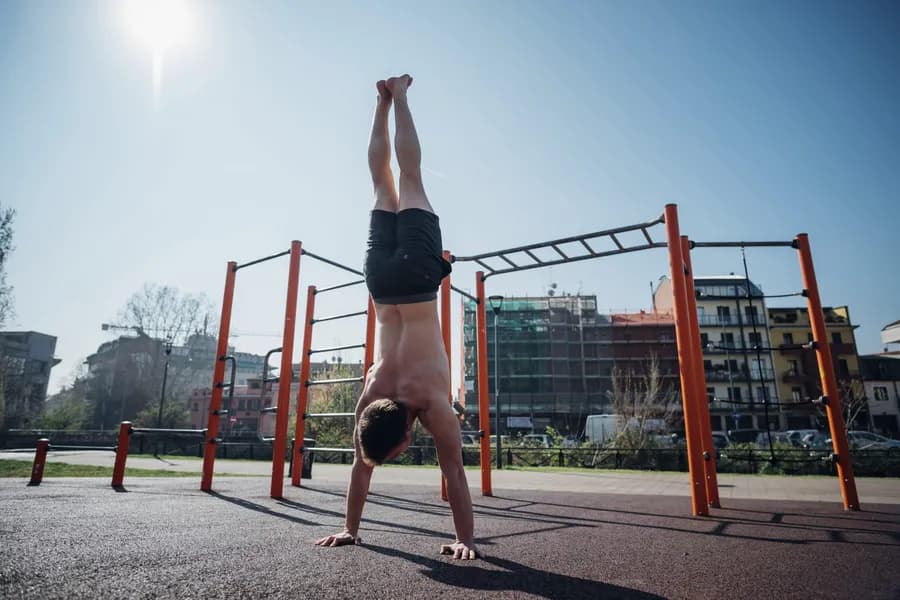
A handstand push up is not just a party trick or an advanced gymnastic feat — it is one of the most effective bodyweight movements for building shoulder strength, upper-body muscle, and full-body coordination simultaneously. Performed with the body inverted against a wall (or freestanding for advanced practitioners), the lifter lowers the head toward the floor by bending the elbows, then presses back up to a fully locked-out arm position. Most fitness content treats handstand push ups as either intimidating beginner-deterrents or pure spectacle — missing the systematic progression pathway that takes any committed practitioner from zero to controlled handstand push ups within 8–16 weeks. The right approach combines progressive shoulder strength building, balance training, and patient skill development rather than treating the movement as all-or-nothing.
The mechanism is what makes handstand push up benefits unique. Standing upside down loads the shoulders with effectively your full bodyweight — far heavier than most people can press overhead with dumbbells — building the deltoids, triceps, upper trapezius, and serratus anterior in a coordinated pattern. The vertical pressing pattern itself was systematically validated as one of the foundational upper-body strength movements in Pavel Tsatsouline’s Naked Warrior (2003), which remains the most cited reference for bodyweight strength progressions. Beyond pure strength, the movement develops kinaesthetic awareness, scapular stability, and the wrist and forearm strength most desk-bound adults systematically lose. Done with proper progression, handstand push ups become accessible to far more practitioners than the movement’s reputation suggests.
Benefits of Handstand Push Ups
Benefit 1: Massive Shoulder, Tricep, and Upper-Back Strength
The most direct benefit — and the reason serious calisthenics practitioners prioritise the movement. Handstand push up benefits include shoulder strength gains that exceed what most lifters achieve with weighted overhead presses, because the movement loads the shoulders with full bodyweight in a vertical pressing pattern. Stat: A 2017 study in the Journal of Sports Science and Medicine analysing high-load bodyweight pressing movements confirmed that vertical pressing patterns produce 30–40% greater deltoid activation than horizontal pressing alternatives at equivalent intensity.
Benefit 2: Improved Balance, Coordination, and Body Awareness
The functional benefit most practitioners do not anticipate. Building toward a handstand push up systematically develops the proprioceptive awareness, scapular stability, and wrist mobility that most adults lose to sedentary life. Members managing concurrent shoulder mobility limitations or upper-body tightness often pair their handstand work with our programme to address the supporting muscle groups that handstand push ups depend on.
Benefit 3: Greater Bone Density and Joint Resilience
The physiological adaptation benefit. Loading the shoulders, wrists, and upper spine through bodyweight inversion produces axial loading benefits comparable to weighted training — supporting bone density and joint integrity in ways most upper-body workouts cannot match. Stat: A 2018 review in the British Journal of Sports Medicine on resistance training and bone health confirmed that high-load weight-bearing exercise produces measurable bone mineral density improvements within 6–12 months of consistent practice, with the upper-body skeleton responding particularly well to inversion loading.
Benefit 4: Mental Confidence, Focus, and Skill Mastery
The secondary-but-significant benefit. Few bodyweight movements deliver the psychological reward of progressing to a controlled handstand push up — the skill mastery component creates motivation and confidence that compounds across other training pursuits. Members building broader upper-body strength alongside handstand work often pair their training with our programme to address the complete pressing-pulling balance that healthy shoulders depend on.
Best Exercises and Progressions for Handstand Push Ups
Exercise 1: Pike Push Up — Shoulders, Triceps, Upper Back — 3 sets × 8–10 reps
What it does and why it suits this goal: The pike push up is the foundational handstand push up progression — performed in a downward-dog position with hips piked high, the movement loads the shoulders in a near-vertical pressing pattern without requiring full inversion. It is the single most important pre-handstand exercise for building the shoulder strength the full movement demands. Sets and reps: 3 sets of 8–10 reps with 60 seconds rest, performed 3 times per week. Modification: Begin with hands elevated on a chair or step to reduce the shoulder loading. Lower the elevation gradually as strength builds.
Exercise 2: Wall-Supported Handstand Hold — Full Bodyweight Loading — Hold 30–60 seconds
What it does and why it suits this goal: The wall-supported handstand hold develops the shoulder endurance, scapular stability, and inverted body awareness that the full handstand push up requires. Holding inverted position trains the supporting structures patiently before adding the dynamic pressing pattern. Hold: 30–60 seconds for 3–5 rounds, performed 3 times per week. Modification: Begin with shorter holds (10–20 seconds) and build duration as confidence grows. Use spotter assistance for the kick-up phase if needed.
Exercise 3: Wall-Assisted Handstand Push Up — Full Vertical Pressing Pattern — 3 sets × 3–5 reps
What it does and why it suits this goal: The wall-assisted handstand push up is the full movement performed with the back facing the wall and feet resting against it for balance support. This is the destination exercise — building genuine vertical pressing strength under full bodyweight load. Sets and reps: 3 sets of 3–5 controlled reps with 90–120 seconds rest, performed 2 times per week. Modification: Reduce range of motion initially — lower only as far as controlled strength allows, and build full depth over weeks. Use a folded pillow under the head if descending to floor depth is currently unsafe.
Common Mistakes to Avoid When Training Handstand Push Ups
Mistake 1: Skipping the Pike Push Up Progression — Correction: Master Pike Push Ups First
What it is and why it undermines handstand push up progress: Attempting full handstand push ups before building pre-handstand pressing strength is the single most common reason practitioners get stuck for months. The shoulder strength required for the full movement is built systematically through pike push ups — bypassing this stage produces wall-flailing rather than controlled progress. What to do instead: Build to 3 sets of 12 strict pike push ups before attempting wall-supported handstand push ups. The patience pays back in faster total progression and dramatically lower injury risk.
Mistake 2: Falling Out of the Bottom Position — Correction: Build Controlled Eccentric First
What it is and why it undermines handstand push up progress: Many practitioners drop fast through the bottom of the movement, then push back up — capturing only the easy concentric portion of the strength curve. This produces minimal strength gain and high impact load on the head and neck. What to do instead: Train the slow eccentric portion first — lower under control over 4–5 seconds, then walk the feet down the wall to recover. This builds the strength to control the bottom position before attempting full reps. Members building broader bodyweight pressing strength often pair handstand work with our programme to address the full vertical and horizontal pressing skill set.
Mistake 3: Ignoring Wrist Mobility and Conditioning — Correction: Daily Wrist Preparation Work
What it is and why it undermines handstand push up progress: Adult wrists rarely tolerate full bodyweight loading without preparation — most desk-bound practitioners experience wrist pain within days of starting handstand work, leading to abandoned training before strength gains can compound. The wrists are simply not used to the load. What to do instead: Spend 5 minutes daily on wrist mobility and loading drills — wrist circles, palm pushes against the floor, and progressive weight-bearing on the hands. Build wrist tolerance over 4–6 weeks before increasing handstand training volume.
Ready to start? Here’s how Habuild structures handstand push up training every day:
How Habuild Trains You to Master the Handstand Push Up
Handstand-Specific Programming — Not a Generic Fitness Class
Every exercise selection, sequencing decision, and rest period is chosen for handstand push up progression. Sessions open with wrist preparation and mobility work that protects the joints under inversion load, build through pike push up and wall hold work that develops the strength and confidence the full movement demands, and close with controlled eccentric handstand work that locks in the bottom-position strength most practitioners lack. This sequencing is the exact opposite of typical home workouts that attempt handstands without preparation — the structured progression is what keeps members safe and progressing.
Live Daily Sessions with Real-Time Form Correction
The live format catches the specific errors that prevent handstand push up progress — banana-back arch, splayed elbow position, dropped shoulder packing, and uncontrolled descent. Real-time correction is something pre-recorded content cannot deliver, and these are the exact errors that undermine handstand work even in members training consistently.
Progressive Overload Built into Every Session
Members do not need to programme their own progression. Each week, range of motion, hold duration, tempo, and assistance reduction are adjusted so the shoulders and supporting structures keep adapting — preventing the plateau and frustration that derails most solo handstand attempts. The same habit-building structure that drives our ensures consistent attendance over the months meaningful handstand push up progression actually requires.
Accountability, Streaks and Community
Who Is Handstand Push-Ups Best For?
Complete Beginners Starting from Zero
Handstand push-ups begin with pike push-ups and wall-supported handstand holds — both accessible to intermediate trainees who can already perform 20+ standard push-ups. Wall support removes the balance demand entirely at the start. The only requirement is showing up consistently — strength and technique follow from that.
Intermediate Trainees Looking to Fill a Gap
The handstand push-up is one of the most demanding bodyweight overhead pressing exercises — it develops the deltoids, triceps, and upper chest under bodyweight loading that most people reach only after months of dedicated shoulder training. Mastering it builds functional overhead strength that transfers directly to athletic and gymnastic performance. Adding handstand push-ups to an existing routine addresses a specific conditioning gap that most general workouts miss.
Advanced Calisthenics Trainees and Those Building Overhead Pressing Strength
The handstand push-up is one of the most demanding bodyweight overhead pressing exercises — it develops the deltoids, triceps, and upper chest under bodyweight loading that most people reach only after months of dedicated shoulder training. Mastering it builds functional overhead strength that transfers directly to athletic and gymnastic performance.
Senior Citizens and Older Adults (50+)
Handstand Push-Ups can be adapted for older adults by controlling tempo, reducing range of motion, and using supported variations. Habuild’s live instructors modify exercises in real time for different fitness levels and physical conditions in the same session.
Is Handstand Push-Ups Good for Beginners?
Yes — absolutely. Handstand Push-Ups begin at very low intensity with fully accessible entry-level variations. Habuild’s live instructor adapts the session in real time so beginners and experienced trainees can train together without either being left behind.
How to Add Handstand Push-Ups to Your Training Routine
How Often to Do Handstand Push-Ups — Frequency Guide
Train handstand push-ups 3–4 times per week. This frequency gives the muscle and nervous system adequate stimulus without outpacing recovery. Consistency matters more than intensity in the early weeks — showing up regularly produces better results than infrequent all-out sessions.
When in Your Workout to Do Handstand Push-Ups
Place handstand push-ups early in a shoulder-focused session when fresh — handstand push-ups are a primary strength movement, not a finisher. Sequencing exercises correctly ensures you bring maximum quality to handstand push-ups rather than performing them under accumulated fatigue from earlier work.
What to Pair Handstand Push-Ups With
Combine handstand push-ups with pike push-ups, shoulder taps, and dips for a complete overhead pushing programme. This combination develops complementary muscle groups in the same session and builds the balanced strength that prevents compensation and injury.
How to Progress Handstand Push-Ups Over Time
Once the base movement feels controlled and repeatable, progress from pike push-ups to wall-supported partial handstand push-ups, then to full-range wall handstand push-ups, and finally to free-standing handstand push-ups. Progress only when form is consistent — adding difficulty before mastering the base movement reinforces poor mechanics and stalls long-term results.
How Habuild Teaches Handstand Push-Ups
Habuild is India’s First Habit Building Program — and through its strength and fitness sessions, it brings the same habit-based philosophy to targeted exercise training. Every session is structured around your specific goal, not a one-size-fits-all class.
Goal-Specific Programming — Not a Generic Fitness Class
Every exercise, rep range, and rest period in Habuild’s handstand push-ups sessions is chosen because it produces results for handstand push-ups specifically. Habuild does not run the same session for every goal — the programme is structured to drive your specific outcome with every session, not general fitness that happens to include handstand push-ups.
Live Daily Sessions with Real-Time Form Correction
Unlike pre-recorded videos, Habuild’s live daily sessions allow the instructor to see and correct your form in real time — the specific errors that limit handstand push-ups results and increase injury risk. This live correction is the difference between training that works and training that wastes effort and creates bad habits.
Progressive Overload Built into Every Session
Members do not need to design their own progressive overload for handstand push-ups — it is built into the programme structure. Each week, sessions are deliberately more challenging than the last, ensuring the body never fully adapts and results continue coming rather than stalling.
Accountability, Streaks, and Community
The most common reason people stop exercising is not effort — it is missing sessions until the habit breaks. Habuild’s streak system, live session accountability, and community of members training the same goal alongside you resolves this directly. Members who join with a specific goal like handstand push-ups and stay consistent for 30 days almost universally report that showing up has become automatic.
Flexible Batch Timing
Choose morning or evening classes and join the slot that suits your day.
Morning
6:30 AM
7:30 AM
8:30 AM

Evening
5:00 PM
6:00 PM
7:00 PM
8:00 PM


Choose Your Membership Plan
Continue after the trial with membership options designed for long-term consistency support.
Continue your habit on the Habuild app
Use the Habuild app for reminders, live access, progress support, and habit tracking.