7 Variations of Sit Ups
A 7-variation sit ups routine that builds strong, defined abs with beginner-friendly progressions.
Key Takeaways
- Core strength improves within 2-3 weeks of practice
- Visible ab definition typically at 8-12 weeks
- 7 variations include bench and beginner versions
- Guided by senior instructor Saurabh Bothra's live sessions
- Builds muscle while body fat reduction reveals it
What Are Sit Ups?
Sit ups are one of the oldest and most recognised abdominal exercises — a full-range movement where you start lying on your back, knees bent, feet flat on the floor (or anchored), and lift the entire upper body up to a seated position before returning to start. Unlike crunches (which lift only the shoulder blades a few inches off the floor), sit ups travel through a much larger range of motion, engaging both the rectus abdominis AND the hip flexors throughout the movement. Sit ups for beginners typically use the arms-across-chest position to reduce neck strain; advanced variations include the sit up bench workout (which adds incline for more resistance), the reverse sit up bench (which inverts the angle for harder work), and weighted sit ups (which load the chest with a plate or dumbbell).
The mechanism of sit ups differs from crunches in one important way. Crunches isolate spinal flexion to the upper abs; sit ups train the full kinetic chain of the trunk — abs, hip flexors, and the connection between them. This makes sit ups more functionally relevant for athletic movement (sitting up from the floor, getting out of bed, transitioning from supine to standing) but also more demanding on the lower back. The right form makes sit ups safe and highly effective; the wrong form turns them into a hip-flexor swing that compresses the lumbar spine. The sit up equipment market — best sit up bench options, anchor straps, decline benches — exists primarily to manage this form challenge by stabilising the feet and standardising the movement pattern. For those new to ab training, building foundational core strength first through programmes like makes sit ups significantly safer and more productive.
Benefits of Sit Ups
Builds Full-Range Abdominal Strength
Unlike crunches that train only the upper portion of the rectus abdominis, sit ups engage the full muscle through its entire range of motion. Daily sit up training builds visible ab thickness and functional strength faster than crunches alone. Stat: EMG research on abdominal exercises (Escamilla et al., 2010, Journal of Orthopaedic & Sports Physical Therapy) shows sit ups produce significantly greater full-range rectus abdominis activation than partial-range crunches.
Strengthens the Hip Flexors and Core Integration
Sit ups train the iliacus and psoas (the deep hip flexors) alongside the abs — building the trunk-to-leg connection used in walking, running, climbing stairs and getting up off the floor. This functional integration is what transfers ab strength into real-world performance. For office workers with weakened hip flexors from prolonged sitting, sit ups directly address the deficit.
Highly Time-Efficient and Equipment-Free
One of the most equipment-free exercises in the entire fitness toolkit. 10 minutes of sit ups daily produces measurable ab strength gains within 4 weeks — no gym membership, no fancy machines, no learning curve. Stat: military fitness tests use 60-second sit up counts as a primary core measure precisely because they’re standardised and equipment-free.
Builds Visible Abs When Body Fat Drops
Daily sit up training builds the rectus abdominis muscle thickness needed for visible “six-pack” definition once body fat drops below ~15% (men) or ~22% (women). Most members see meaningful definition by week 8–12 of consistent practice combined with reasonable eating and overall fat loss.
Best Sit Up Variations
Below are 3 fully detailed variations; weighted sit ups, anchored sit ups, reverse sit up bench and sit up equipment options round out the 7-variation set, covered briefly below and in the FAQ. The full progression is built into Habuild’s daily live sessions.
Exercise 1: Standard Sit Up — Rectus Abdominis + Hip Flexors — 3 sets × 15–20 reps
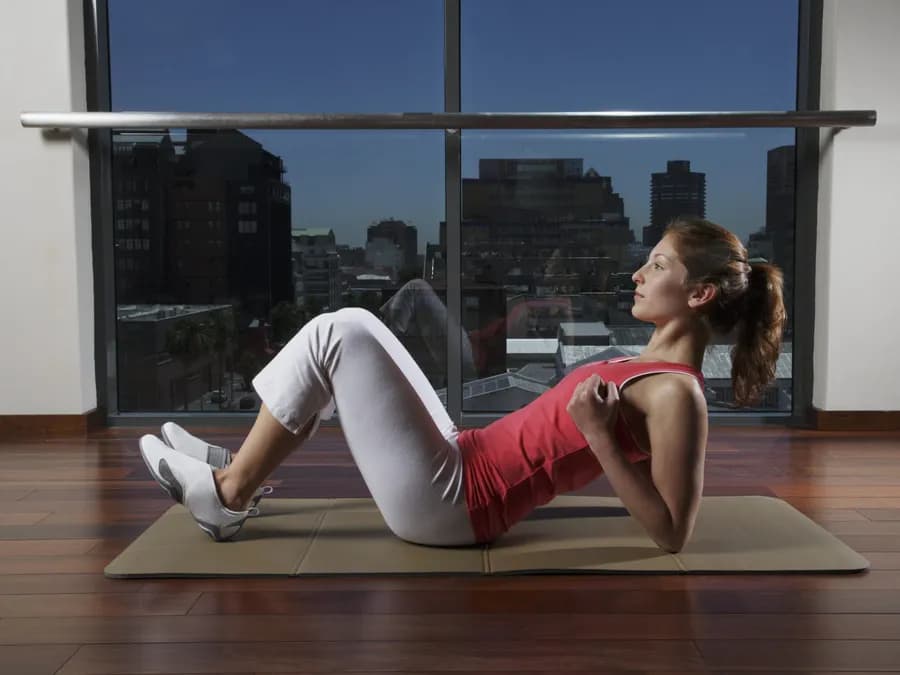
Lie on your back, knees bent at 45°, feet flat on the floor (or anchored under a couch). Hands lightly behind ears or crossed over chest. Lift entire upper body up until elbows touch knees (or near them), lower with control. 3 sets × 15–20 reps. The foundational variation. Modification: cross arms over chest if hands behind the head causes neck strain; use a partner or strap to anchor feet for additional support.
Exercise 2: Sit Ups for Beginners (Knees Bent, Arms Crossed) — Entry-Level — 3 sets × 10–12 reps
Same starting position, arms crossed firmly over the chest, knees fully bent so heels are close to glutes. Slow lift up, slow lower. 3 sets × 10–12 reps. Designed for those building ab strength from zero — the bent knees reduce hip flexor demand and the crossed arms reduce neck strain. Build to standard sit up over 3–4 weeks once form is locked. Modification: reduce range — only lift halfway up, build to full range gradually.
Exercise 3: Decline / Incline Sit Up Bench Workout — Full Abs + Resistance — 3 sets × 12–15 reps
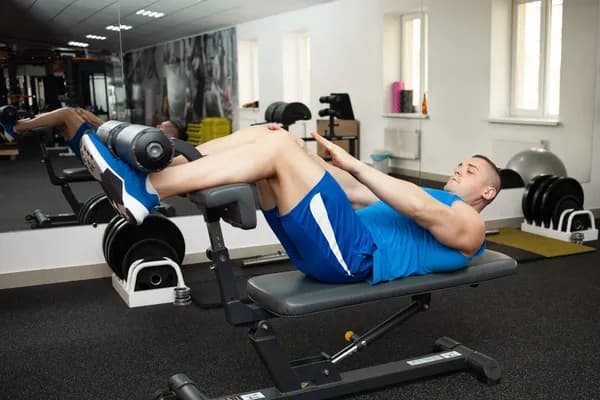
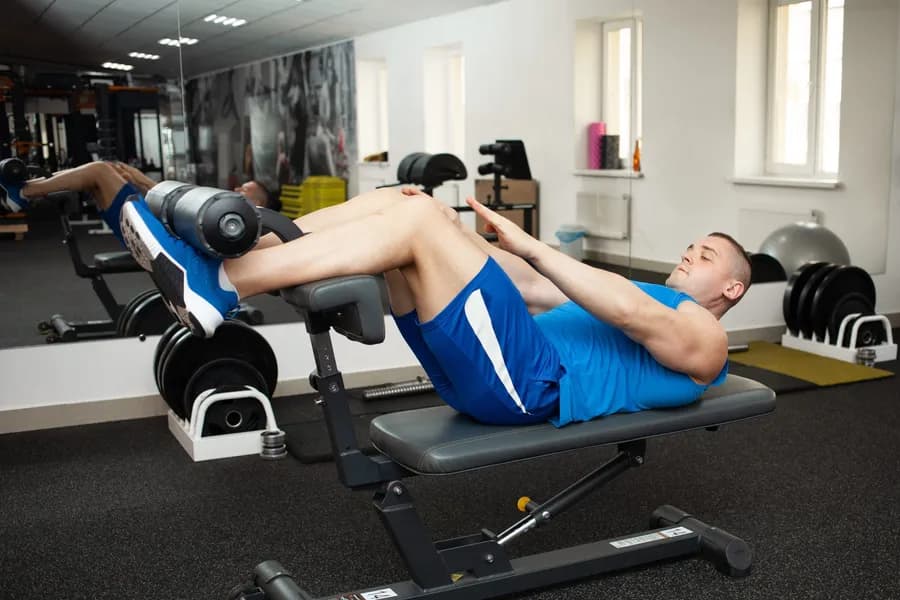
Set a sit up bench at 30–45° decline (head lower than feet). Lock feet under the pads. Lift upper body up to vertical, lower with control. 3 sets × 12–15 reps. The sit up bench workout multiplies the load on the abs because gravity now resists the lift through a longer range. Add a weight plate held at the chest for further progression. Modification: reduce decline angle to 15° initially; perform standard floor sit ups for 4–6 weeks before transitioning to a decline bench.
Beyond these three, the reverse sit up bench variation (using a glute-ham bench positioned for ab work) flips the angle so the head ends up high — the resistance comes from the lower portion of the rep. This is highly advanced and rarely needed for general ab development. The classic equipment options — best sit up bench picks for home — typically include adjustable decline benches with foam-padded foot anchors, and these matter more for serious ab development than any decoration on the device itself.
Common Mistakes to Avoid With Sit Ups
Mistake 1: Pulling on the Neck With Hands Clasped Behind the Head — Correction: Fingers Lightly Behind Ears or Arms Crossed
The most common sit up error: yanking the head forward with clasped hands behind the head, which strains the cervical spine and produces neck pain rather than ab burn. What to do instead: rest the fingertips lightly behind the ears with elbows wide, or simply cross arms over chest. Keep eyes pointed at the knees during the lift; the head follows the torso, not the other way around. The chin-to-chest tuck should be gentle, not crunched.
Mistake 2: Using Hip Flexor Swing Instead of Ab Contraction — Correction: Slow Tempo, Lift From the Belly
Speed-doing sit ups by bouncing off the floor with hip-flexor momentum trains the hip flexors and lower back, not the abs. Many people do hundreds of these and wonder why their abs never develop. What to do instead: 2-second lift, 1-second pause at top, 2-second lower. Initiate the lift by curling the spine — shoulders, then upper back, then mid-back peel off the floor in sequence. The abs do the work, not the hip flexors. The same applies to all sit ups for beginners variations.
Mistake 3: Doing Only Sit Ups Without Full Core Programming — Correction: Pair With Anti-Extension and Anti-Rotation Work
Even perfectly executed daily sit ups build only one slice of the core — spinal flexion. They miss the obliques entirely and work the deep stabilisers minimally. The result: members who do sit ups religiously still suffer from lower back pain because their anti-extension and anti-rotation strength stays weak. What to do instead: pair sit ups with planks, Russian twists, dead bugs and bird dogs in a balanced weekly programme. Habuild’s daily sessions integrate this — sit ups serve as one of multiple core-pattern exercises, not the entire ab workout.
How Habuild Trains You for Strong, Functional Abs
Full-Spectrum Core Programming, Not Just Sit Ups
Most online ab routines are 80% sit ups and crunches with token plank work added at the end — leaving the obliques and deep core underdeveloped. Habuild’s daily sessions explicitly programme sit ups alongside Russian twists (rotation), planks (isometric), dead bugs (anti-extension) and side planks (lateral) in a balanced weekly rotation, ensuring all seven core muscle groups develop together.
Live Daily Sessions With Real-Time Form Correction
The neck-yank, the hip-flexor-swing, the half-rep — all corrected within seconds on the live call. Sit ups done badly are some of the most common drivers of neck and lower-back pain in home workouts; sit ups done well are highly effective ab builders. The difference is form, and form requires live coaching.
Progressive Overload Built Into Every Session
Week 1: sit ups for beginners with arms crossed, half-range. Week 4: standard sit up with full range. Week 8: sit ups with hands behind head. Week 12: weighted or decline-bench progression for those with access. Members don’t programme this — duration, complexity and load build progressively within the live class flow.
Accountability, Streaks and Community
Visible abs require 8–12 weeks of unbroken practice plus diet discipline. Daily streak tracking, the WhatsApp community and live morning sessions keep members on the mat through the slow window where the muscle is being built but isn’t yet visible — and through the unrelated weeks when motivation dips for other reasons.
Who Is Sit Ups Best For?
Complete Beginners Starting from Zero
Sit-ups begin with knees bent and feet flat on the floor — the most supported variation. Anyone can perform a partial sit-up (rising only partway) as a starting point, then build toward the full movement over time. The only requirement is showing up consistently — strength and technique follow from that.
Intermediate Trainees Looking to Fill a Gap
Sit-ups develop the rectus abdominis through a full range of motion that crunches only partially train, and build the hip flexor strength and spinal mobility that many other ab exercises neglect. They are the foundational ab exercise in military and athletic fitness programmes worldwide. Adding sit-ups to an existing routine addresses a specific conditioning gap that most general workouts miss.
Those Building Classical Ab Strength and Upper-Body Endurance
Sit-ups develop the rectus abdominis through a full range of motion that crunches only partially train, and build the hip flexor strength and spinal mobility that many other ab exercises neglect. They are the foundational ab exercise in military and athletic fitness programmes worldwide.
Senior Citizens and Older Adults (50+)
Sit Ups can be adapted for older adults by controlling tempo, reducing range of motion, and using supported variations. Habuild’s live instructors modify exercises in real time for different fitness levels and physical conditions in the same session.
Is Sit Ups Good for Beginners?
Yes — absolutely. Sit Ups begin at very low intensity with fully accessible entry-level variations. Habuild’s live instructor adapts the session in real time so beginners and experienced trainees can train together without either being left behind.
How to Add Sit Ups to Your Training Routine
How Often to Do Sit Ups — Frequency Guide
Train sit-ups 4–5 times per week. This frequency gives the muscle and nervous system adequate stimulus without outpacing recovery. Consistency matters more than intensity in the early weeks — showing up regularly produces better results than infrequent all-out sessions.
When in Your Workout to Do Sit Ups
Place sit-ups in the core block or as part of a timed fitness circuit — sit-ups pair naturally with push-ups and squats in bodyweight training programmes. Sequencing exercises correctly ensures you bring maximum quality to sit-ups rather than performing them under accumulated fatigue from earlier work.
What to Pair Sit Ups With
Combine sit-ups with crunches, planks, and leg raises for a complete ab programme that covers range, endurance, and stability. This combination develops complementary muscle groups in the same session and builds the balanced strength that prevents compensation and injury.
How to Progress Sit Ups Over Time
Once the base movement feels controlled and repeatable, progress from bent-knee to straight-leg sit-ups, add a medicine ball or weight plate at the chest, then progress to decline sit-ups for a greater range of motion and increased difficulty. Progress only when form is consistent — adding difficulty before mastering the base movement reinforces poor mechanics and stalls long-term results.
How Habuild Teaches Sit Ups
Habuild is India’s First Habit Building Program — and through its strength and fitness sessions, it brings the same habit-based philosophy to targeted exercise training. Every session is structured around your specific goal, not a one-size-fits-all class.
Goal-Specific Programming — Not a Generic Fitness Class
Every exercise, rep range, and rest period in Habuild’s sit-ups sessions is chosen because it produces results for sit-ups specifically. Habuild does not run the same session for every goal — the programme is structured to drive your specific outcome with every session, not general fitness that happens to include sit-ups.
Live Daily Sessions with Real-Time Form Correction
Unlike pre-recorded videos, Habuild’s live daily sessions allow the instructor to see and correct your form in real time — the specific errors that limit sit-ups results and increase injury risk. This live correction is the difference between training that works and training that wastes effort and creates bad habits.
Progressive Overload Built into Every Session
Members do not need to design their own progressive overload for sit-ups — it is built into the programme structure. Each week, sessions are deliberately more challenging than the last, ensuring the body never fully adapts and results continue coming rather than stalling.
Accountability, Streaks, and Community
The most common reason people stop exercising is not effort — it is missing sessions until the habit breaks. Habuild’s streak system, live session accountability, and community of members training the same goal alongside you resolves this directly. Members who join with a specific goal like sit-ups and stay consistent for 30 days almost universally report that showing up has become automatic.
Flexible Batch Timing
Choose morning or evening classes and join the slot that suits your day.
Morning
6:30 AM
7:30 AM
8:30 AM

Evening
5:00 PM
6:00 PM
7:00 PM
8:00 PM


Choose Your Membership Plan
Continue after the trial with membership options designed for long-term consistency support.
Continue your habit on the Habuild app
Use the Habuild app for reminders, live access, progress support, and habit tracking.