Step Back Lunges
A step back lunge routine that builds knee-friendly glute and leg strength through a reverse stepping pattern.
Key Takeaways
- Also known as reverse lunges for knee-friendly training
- Primarily targets the glutes and quadriceps
- Engages hamstrings, adductors, and core stabilisers
- Guided by senior instructor Saurabh Bothra's live sessions
- A single-leg movement building unilateral strength
What Are Step Back Lunges?
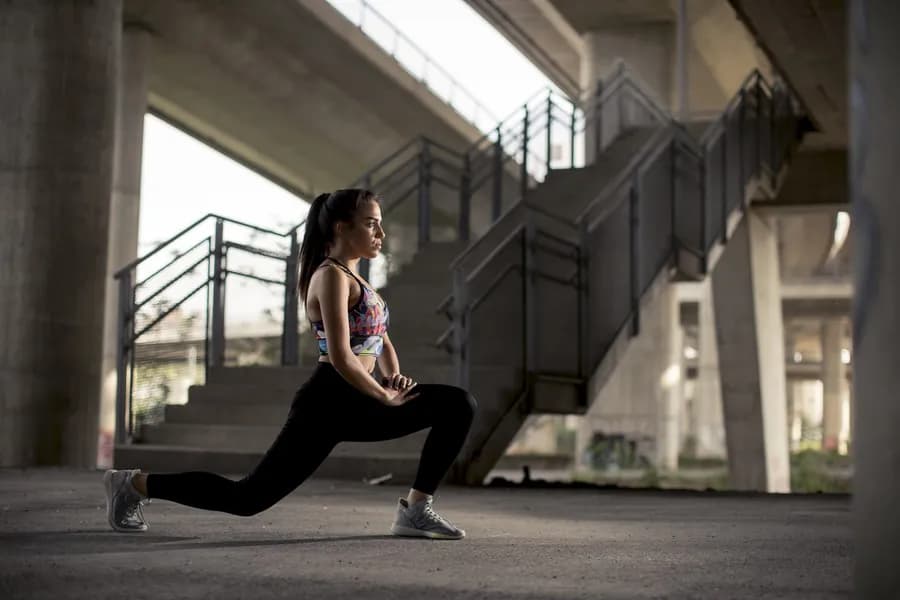
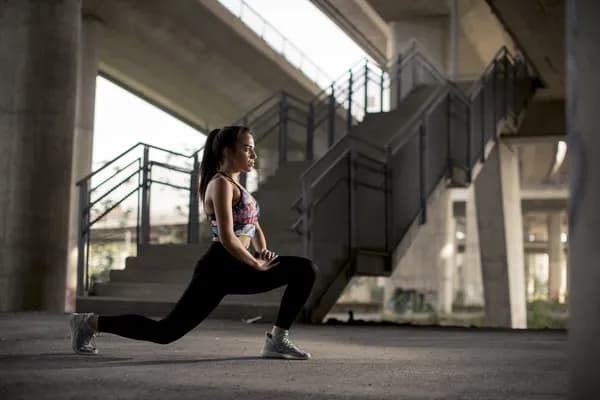
Step back lunges — also commonly called reverse lunges — are a single-leg strength exercise where you stand upright, then step one leg backward into a lunge position, lowering until both knees form approximately 90-degree angles. The backward-stepping motion is what fundamentally distinguishes them from standard forward lunges. Where forward lunges step into the lunge by driving the lead leg forward (placing significant shear force across the front knee), step back lunges step away from the front knee, shifting bodyweight onto the heel of the planted leg and dramatically reducing knee joint stress. They are the lunge variation most often prescribed by physiotherapists, knee surgeons, and rehabilitation specialists for exactly this reason.
The mechanism is muscle emphasis and joint loading. The backward step changes the angle of the front leg’s hip, increasing demand on the gluteus maximus (which extends the hip) while reducing demand on the quadriceps (which extend the knee). This makes step back lunges measurably superior to forward lunges for glute development. The reduced forward knee travel also lowers patellofemoral pressure — beneficial for anyone with knee pain, mild arthritis, or a history of knee injury. Used as the primary lunge variation in a programme, step back lunges deliver glute and leg strength gains comparable to forward lunges with a fraction of the joint stress.
Benefits of Step Back Lunges
Targets Glutes More Effectively Than Forward Lunges
EMG research on lunge variations consistently shows substantially higher gluteus maximus activation in reverse lunges than in equivalent forward lunges. They are the more efficient choice for glute development and pair well with other in a complete lower-body programme.
Significantly Easier on the Knees
The backward step reduces forward knee shear and patellofemoral pressure. Step back lunges are routinely prescribed for knee rehabilitation, mild arthritis, and post-injury training.
Builds Single-Leg Stability and Reduces Imbalances
Like all single-leg exercises, step back lunges expose left-right strength asymmetries that bilateral squats hide — and then fix them through dedicated unilateral training.
Improves Functional Movement Patterns
Stepping backward under load trains a movement pattern with direct daily-life carryover — climbing stairs, getting up from a chair, navigating uneven terrain. Few isolation exercises match this functional benefit, which makes step back lunges a staple of for adults at any age.
How to Do Step Back Lunges — 3 Variations
Knee Safety Note: If you have an active knee injury, recent meniscus or ligament issue, or significant active knee pain, work with a physiotherapist before starting loaded lunges. Step back lunges are generally knee-friendlier than forward lunges, but active injuries require clearance and modification — typically reduced range of motion and bodyweight-only loading initially.
Variation 1: Bodyweight Step Back Lunge — Glutes, Quads, Hamstrings — 3 sets × 12 reps each side
How to perform: Stand tall with feet hip-width apart. Step one leg backward and lower until both knees form 90-degree angles — front shin vertical, back knee close to the floor. Drive through the front heel to return. Why it suits this goal: The benchmark variation. Master 15 quality reps per side before adding load. Modification: Hold a chair for balance; reduce range of motion initially.
Variation 2: Dumbbell Step Back Lunges — Glutes, Quads, Grip — 3 sets × 10 reps each side
How to perform: Hold a dumbbell in each hand at your sides. Perform standard step back lunges with the added load. Why it suits this goal: Adds the load required for hypertrophy beyond bodyweight. The most efficient glute-and-quad builder for home training. Modification: Start with light dumbbells (3–5 kg per hand); prioritise depth over weight.
Variation 3: Step Back Lunge with Knee Drive — Glutes, Hip Flexors, Cardio — 3 sets × 12 reps each side
How to perform: From the lunge position, drive up explosively and lift the back knee toward your chest at the top before stepping back into the next lunge. Why it suits this goal: Adds power, balance, and cardiovascular work — useful for fat loss alongside strength gain. The same explosive drive trains stride power for runners and pairs well with . Modification: Skip the explosive lift initially; just touch the back knee forward and return.
Common Mistakes to Avoid in Step Back Lunges
Mistake 1: Front Knee Caving Inward — Correction: Drive Front Knee Out Toward Pinky Toe
What it is + why it undermines results: Knee valgus collapses glute activation and transfers strain to the medial knee — defeating the knee-friendly purpose of step back lunges. What to do instead: Throughout the descent and ascent, actively push the front knee outward toward the pinky toe.
Mistake 2: Too Short a Backward Step — Correction: Step Far Enough That Both Knees Form 90 Degrees
What it is + why it undermines results: Many beginners step only halfway back, creating a partial lunge that fails to load the glutes properly. What to do instead: Step far enough back that the front shin stays vertical at the bottom of the rep and the back knee can drop close to the floor.
Mistake 3: Rushing Through Reps — Correction: 3 Seconds Down, 1 Second Up
What it is + why it undermines results: Fast lunges use momentum, reducing glute activation and bypassing the strength challenge. What to do instead: Lower for 3 seconds, drive up for 1, with a brief pause at the bottom. The same tempo principle drives all good — half the reps, double the strength gain. In a live Habuild class, knee-cave gets called out the moment it starts — that’s the cue most self-trainers miss for years and that quietly stalls glute development.
650,000+ people already building better habits every morning with Habuild
Live daily sessions · Expert instructor · Cancel anytime
How Habuild Trains You to Master Step Back Lunges
Single-Leg-First Programming, Not Generic Leg Day
Habuild’s lower-body sessions programme step back lunges before bilateral squats — single-leg work demands more stability and is best done when fresh. Most home routines reverse this, leaving the most demanding exercise for the most fatigued moment.
Live Daily Sessions With Real-Time Form Correction
The three step back lunge failures — knee cave, short step, rushed pace — are all invisible to the trainer. A live coach catches them in real time, preventing knee strain and stalled progress.
Progressive Overload Built Into Every Session
Members progress from bodyweight to dumbbell to power variations on a structured schedule based on rep benchmarks. The progression is built in.
Accountability, Streaks, and Community
Visible glute development takes 12+ weeks. Daily streaks and live cohort timing keep members showing up across the long timeline strength change requires.
Who Is Step Back Lunges Best For?
Complete Beginners Starting from Zero
Step back lunges begin with bodyweight only — no equipment needed. The backward step pattern is intuitive and can be slowed down as needed. A wall or chair provides balance support for those new to single-leg training. The only requirement is showing up consistently — strength and technique follow from that.
Intermediate Trainees Looking to Fill a Gap
Step back lunges are the knee-friendliest lunge variation available — the backward step reduces the shear force on the knee joint compared to forward lunges, making them accessible for people with knee discomfort and suitable for runners building single-leg strength without aggravating overuse issues. Adding step back lunges to an existing routine addresses a specific conditioning gap that most general workouts miss.
Runners, Cyclists, and Those with Knee Sensitivity
Step back lunges are the knee-friendliest lunge variation available — the backward step reduces the shear force on the knee joint compared to forward lunges, making them accessible for people with knee discomfort and suitable for runners building single-leg strength without aggravating overuse issues.
Senior Citizens and Older Adults (50+)
Step Back Lunges can be adapted for older adults by controlling tempo, reducing range of motion, and using supported variations. Habuild’s live instructors modify exercises in real time for different fitness levels and physical conditions in the same session.
Is Step Back Lunges Good for Beginners?
Yes — absolutely. Step Back Lunges begin at very low intensity with fully accessible entry-level variations. Habuild’s live instructor adapts the session in real time so beginners and experienced trainees can train together without either being left behind.
How to Add Step Back Lunges to Your Training Routine
How Often to Do Step Back Lunges — Frequency Guide
Train step back lunges 3–4 times per week. This frequency gives the muscle and nervous system adequate stimulus without outpacing recovery. Consistency matters more than intensity in the early weeks — showing up regularly produces better results than infrequent all-out sessions.
When in Your Workout to Do Step Back Lunges
Place step back lunges in the main block of a lower-body session, after a warm-up and before isolated movements like calf raises. Sequencing exercises correctly ensures you bring maximum quality to step back lunges rather than performing them under accumulated fatigue from earlier work.
What to Pair Step Back Lunges With
Combine step back lunges with glute bridges, hip abductions, and calf raises for a balanced lower-body session that develops the full posterior chain. This combination develops complementary muscle groups in the same session and builds the balanced strength that prevents compensation and injury.
How to Progress Step Back Lunges Over Time
Once the base movement feels controlled and repeatable, add dumbbells held at sides, then increase to a front rack or goblet hold for a greater core challenge, and finally progress to deficit reverse lunges for extended range of motion. Progress only when form is consistent — adding difficulty before mastering the base movement reinforces poor mechanics and stalls long-term results.
How Habuild Teaches Step Back Lunges
Habuild is India’s First Habit Building Program — and through its strength and fitness sessions, it brings the same habit-based philosophy to targeted exercise training. Every session is structured around your specific goal, not a one-size-fits-all class.
Goal-Specific Programming — Not a Generic Fitness Class
Every exercise, rep range, and rest period in Habuild’s step back lunges sessions is chosen because it produces results for step back lunges specifically. Habuild does not run the same session for every goal — the programme is structured to drive your specific outcome with every session, not general fitness that happens to include step back lunges.
Live Daily Sessions with Real-Time Form Correction
Unlike pre-recorded videos, Habuild’s live daily sessions allow the instructor to see and correct your form in real time — the specific errors that limit step back lunges results and increase injury risk. This live correction is the difference between training that works and training that wastes effort and creates bad habits.
Progressive Overload Built into Every Session
Members do not need to design their own progressive overload for step back lunges — it is built into the programme structure. Each week, sessions are deliberately more challenging than the last, ensuring the body never fully adapts and results continue coming rather than stalling.
Accountability, Streaks, and Community
The most common reason people stop exercising is not effort — it is missing sessions until the habit breaks. Habuild’s streak system, live session accountability, and community of members training the same goal alongside you resolves this directly. Members who join with a specific goal like step back lunges and stay consistent for 30 days almost universally report that showing up has become automatic.
Flexible Batch Timing
Choose morning or evening classes and join the slot that suits your day.
Morning
6:30 AM
7:30 AM
8:30 AM

Evening
5:00 PM
6:00 PM
7:00 PM
8:00 PM

Choose Your Membership Plan
Continue after the trial with membership options designed for long-term consistency support.
Continue your habit on the Habuild app
Use the Habuild app for reminders, live access, progress support, and habit tracking.