
Lactobacillus Rhamnosus: What This Probiotic Can and Cannot Do
Learn what this probiotic is, how strain-specific evidence works and when a targeted course may be more useful than an everyday supplement habit.
Key Takeaways
- Probiotic benefits depend on the specific strain.
- During diarrhoea, fluids come first.
- Ordinary curd is not the same as a studied strain.
- A bigger bacterial count is not always better.
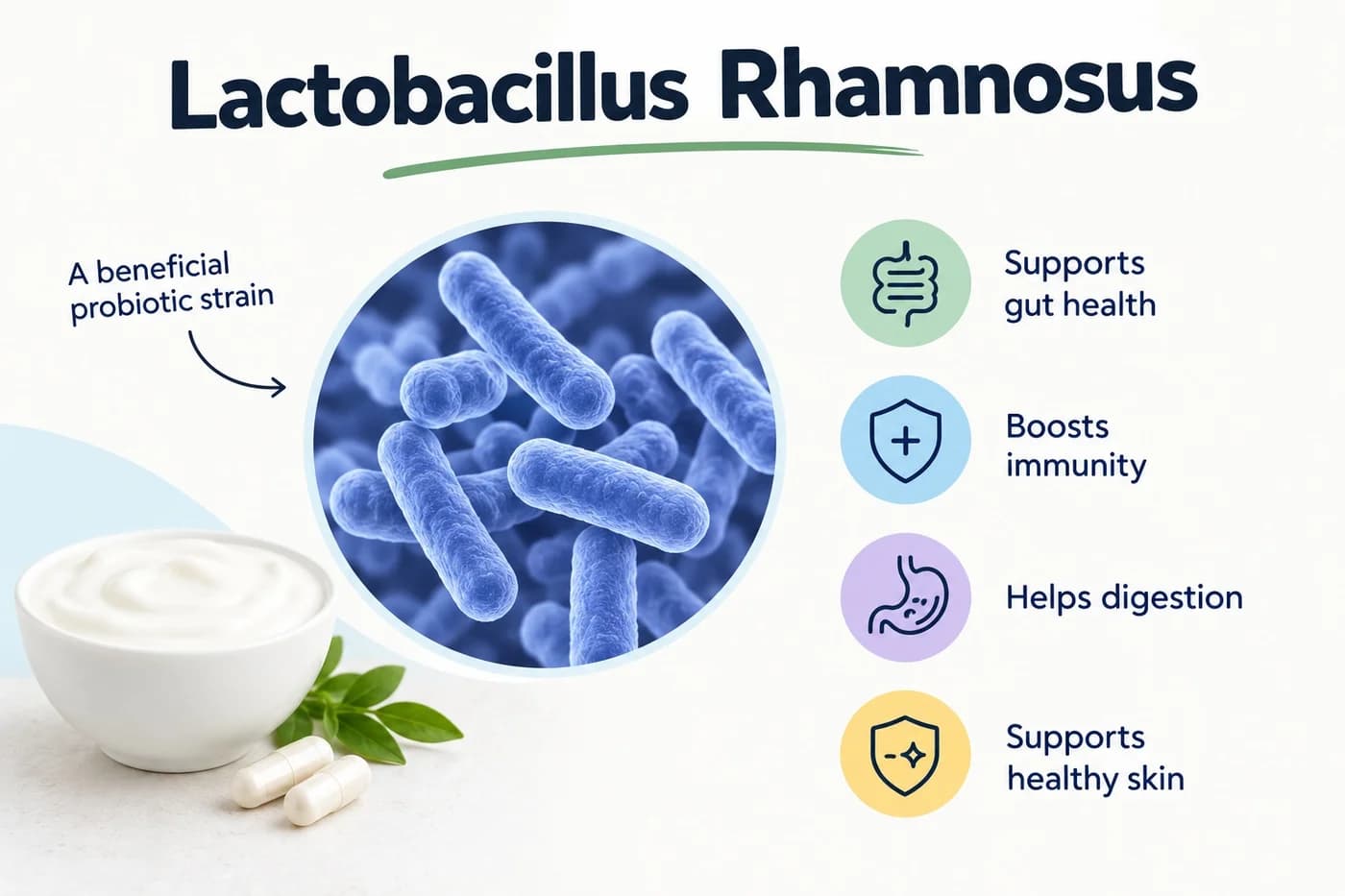
Lactobacillus rhamnosus is a bacterium used in some probiotic foods and supplements. Its usefulness depends on the strain and the reason for taking it. Certain strains have been studied for particular digestive problems, but that does not make every product useful for everyone. The most helpful question is what you want it to do, rather than how many billions of bacteria a capsule promises.
Why the letters after the name matter
You may now see the name Lacticaseibacillus rhamnosus. This reflects a scientific reclassification; older research and many products still use Lactobacillus. Both names can refer to the same species.
A strain is a more specific identity within that species. Lactobacillus rhamnosus GG, often shortened to LGG, is one well-studied example. Evidence about GG cannot automatically be applied to another strain or a mixture that happens to contain the same species.
Think of the full name as part of identifying the treatment. A large number on the front of a bottle does not tell you whether the organisms inside were studied for your concern.
Where it may be useful
Some research supports particular probiotics, including LGG in certain settings, for reducing the chance of diarrhoea associated with antibiotics. Results depend on the person, antibiotic, timing and preparation. This is a possible additional measure, not a reason to take probiotics whenever any medicine is prescribed.
Treatment of diarrhoea that has already started is a separate question. Trials have produced mixed findings, and some large studies of childhood gastroenteritis have not found a useful benefit from LGG. A positive result for prevention does not establish treatment for every stomach infection.
Claims about eczema, weight loss, immunity and a complete gut reset need similar care. Research on one outcome does not prove all the others. You should not expect a capsule to treat unexplained digestive symptoms simply because the gut contains bacteria.
During diarrhoea, fluids come first
If someone has diarrhoea, preventing dehydration is more urgent than choosing a probiotic. Use oral rehydration solution when appropriate, prepared with the exact amount of safe water stated on the sachet. Continue suitable food and follow the care plan for the illness.
Seek prompt care for blood in stool, severe pain, high fever, inability to keep fluids down, marked weakness or signs of dehydration. Babies, older adults and people with significant illness can become unwell more quickly.
Do not delay assessment while trying successive probiotic brands. Persistent diarrhoea during or after antibiotics can need specific investigation and treatment. A probiotic does not rule out a serious cause or make it safe to continue without review.
Is ordinary curd the same thing?
Curd can be a useful food, providing nourishment and, depending on preparation, live cultures. It is not automatically a source of LGG. Homemade fermentation does not guarantee a particular strain or a consistent amount.
Similarly, idli batter, dosa, pickles and other fermented foods should not all be called equivalent probiotic treatments. Cooking changes whether organisms remain alive, while some products are preserved or processed after fermentation.
Enjoy curd because it suits your meals. A bowl alongside khichdi or a cucumber raita does not need to carry a medical promise. When a specific probiotic is being used for a defined purpose, ordinary fermented food is not a measured substitute.
A bigger bacterial count is not always better
CFU stands for colony-forming units, a way of expressing the number of viable microorganisms. It is not a score for overall quality. Fifty billion of an unhelpful strain need not outperform a smaller amount of one studied for the relevant problem.
There is no single daily dose of L. rhamnosus suitable for every adult and child. The strain, preparation and reason for use determine the plan. Avoid copying a dose from a trial or giving an adult capsule to a child because it sounds similar.
If a course has been recommended, establish its intended duration. Continuing indefinitely because you fear your gut will become dependent is not a good reason to keep buying it. Benefits are not guaranteed to persist after stopping, and permanent colonisation should not be assumed.
Make a prescribed course easy to follow
Keep the product under its stated storage conditions. Some preparations need refrigeration and others do not; leaving a heat-sensitive sachet in a hot car can undermine what you intended to take.
Do not stir live cultures into boiling tea or very hot food. If using a sachet with food is permitted, use the suitable temperature and method given for that preparation.
With antibiotics, timing may need to be separated for a bacterial probiotic. Use the schedule provided for the actual product and medicine instead of assuming they should be swallowed together. One clear schedule is more useful than adding several overlapping gut supplements.
Who should avoid casual self-treatment?
Mild gas or bloating can occur. Severe or worsening symptoms should not be described as a necessary cleansing phase.
Live microorganisms require particular caution in people who are critically ill, severely immunocompromised or have a central venous catheter. Rare serious infections have been reported in vulnerable patients. Probiotic use for premature infants belongs within specialist care, not a home supplement experiment.
For a generally healthy person with comfortable digestion, there is no need to manufacture a reason to take LGG. Regular meals with pulses, vegetables, fruit and whole grains are a practical way to support nutrition. If a probiotic has a useful role, it should solve a specific problem within that wider routine.
Editorial sources
Frequently Asked Questions
Related Articles

Lactobacillus: What It Is, Its New Names and Where It Is Found
Lactobacillus is a large, varied group of bacteria, not one supplement. Learn what the name means, why labels changed and where it occurs in food.


Probiotics: Strains, Uses and How to Choose One
A practical guide to probiotic supplements: why strains matter, where evidence is strongest, how to read labels and when to be cautious.

Prebiotics and Probiotics: Differences, Food Sources and Safety
Prebiotics are substrates selectively used by microorganisms, while probiotics are live microorganisms that provide a demonstrated health benefit…
Probiotic Foods: Real Indian Sources and How Much You Need
Probiotic foods contain live, beneficial bacteria that support your gut when eaten regularly — dahi, buttermilk, and fermented pickles are everyday.