
What Is Sleep Divorce? Should Couples Sleep Separately?
Sleep divorce sounds dramatic, but for most couples who try it, it's a practical decision, not a relationship red flag. See why more couples are sleeping apart, and how to do it well.
Key Takeaways
- States surveys cite one in four to one in three couples sleeping apart at least some nights.
- States the practice has become less taboo to discuss openly over the past decade.
- Lists mismatched chronotypes and differing temperature preferences as common specific triggers.
- States the sleep benefit comes from removing the specific disruption, not sleeping apart itself.
- Recommends trying snoring remedies first if snoring is the specific reason it’s being considered.
- States many couples land on a middle ground rather than fully separate bedrooms every night.
Sleep divorce is the practice of couples choosing to sleep in separate beds or separate rooms, not as a sign of relationship trouble but as a deliberate decision to protect both partners’ sleep quality when sharing a bed consistently disrupts it. The term sounds more dramatic than the reality usually is — for most couples who try it, it’s a practical fix, not an emotional statement.
Sleep divorce meaning: it’s not what it sounds like
Despite the dramatic-sounding name, sleep divorce meaning has nothing to do with the state of a relationship — it’s simply an arrangement where partners sleep apart some or all nights, usually because of mismatched schedules, snoring, restlessness, temperature preferences, or different sleep timings, while remaining just as committed a couple during waking hours.
How common is sleep divorce, really?
Surveys from sleep foundations and mattress industry research in several countries have found that a meaningful share of couples — often cited in the range of one in four to one in three — sleep apart at least some nights, a number that’s risen over the past decade as the topic has become less taboo to discuss openly. The actual practice is likely even more common than reported, since many couples who do this don’t necessarily label it “sleep divorce” or think of it as a distinct decision — it’s simply what evolved naturally after one too many disrupted nights.
Why couples choose sleep divorce
- Snoring or sleep apnea in one partner disrupting the other’s sleep, sometimes for years
- Mismatched chronotypes — one partner is a natural early riser, the other a night owl, and forcing alignment costs both of them sleep
- Different temperature preferences, which are surprisingly hard to compromise on within one bed and one blanket
- Restlessness or frequent waking from one partner disturbing the other’s sleep cycle
- Shift work, where one partner’s schedule simply doesn’t overlap with a shared sleep window
If snoring is the specific reason a sleep divorce is on the table, it’s worth trying how to stop snoring remedies first — sometimes the disruption can be resolved without needing to sleep apart at all.
Does sleep divorce actually improve sleep quality?
For couples whose sleep was genuinely being disrupted by their partner, yes — studies and surveys consistently show people report better sleep quality and duration when the specific disruption (snoring, mismatched schedules, restlessness) is removed. The benefit isn’t from sleeping apart itself, but from removing whatever was interrupting sleep in the first place.
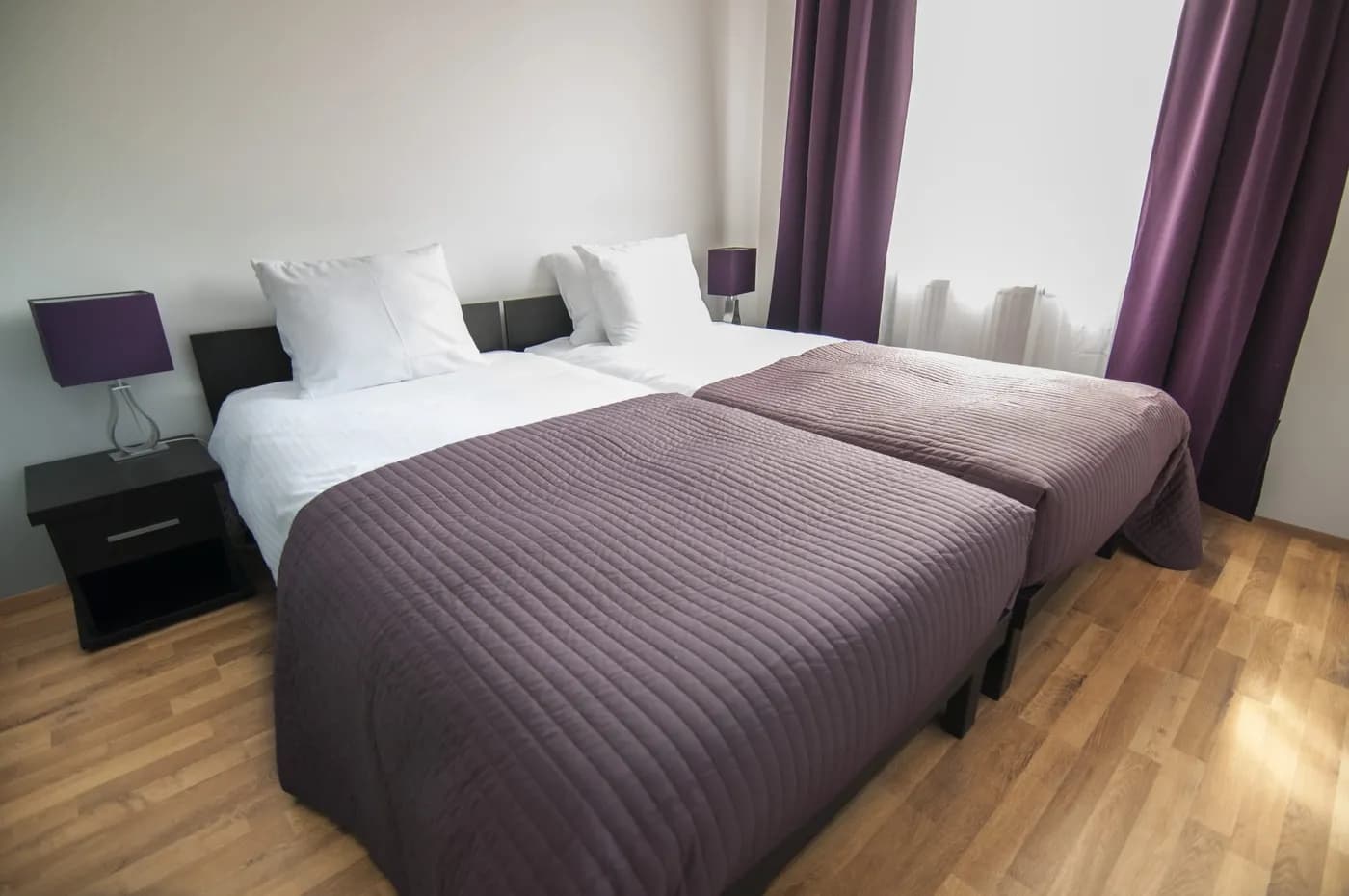
Separate twin beds representing a sleep divorce arrangement
Different ways couples structure a sleep divorce
Sleep divorce doesn’t have to mean fully separate bedrooms every single night — many couples land on a middle ground that still counts as the arrangement in practice:
- Separate rooms full-time — the most complete version, usually chosen when the disruption (severe snoring, very different schedules) is significant and ongoing
- Separate beds, same room — allows some shared presence and pre-sleep conversation while removing the physical disruption of sharing a mattress
- Occasional sleep divorce — separate sleeping only on specific nights (before an important workday, during illness, or when one partner is on a late shift), with shared sleep the rest of the time
- A “starting together, ending separately” pattern — falling asleep together for closeness, then one partner moving to another room later in the night once truly asleep
Couples who frame it as flexible rather than an all-or-nothing decision often find it easier to adopt without it feeling like a loss.
Talking to a partner about sleep divorce
Because of the name’s dramatic connotation, bringing up sleep divorce can feel more loaded than it needs to be. Framing the conversation around the actual goal — “I want us both to sleep better” rather than anything about wanting distance — tends to land better than leading with the logistics. It also helps to propose it as a trial rather than a permanent change, since many couples find the idea easier to accept once they can frame it as reversible rather than a fixed new arrangement.
Does sleeping separately hurt the relationship?
Not inherently — many couples who choose sleep divorce report that better-rested, less irritable versions of themselves during waking hours actually improve the relationship, offsetting any loss of together-in-bed time. That said, it’s worth being intentional about preserving other forms of closeness and connection if sleep becomes fully separate, since the physical closeness of shared sleep does matter to some couples specifically, even if it costs them sleep quality.
Frequently Asked Questions
Related Articles

Mudra for Sleep (Shakti Mudra): Steps, Benefits, and Precautions
Shakti Mudra and Prithvi Mudra activate the parasympathetic nervous system and establish a conditioned pre-sleep signal when held for 10-15 minutes before

Mudra for Insomnia: Hand Gestures That Support Better Sleep
Each finger represents one of the five elements, and joining specific fingers is said to balance these elements and shift the body toward calm before