Sleep Music and Binaural Beats: Do They Actually Help You Sleep?
Sleep music and binaural beats work through different mechanisms than most people assume, and the evidence behind them is more mixed than the marketing suggests. See what research actually supports.
Key Takeaways
- States effective sleep music sits around 60-80 beats per minute, close to a resting heart rate.
- States binaural beats research remains limited and mixed despite plausible brainwave claims.
- Names late-night ragas like Yaman or Bhairavi as traditional Indian pre-sleep listening.
- States the goal of sleep music is to fade into the background, not hold active attention.
- States slow music’s heart-rate and cortisol-lowering effect is well established for relaxation.
- Recommends pairing music with a spoken practice like meditation if sound alone isn’t enough.
Sleep music works differently from white noise or a meditation track — instead of masking sound or guiding your attention with words, it uses slow tempo, low pitch, and simple, repetitive melody to gently lower heart rate and signal to your body that it’s time to relax.
What makes something work as sleep music
Effective sleep music tends to share a few traits: a tempo around 60-80 beats per minute (close to a resting heart rate), minimal sudden changes in volume or melody, and simple, unresolved musical phrases that don’t demand active listening. Deep sleep music built specifically for this purpose is usually instrumental, ambient, and deliberately unmemorable — the goal is to fade into the background of your attention, not hold it.
Relaxing sleep music vs. binaural beats sleep tracks
- Relaxing sleep music — ambient, instrumental tracks with slow tempo and simple melody, the most broadly accessible option
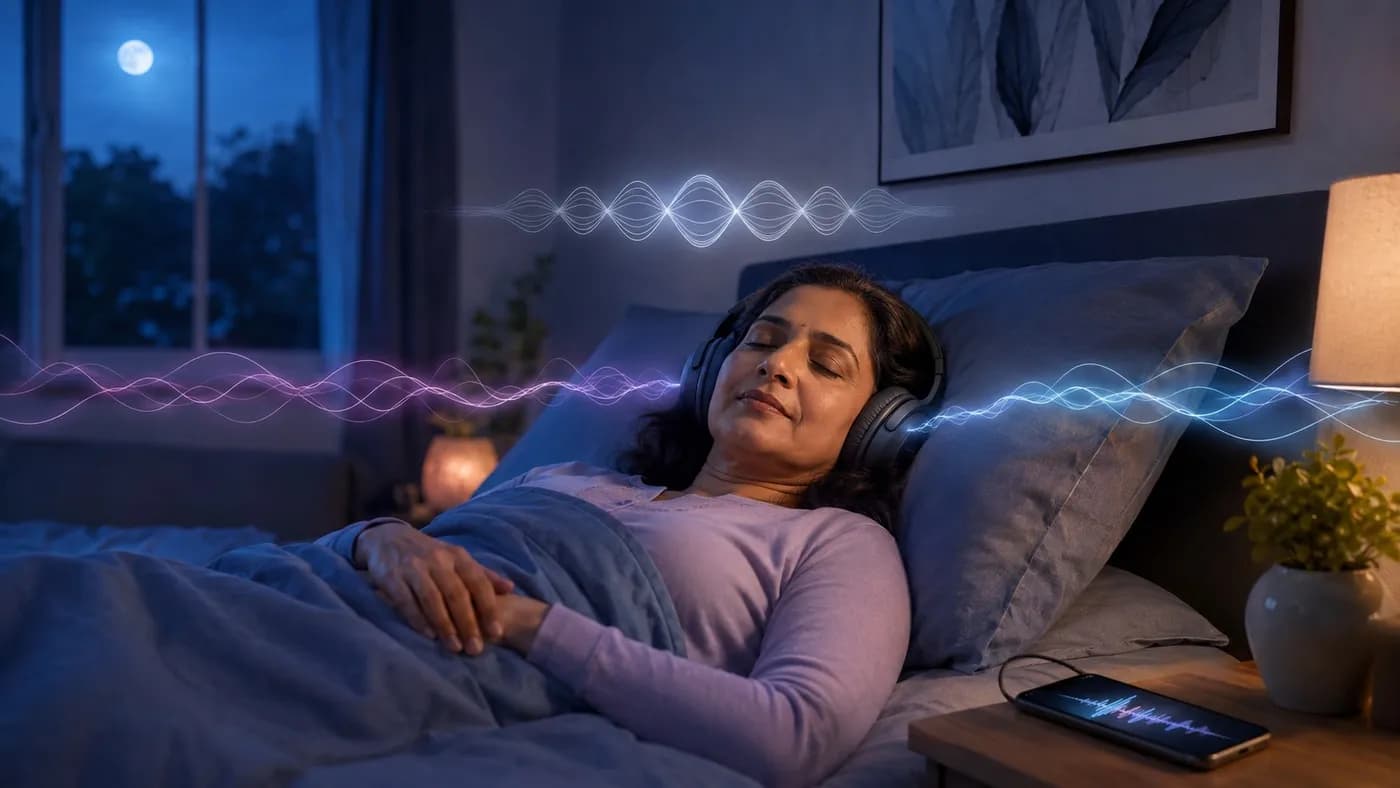
- Binaural beats sleep tracks — two slightly different frequencies played separately in each ear, which the brain perceives as a single pulsing tone; some research suggests certain frequency ranges may support the brainwave patterns associated with deep sleep, though the evidence is still limited and mixed
- Nature-based sleep sounds — rain, ocean waves, or forest sounds, often layered under either of the above
None of these has strong evidence of being clearly superior to the others — the calming effect depends heavily on personal preference and what your brain associates with rest.
Does sleep music actually work, or is it mostly personal preference?
There’s a real physiological basis for slow music lowering heart rate and cortisol, which is well established for relaxation generally. Whether it specifically improves measurable sleep quality is less conclusively proven — much of the research is small-scale, and binaural beats sleep studies in particular have shown mixed results. That said, the mechanism is plausible and the downside risk is essentially zero, which is why it’s a reasonable thing to try even without airtight proof. If sound alone isn’t enough for you, pairing sleep music with a spoken practice like meditation for sleep gives your mind something to follow, not just something to hear.
Indian classical and devotional music as sleep music
Outside the ambient-instrumental genre most Western sleep music falls into, Indian classical ragas — particularly late-night ragas like Yaman or Bhairavi — and slow devotional bhajans are traditionally used as calming pre-sleep listening in many Indian households, long before “sleep music” became a marketed category. Ragas built around specific time-of-day associations often share the same core traits that make Western sleep music effective: slow tempo, minimal sudden shifts, and a meditative, unresolved quality. For listeners who find generic ambient tracks unfamiliar or unengaging, a slow raga or bhajan can work just as well as sleep music, since the calming mechanism is really about tempo and predictability rather than any specific genre.
Building a sleep music playlist that actually works for you
Rather than relying on a single track, most people do better with a playlist of similar-feeling songs set to fade out or loop quietly, avoiding the jarring silence or algorithm-selected next track that can follow a single song ending. A playlist built entirely from one genre or artist tends to work better than a shuffled mix, since consistency in tempo and mood is what keeps it working as background rather than something your brain keeps re-evaluating each time the sound changes. Streaming services now offer curated “sleep” or “deep focus” playlists that are a reasonable starting point, though building your own from tracks you’ve personally found calming tends to hold your attention less than an unfamiliar algorithmic mix would.
How to use sleep music without it disrupting sleep further
- Use a sleep timer rather than letting music play all night, since research suggests continuous sound through deep sleep stages may cause subtle disruption for some people
- Keep volume low — background level, not something you’d actively listen to while awake
- Avoid music with lyrics, which tends to engage the language-processing parts of the brain more than instrumental sleep music does
- If binaural beats sleep tracks give you a headache or feel unpleasant, stop — not everyone responds the same way to the dual-frequency effect
Frequently Asked Questions
Related Articles

Why Is Sleep Important? Benefits for Your Body and Mind
Why is sleep important? It's an active process your body uses for memory, immune function and emotional regulation, not just rest. See what actually happens overnight, and why cutting it short costs more than it seems to save.

Mudra for Insomnia: Hand Gestures That Support Better Sleep
Each finger represents one of the five elements, and joining specific fingers is said to balance these elements and shift the body toward calm before