
12-3-30 Workout: Does This Walking Trend Work?
12% incline, 3 mph, 30 minutes. The 12-3-30 treadmill workout went viral for a reason, but it isn't for everyone. Here's what research says and how to build up safely.
Key Takeaways
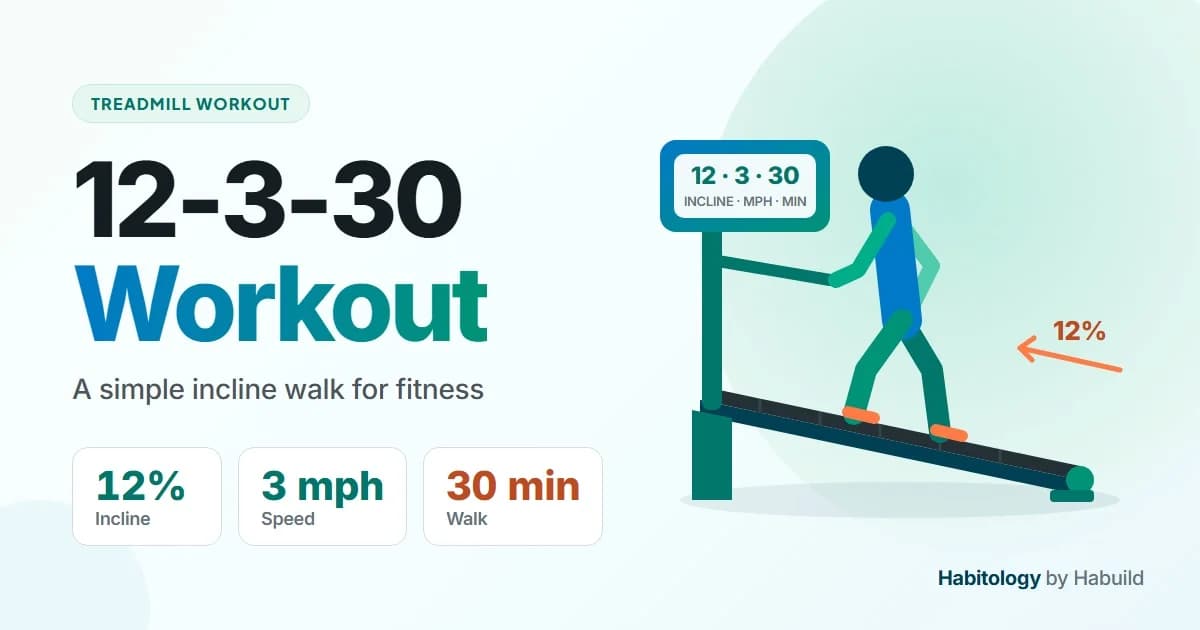
- 12-3-30 means walking on a treadmill at a 12% incline and 3 mph (4.8 km/h) for 30 minutes.
- It was first shared by Lauren Giraldo on YouTube in 2019 and later went viral on TikTok.
- A 2025 study found it used energy more slowly than running but burned a higher share of fat.
- It's tough for beginners, so start with a lower incline and a shorter time.
- Avoid holding the handrails, and check with a doctor if you have heart or joint issues.
What Is the 12-3-30 Workout?
The 12-3-30 workout is a simple treadmill routine built around three numbers. You set the treadmill incline to 12%, set the speed to 3 miles per hour, which is about 4.8 km/h, and walk for 30 minutes. That's the whole workout. There's no running, no complicated intervals and no equipment beyond the treadmill itself.
It sounds easy on paper, but walking steadily uphill at that steepness for half an hour is much harder than it sounds. Most people find their heart rate rises quickly, their breathing becomes heavy and their calves and glutes start to burn within the first few minutes. That challenge, combined with its simplicity, is a big part of why it caught on.
Where Did It Come From?
According to Cleveland Clinic, the workout was first shared by Lauren Giraldo on YouTube in 2019 and became a TikTok trend about a year later. She has said that it helped her lose weight, which inspired many others to try it. But that's a personal story rather than research. The routine wasn't designed or tested by scientists before it went viral, so it's worth looking at what studies have found since.
What Does the Research Say?
A small 2025 study from the University of Nevada, Las Vegas, published in the International Journal of Exercise Science, compared the 12-3-30 workout with self-paced treadmill running in 16 adults. To make the comparison fair, the researchers matched the two sessions for the total amount of energy used.
They found that 12-3-30 took longer to burn the same amount of energy as running, and used energy at a lower rate per minute. However, it used a higher percentage of fat and a lower percentage of carbohydrate for fuel.
So 12-3-30 isn't a shortcut to burning more calories than running. What it does offer is a demanding, low-impact workout that relies relatively more on fat for fuel. The study was small, though, so more research is needed before drawing firm conclusions.
Benefits of 12-3-30
The biggest advantage of 12-3-30 is that it's lower impact than running. You keep one foot on the belt at all times, which is gentler on the knees and ankles for many people. At the same time, it's a real challenge: steep incline walking raises your heart rate and breathing much more than walking on the flat.
Walking uphill also puts more demand on the back of your legs, especially your calves, hamstrings and glutes, so many people feel it in muscles that ordinary walking barely touches. And because the routine is just three numbers, it's easy to remember and repeat without any planning.
Downsides and Risks

The same steepness that makes 12-3-30 effective also makes it very hard for beginners. Jumping straight into a 12% incline for 30 minutes can be exhausting and discouraging. Steep inclines also stretch and load the calves and Achilles tendons, which can lead to soreness or strain if you do too much too soon.
Posture is another concern. Leaning forward too much to cope with the slope can strain your lower back, and gripping the handrails takes weight off your legs, reduces the effort and encourages poor posture. Finally, the workout isn't suitable for everyone. People with heart conditions, high blood pressure, balance problems or ankle, knee or back issues should get medical advice before trying it.
How to Build Up to 12-3-30
Start with a lower incline and work up over several weeks:
- Weeks 1 and 2: 5% incline, 3 mph (4.8 km/h), 15 to 20 minutes
- Weeks 3 and 4: 7 to 8% incline, 20 to 25 minutes
- Weeks 5 and 6: 10% incline, 25 to 30 minutes
- Week 7 onwards: 12% incline, 30 minutes
You can also lower the speed while keeping the incline. If you can't talk in short sentences, slow down or reduce the incline.
Tips for Good Form
Stand tall and keep your chest up, with only a slight forward lean that comes from your ankles rather than your waist. Let your arms swing naturally instead of holding the rails, and take shorter steps on the steep incline. Warm up with about 5 minutes on a flat setting before you raise the incline, cool down the same way at the end, and stretch your calves afterwards.
No Treadmill? Try These Instead
You don't need a treadmill to get a similar challenge. A steady uphill road or path, walked at a brisk pace, works your legs and lungs in much the same way. Climbing stairs at a steady pace, holding the handrail if you need to, is another option. You can read more in our guide to incline walking benefits. And if hills aren't available, simply walking briskly on the flat for longer can use a similar amount of energy.
Is 12-3-30 Good for Weight Loss?
It can support weight loss because it's demanding and easy to repeat. But like any workout, it only helps if your overall diet supports it. Running for the same time burns more energy, while 12-3-30 is gentler on the joints. Choose the one you can do safely and regularly. Habuild's live sessions include walking along with exercises, yoga and breathing, so you can stay active without a treadmill, and the Habuild app's Walk Daily habit helps you track your walks.
Editorial Sources
- Cleveland Clinic – The 12-3-30 workout
- Wong et al. – Comparing the metabolic responses between the 12-3-30 treadmill workout and self-paced running, International Journal of Exercise Science (2025)
- WHO Europe – Physical activity fact sheet
Health Disclaimer
This article is for general information only and is not medical advice. Please consult a doctor before starting incline workouts, especially if you have a heart condition, high blood pressure or joint problems.
Frequently Asked Questions
Related Articles
Incline Walking Benefits: Why Walking Uphill Changes Everything
Raising the gradient on a walk — treadmill or hilly path — makes your heart work harder and burns significantly more energy than flat ground. See why.

Beginner Fat Loss Workout: The Complete Guide to Getting Started at Home
A beginner fat loss workout doesn't need to be complicated to be effective — the right starting point, done consistently, makes all the difference. See the benefits, best exercises, and common mistakes.

10 Benefits of Walking 30 Minutes a Day for Health, Fitness, and Weight Loss
The trick isn't to walk longer, it's to walk daily, at the right pace, with consistency over months. See all 10 benefits for health, fitness, and weight loss.


Walking Exercise: a Complete Guide to Walking Programs, Treadmill Plans, and Daily Workouts
The difference between a casual stroll and a transformative walking routine isn't speed or distance — it's intentional pacing, consistent volume, and progression. See the complete guide to programs and plans.