
How to Fix Rounded Shoulders: Exercises, Causes & a Routine That Works
Rounded shoulders come from tight chest muscles and a weak mid-back — wall angels, face pulls, and band pull-aparts, done daily over 6-12 weeks, ease the.

Key Takeaways
- Occurs when tight chest muscles and a weak mid-back pull shoulders forward of the midline.
- Wall angels, face pulls, and band pull-aparts are the core corrective exercises.
- Compresses the chest cavity, restricting how fully the lungs can expand.
- Visible postural changes typically follow 6-12 weeks of consistent, targeted practice.
- Strengthens the mid-back, rear deltoids, and rhomboids – muscles rarely trained deliberately.
Rounded shoulders occur when the shoulders drift forward of the body’s midline due to tight chest muscles and a weak mid-back. Learning how to fix rounded shoulders requires consistent corrective exercises — including wall angels, face pulls, and band pull-aparts — paired with daily practice over 6–12 weeks to see lasting postural change.
If you spend long hours at a desk, on your phone, or simply never had anyone correct your posture growing up, you’ve likely noticed your shoulders creeping forward over time. Learning how to fix rounded shoulders isn’t about one magic stretch — it’s about consistently addressing muscle imbalances through targeted movement. This guide walks you through the causes, the most effective exercises, and a practical routine you can start today.
6 Key Benefits of Correcting Rounded Shoulders
- Reduces Neck and Upper Back Pain When your shoulders roll forward, the muscles around your neck and upper back are constantly under strain. Gradually correcting this alignment may ease that persistent tension you feel by end of day.
- Improves Breathing Capacity Rounded shoulders compress the chest cavity, restricting how fully your lungs can expand. Opening the chest and pulling the shoulders back supports easier, deeper breathing over time.
- Boosts Confidence and Presence Posture affects how you carry yourself — and how others perceive you. Standing taller with open shoulders can shift your energy and confidence in everyday interactions.
- Enhances Athletic Performance Whether you run, lift, or do yoga, correct shoulder alignment improves the efficiency of nearly every upper-body movement. Poor posture bleeds into poor mechanics across the board.
- Supports Long-Term Joint Health Chronically rounded shoulders place uneven load on your shoulder joints and rotator cuff muscles. Working toward better alignment may help reduce wear on these structures over the years.
- Strengthens the Posterior Chain Fixing rounded shoulders requires activating the mid-back, rear deltoids, and rhomboids — muscles most people rarely target deliberately. Building these muscles also carries over to upper body strength training and overall functional fitness.
How to Get Started with Rounded Shoulder Correction
What You Need to Begin
You need almost nothing to start. A yoga mat or a firm surface is enough for most of the foundational exercises below. A resistance band is helpful for a few movements but entirely optional — bodyweight alone goes a long way. No gym membership required.
Setting Realistic Goals
Rounded shoulders develop over months or years, so they won’t reverse in a week. Aim to practise targeted movements at least 4–5 days per week. You’ll likely notice reduced discomfort within 2–4 weeks, and visible postural changes typically follow with consistent effort over 6–12 weeks. Track small wins: Does your neck feel less stiff after a session? Are you catching yourself sitting straighter during the day?
Start with the Basics
Don’t jump into advanced strengthening exercises before you can feel your shoulder blades moving. Begin by practising scapular awareness — sitting upright and gently squeezing your shoulder blades together for 5 seconds at a time. This simple activation drill teaches your brain and muscles to coordinate before you layer on load.
Best Exercises to Fix Rounded Shoulders
These are the most effective movements for addressing the muscle imbalances behind rounded shoulders. Pair them with consistent daily practice for best results. You may also find value in exploring a broader set of strength training exercises that reinforce proper posture throughout the body.
Wall Angels
Stand with your back flat against a wall, feet a few inches away. Press your lower back, upper back, and the backs of your arms against the wall. Slowly slide your arms upward into a Y shape and back down. This retrains the overhead shoulder path with immediate feedback from the wall. Do 3 sets of 10 reps.
Band Pull-Aparts
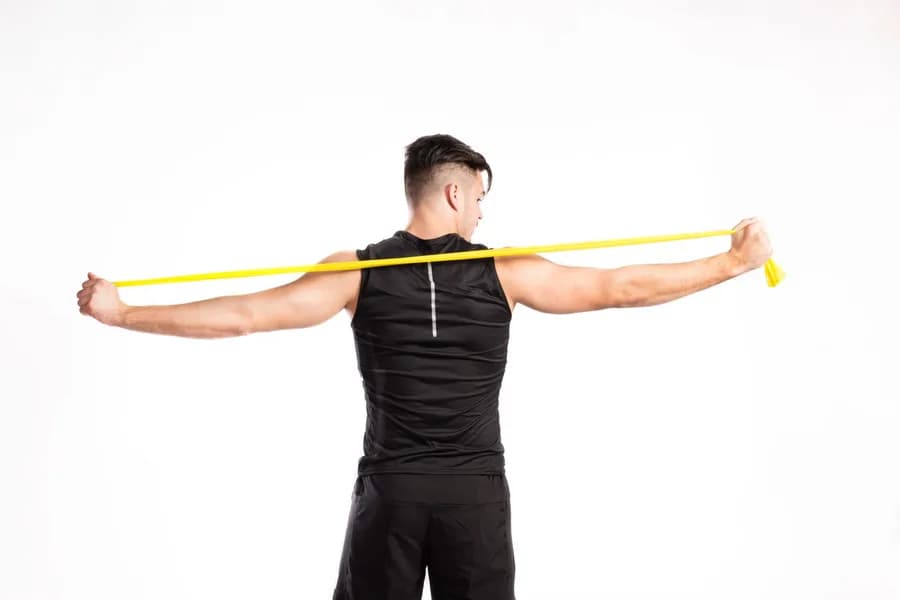
Hold a resistance band or a towel at shoulder width in front of you. Pull it apart horizontally until your arms are fully extended to the sides, squeezing the shoulder blades together at the end. This directly targets the rear deltoids and rhomboids — the muscles most weakened by rounded shoulders. Do 3 sets of 15 reps.
Face Pulls
Using a resistance band anchored at face height, pull the band toward your face while flaring your elbows out to the sides. Focus on the contraction in the upper back and rear deltoids. This is one of the single best movements for undoing the damage of desk posture. Do 3 sets of 12–15 reps.
Prone Y-T-W Raises
Lie face down on a mat. Lift your arms into a Y shape (overhead), a T shape (out to the sides), and a W shape (bent elbows pulled toward your waist) — holding each for 2–3 seconds. No weight needed initially. These three positions activate the entire posterior shoulder complex. Do 2 sets of 8 reps per position.
Doorway Chest Stretch
Place both forearms on a door frame with elbows at 90 degrees. Gently lean forward until you feel a stretch across the chest and the front of the shoulders. Hold for 30 seconds, 3 times. Tight chest muscles actively pull shoulders forward, so stretching them is just as important as strengthening the back.
Cat-Cow with Shoulder Focus
In the standard cat-cow position on all fours, add an intentional shoulder blade squeeze at the top of the cow (back arched) phase. This integrates spinal mobility with scapular control. You can read more about the benefits of cat-cow pose for the full-body impact of this movement. Do 10 slow cycles.
Scapular Push-Ups
In a plank position with arms straight, allow your shoulder blades to collapse together (without bending the elbows), then actively push the ground away until your upper back rounds slightly upward. This trains serratus anterior — a muscle critical for keeping the shoulder blade correctly seated. Do 3 sets of 10 reps.
Common Mistakes to Avoid
- Poor Form During Exercises Many people do rows, pull-aparts, and face pulls without actually engaging their mid-back — they just move their arms. The movement must come from the shoulder blades, not momentum. Slow down each rep and concentrate on feeling the contraction before adding any resistance.
- Skipping the Warm-Up Cold, tight muscles don’t respond well to corrective work. Spend 5 minutes doing shoulder rolls, thoracic rotations, and light chest openers before your session. Warming up increases blood flow and makes every subsequent exercise more effective.
- Only Stretching Without Strengthening Stretching the chest without building the upper back is like loosening one end of a rope without anchoring the other. You need both: flexibility in the chest and anterior shoulder, and genuine strength in the rhomboids, mid-traps, and rear deltoids. Neglecting strengthening is the single most common reason posture doesn’t improve despite consistent effort.
- Inconsistency Doing a corrective routine once a week produces almost no lasting change. Muscles need regular stimulus to remodel. Aim for daily or near-daily practice — even 10 minutes counts. Think of it less as a workout and more as a daily recalibration.
Who Should Try Rounded Shoulder Correction?
- Beginners If you’ve never done any structured back or posture work, this is an ideal starting point. The exercises above require no equipment and build from very low intensity. Starting here also builds body awareness that makes every other form of training safer and more effective.
- Women Rounded shoulders are extremely common among women — partly from long hours at desks, partly from a fitness culture that historically underemphasised back and upper-body strength. Corrective exercises will not make your shoulders bulky. They’ll improve your posture, reduce tension, and help you feel stronger in everything you do. Female strength training programmes that include postural work are particularly effective for this group.
- Older Adults Postural changes often accelerate with age, partly due to reduced bone density and muscle mass. Gentle corrective exercises can support better alignment and reduce the risk of falls or chronic back discomfort. Always consult your doctor before starting if you have existing neck, shoulder, or spine conditions.
- Working Professionals Eight or more hours at a desk is one of the strongest drivers of rounded shoulders. A 10-minute corrective routine before or after work — or even broken across the day — can meaningfully offset the postural load of screen time. Improved posture also reduces the afternoon fatigue that builds from sustained forward-head and rounded-shoulder positioning.
Build Strength with a Routine That Actually Works
Fixing rounded shoulders isn’t about doing random stretches on a rest day — it’s about consistent, guided practice that targets the right muscles in the right order. With proper support, you can see real postural improvement from home without any special equipment.
What You Get with Habuild’s Strong Everyday Program:
- Daily live guided strength and yoga sessions
- Beginner-to-advanced progression with postural focus
- No-equipment, home-friendly workouts
- Expert guidance to ensure correct form from day one
- Community support to help you stay consistent
If you’ve been looking for a structured strength training programme that includes corrective work alongside real fitness gains, this is a practical place to start.
Start Your Rounded Shoulder Correction Journey
You can also explore strength training for muscle strength if you want to build on your corrective work with a full progressive training plan.
Frequently Asked Questions
Related Articles

How to Fix Fatigue: 7 Practical Ways to Beat Daily Tiredness
Poor sleep, sedentary work, stress, and nutritional gaps are the most common causes of daily fatigue, each with a distinct fix. See 7 practical ways to

Best Exercises for Broad Shoulders
The overhead press, lateral raise, and face pull target all three deltoid heads — front, side, and rear — building visible width within weeks of consistent training. See the full routine.
How to Fix Muscle Imbalances: A Practical Guide
When one side of the body is noticeably stronger or tighter than the other, targeted unilateral training can reduce injury risk and unlock strength progress bilateral exercises can't. See the practical guide.