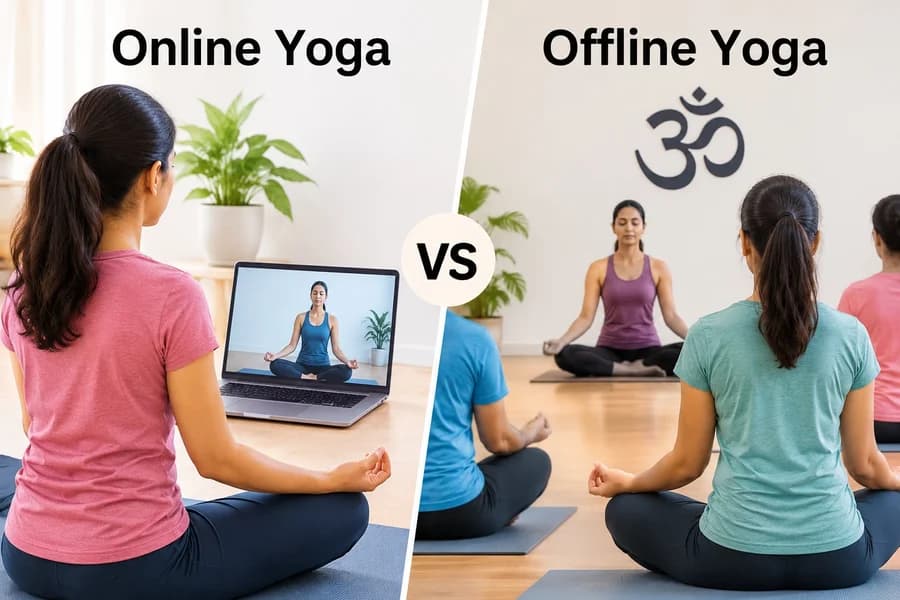
Online vs Offline Yoga Classes: An Honest Comparison
Online vs offline yoga classes: cost, travel, timings and corrections compared to help you choose.
Key Takeaways
- Offline classes give hands-on corrections; online classes give convenience and lower cost.
- The best format is the one you will actually attend week after week.
- Online group classes have no personal corrections, so start gently and use easier options.
- A streak counter, weekly tracker and class reminders help online learners stay regular.
- With an injury, health condition or pregnancy, see a doctor first; in-person guidance may help.
The Short Answer
Neither format is better for everyone. Offline yoga suits people who want a teacher to watch and adjust them, and who can reliably reach a studio. Online yoga suits people who are short on time, live far from a good studio, or want to practise daily at home without a large monthly fee.
The rest of this guide breaks the choice down so you can decide for yourself.
Comparing the Two Formats Point by Point
Travel and time
- Offline: you travel to the studio and back, which can add 30 minutes or more to each class.
- Online: you roll out a mat at home. The time you would spend commuting goes back to your day.
Class timings
- Offline: most studios run a few batches a day, and missing yours often means missing the day.
- Online: larger online programmes can run several batches. Habuild's Yoga Everyday has 6 daily batches: 6:30, 7:30 and 8:30 AM, and 5, 6 and 7 PM IST.
Personal attention
- Offline: a teacher can see your alignment, correct you and suggest props.
- Online group classes: the teacher cannot see or correct each person. You rely on clear spoken instructions and your own body awareness.
This is the biggest trade-off, and it is worth being honest about it.
Cost
- Offline: monthly studio fees vary widely by city and studio, and travel adds to the cost.
- Online: usually cheaper per class. Habuild's membership starts at ₹1,999 for 3 months and includes both yoga and strength classes.
Community and atmosphere
- Offline: you share a room with a small group, which many people enjoy.
- Online: you practise alone at home but as part of a much larger live group. Habuild's yoga classes have a community of 2.1 crore+ members.
Tracking your progress
- Offline: progress is usually tracked informally, or by your teacher.
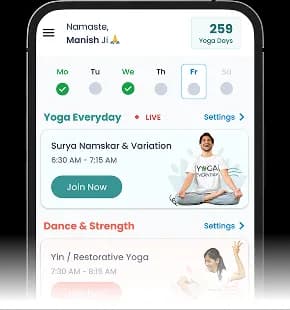
- Online: apps can make your consistency visible. The Habuild app shows a Yoga Days count and a Monday-to-Saturday row with a tick for each day you practise, so you can see at a glance how regular you have been.
When Offline Yoga Is the Better Choice
- You are completely new to yoga and want hands-on help with basic alignment.
- You have an injury, a joint problem or a health condition and need poses adapted for you, after checking with your doctor.
- You are pregnant or have recently given birth and want supervised, specialised classes.
- You find it hard to focus at home because of noise or interruptions.
When Online Yoga Is the Better Choice
- Your work or family schedule changes from day to day.
- The nearest good studio is far away or expensive.
- You want to practise every day rather than two or three times a week.
- You travel often and want the same routine wherever you are.
- You prefer exercising in your own space.
Making Online Yoga Work Without a Teacher Beside You
Because no one is adjusting you in an online class, a few habits make a big difference:
- Set up your space: a mat, a clear area around you and a screen at a distance where you can see the teacher clearly.
- Pick the easier option first for any new pose, then progress slowly over weeks.
- Never push into pain. Mild stretching is normal; sharp pain is a signal to stop.
- Fix your batch time and keep it, so your class becomes part of the day.
- Let the app nudge you: the Habuild app lists your upcoming classes under Today and Calendar, and daily habits such as Walk Daily, Water Reminder and Box Breathing keep you active between sessions.
Research reviewed by the US National Center for Complementary and Integrative Health notes that yoga is generally considered safe for healthy people when practised appropriately, but some poses may need to be modified or avoided by people with certain health conditions. That is another reason to start gently in any unsupervised setting.
What You Get in a Habuild Online Yoga Class
- 45-minute sessions led by Saurabh Bothra, taught in English
- A mix of walking, exercises, yoga and pranayama, with meditation, a music segment or laughter yoga on some days
- A choice of practice on Sundays, at a time that suits you during the day
- A YouTube live link, so you can join from a phone, tablet or laptop
- The Habuild app, with today's classes, your Yoga Days streak and daily habit reminders
Can You Combine Both?
Yes, and for many people this works well. Some people attend an offline class once a week for corrections and practise online on the other days to stay consistent. Others start offline to learn the basics and then move online once they are comfortable with the main poses.
Health Disclaimer
This article is for general information only and is not medical advice. If you have an injury, a health condition or are pregnant, please consult a doctor before choosing any yoga class.
Flexible Batch Timing
Choose morning or evening classes and join the slot that suits your day.
Morning
6:30 AM
7:30 AM
8:30 AM

Evening
5:00 PM
6:00 PM
7:00 PM


Choose Your Membership Plan
Continue after the trial with membership options designed for long-term consistency support.
Continue your habit on the Habuild app
Use the Habuild app for reminders, live access, progress support, and habit tracking.