
Bhunamanasana (Greeting the Earth Pose): Steps, Benefits and Precautions
This deep lateral hip opener and spinal rotation stretch combines the grounding quality of forward folds with the detoxifying benefit of twists. See the steps, benefits, and precautions.

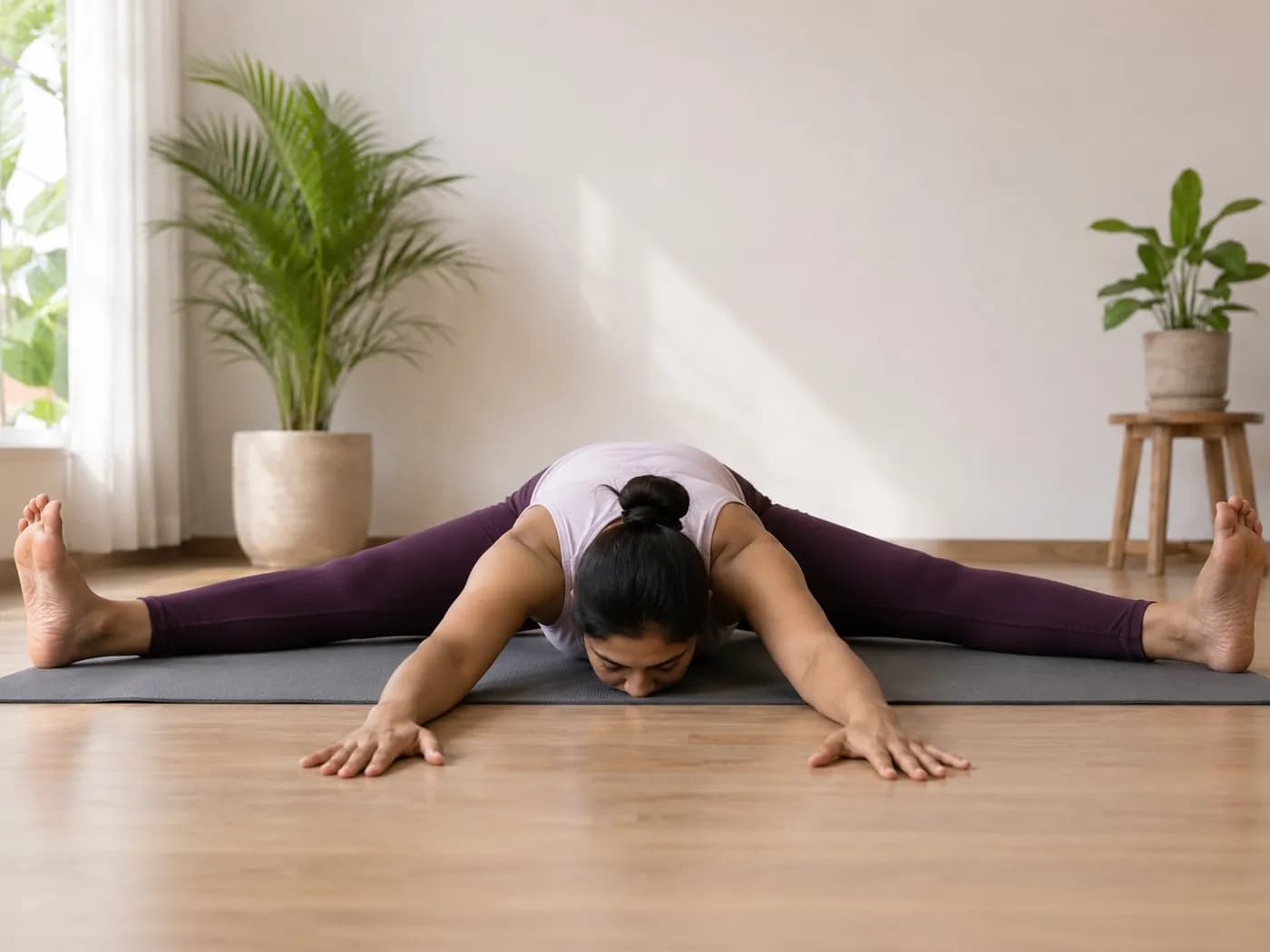
Key Takeaways
- Its name combines bhumi, earth, and namana, salutation, describing a humble bow toward the ground.
- The wide-legged base opens both the inner thighs and adductors in a single passive stretch.
- One arm reaching beneath the body creates thoracic rotation few other prone poses achieve.
- The full expression adds cervical traction as the head lowers completely toward the floor.
- Shares elements with Parivrtta Janu Sirsasana and Thread the Needle in its combined effects.
- Combines a forward fold’s grounding quality with a twist’s detoxifying, organ-massaging benefit.
Bhunamanasana — the Greeting the Earth Pose — is a deep lateral hip opener and spinal rotation stretch that combines the grounding quality of forward folds with the detoxifying benefit of twists. The name comes from Sanskrit: bhumi (earth) and namana (salutation), reflecting the pose’s character of humble, receptive extension toward the ground. This guide covers the complete technique, benefits, preparatory poses and variations.
Bhunamanasana — also called Greeting the Earth Pose or Saluting the Earth Pose — is a deep hip opener, thoracic rotator and nervous system reset in one. The bhunamanasana benefits span from physical hip and inner thigh flexibility to the deep psychological calming that the full surrendered bow toward the earth produces. This complete guide covers bhunamanasana steps, bhunamanasana benefits, common mistakes and every modification from beginner to advanced — so you can begin practising safely from today.
What is Bhunamanasana?
Bhunamanasana — pronounced bhoo-nah-mah-NAH-sah-nah — comes from the Sanskrit bhu (earth), namana (salutation or bowing) and asana (pose). The English translation, Greeting the Earth Pose or Saluting the Earth Pose, captures the essential gesture of the posture: a deep, complete bow toward the ground that combines spinal rotation, hip opening and full surrender of the anterior body. It is one of the most symbolically rich poses in Hatha yoga — an act of humility and gratitude toward the earth that supports all life.
Bhunamanasana is classified as a prone twisting and hip-opening pose that produces a unique combination of effects not easily replicated by other postures. The wide-legged position opens the inner thighs and adductors; the lateral reaching of one arm beneath the body creates a thoracic rotation that few other prone poses achieve; and the complete lowering of the head toward the floor in the full expression creates cervical traction alongside the trunk rotation. The bhunamanasana benefits are therefore spread across multiple body regions simultaneously.
In the broader yoga system, Bhunamanasana is often placed within restorative, hip-opening or spinal health sequences. It shares elements with Parivrtta Janu Sirsasana (Revolved Head-to-Knee), Thread the Needle and Wide-Legged Forward Fold — making it both a stand-alone practice and a complement to these poses within a comprehensive sequence.
Bhunamanasana Benefits
- Physical Benefit 1: Deep Hip and Inner Thigh Opening The wide-legged base of Bhunamanasana provides one of the deepest available passive hip abductor and adductor stretches — loading both the medial and lateral hip structures in the specific combination that wide-legged forward bending produces. The bhunamanasana benefits for hip flexibility are significant for anyone managing tight inner thighs, piriformis tension or restricted hip mobility from prolonged sitting.
- Physical Benefit 2: Thoracic Spinal Rotation and Mobility The reaching of one arm beneath the body creates a thoracic rotation that stretches the costovertebral joints, intercostal muscles and thoracic rotators — the structures that desktop posture chronically restricts. Bhunamanasana benefits for spinal rotation health include the increased range of motion and reduced thoracic stiffness that desk workers specifically require for pain-free daily function.
- Physical Benefit 3: Shoulder and Posterior Chain Release The arm that reaches forward in Bhunamanasana creates the shoulder anterior and superior capsule opening that complements the thoracic rotation, while the wide-legged base simultaneously stretches the hamstrings and posterior hip complex. The combined greeting the earth pose benefits for posterior chain release make it an effective single-pose recovery sequence element.
- Mental and Emotional Benefit 4: Cultivates Humility and Surrender The symbolic gesture of bowing the body fully toward the earth — the traditional meaning of bhunamanasana — cultivates the psychological quality of surrender that anxiety and perfectionism resist. Consistent bhunamanasana practice develops the capacity to let go of control and effort — one of the most important and least physical of the bhunamanasana benefits for mental health.
- Mental and Emotional Benefit 5: Deep Parasympathetic Calming The prone forward-folding position activates the parasympathetic nervous system through the frontal lobe vagal pressure receptors and the diaphragmatic breathing position that the prone orientation supports. Bhunamanasana benefits for nervous system regulation include the deep calming effect that makes it particularly effective as an evening or cool-down pose.
Hip flexor and adductor tightness affects over 70% of desk-based adults — Bhunamanasana produces one of the deepest available passive inner thigh stretches without requiring warm-up equipment.
The thoracic spine should rotate 35–40 degrees to each side. Most desk workers lose up to 50% of this range — Bhunamanasana directly restores costovertebral joint mobility that other poses cannot replicate.
The posterior chain release from Bhunamanasana targets the thoracolumbar fascia and posterior hip complex simultaneously — producing the recovery benefit of multiple separate stretches in a single 5-minute hold.
Research on yoga and psychological flexibility confirms that surrender-based poses and forward folds produce the strongest parasympathetic activation — higher cortisol reduction than effort-based backbends.
Daily yoga reduces cortisol by 15–25% within 8 weeks of consistent practice. Prone poses specifically activate the vagal baroreceptors that directly reduce sympathetic nervous system tone.
How to Do Bhunamanasana — Step-by-Step Instructions
Key Principles
Bhunamanasana requires patience with the hip opening — force should never be applied to the inner thighs or groins. Allow gravity and breath to deepen the pose progressively over the hold duration. The thoracic rotation component should feel releasing, not compressive. Never force the shoulder or neck in the arm reach phase.
Step 1: Starting Position — Wide-Legged Standing
Stand with the feet wide apart — approximately 3-4 feet, or the distance at which the inner thighs feel a moderate stretch without strain. Turn the toes slightly outward (15-20 degrees). Establish equal weight through both feet and stand tall to lengthen the spine before initiating the forward movement.
Step 2: Forward Fold into Wide-Legged Position
Hinge forward from the hips — keeping the spine long — and place both hands on the floor between the feet. Allow the head to hang naturally or rest the crown of the head on the floor if accessible. Breathe slowly here for 3-5 breaths, allowing the inner thighs, hamstrings and lower back to release with each exhalation.
Step 3: Initiate the Spinal Rotation
Keeping the feet planted and the hips level, begin to rotate the thoracic spine to the right — lifting the right arm toward the ceiling if this is the Parivrtta variation, or threading the right arm beneath the body for the classic Bhunamanasana. The rotation should feel like a gentle wringing of the thoracic spine, not a forced movement.
Step 4: Thread the Arm and Lower the Shoulder
Thread the right arm beneath the body, reaching it out to the left — allowing the right shoulder and the right side of the head to lower toward the floor. The right palm faces upward. Allow gravity to draw the shoulder progressively lower without forcing. The left hand remains on the floor for initial stability.
Step 5: Final Position and Hold
In the full expression of Bhunamanasana, the right shoulder and right cheek rest on the floor with the right arm extended to the left — the complete “greeting the earth” gesture. The left arm can remain on the floor for support or reach overhead for additional opening. Hold 5-10 slow breaths, allowing the rotation to deepen passively with each exhalation.
Step 6: How to Come Out of Bhunamanasana
To release, press the left palm into the floor and use the arm to assist lifting the right shoulder back to centre. Return both hands to the floor between the feet and breathe for 2-3 breaths to re-centre before performing the pose on the opposite side. Always perform equal time on both sides to maintain spinal balance.
Breathing in Bhunamanasana
Slow diaphragmatic breathing deepens Bhunamanasana progressively — each inhalation creates space in the thoracic cage; each exhalation allows the shoulder to sink a little closer to the floor and the rotation to naturally deepen. The prone orientation naturally encourages deeper belly breathing. Never hold the breath in this pose.
Preparatory Poses Before Bhunamanasana
- Prasarita Padottanasana (Wide-Legged Forward Fold) — opens the inner thighs and hamstrings in the same base position.
- Thread the Needle — introduces the shoulder-and-arm threading movement in a supported four-point kneeling position.
- Parivritta Trikonasana (Revolved Triangle) — prepares the thoracic rotation in a standing position before the deeper prone version.
- Baddha Konasana (Bound Angle) — opens the hip external rotators required for the wide-legged base.
Variations of Bhunamanasana
Variation 1: Supported Bhunamanasana (Beginner)
Place a folded blanket under the shoulder that is lowering to the floor — reducing the range required for the shoulder contact. This allows the practitioner to experience the thoracic rotation without the full range that forces shoulder discomfort. Difficulty: Beginner
Variation 2: Arm Extended Overhead (Intermediate)
In the final position, extend the free arm overhead along the floor — creating a full lateral body stretch alongside the rotation. This variation increases the stretch along the entire side body and adds the shoulder anterior capsule opening of the overhead reach. Difficulty: Intermediate
Variation 3: Full Bhunamanasana with Cheek on Floor (Advanced)
The classical full expression with the cheek fully on the floor and the threading arm extended as far as possible — requiring significant thoracic rotation range and inner thigh flexibility. This is the complete greeting the earth pose as described in traditional texts. Difficulty: Advanced
Common Mistakes to Avoid in Bhunamanasana
- Mistake 1: Forcing the Shoulder to the Floor Using the free arm or body weight to force the threading shoulder to the floor before adequate rotation range exists creates anterior shoulder impingement. Allow gravity and breath to progressively deepen the shoulder descent over the hold duration.
- Mistake 2: Lifting the Hips During Rotation The hips should remain level throughout Bhunamanasana — rising on the rotating side defeats the thoracic rotation purpose. If the hip lifts, reduce the rotation range until hip stability can be maintained.
- Mistake 3: Unequal Time on Both Sides Spending unequal time on the right and left sides creates the spinal imbalance that Bhunamanasana is intended to address. Always time both sides equally — 5 breaths right, 5 breaths left.
- Mistake 4: Holding the Breath Breath holding prevents the progressive deepening that makes Bhunamanasana effective. Slow continuous breathing is essential for the passive release mechanism that produces the greeting the earth pose benefits.
Who Should Practise Bhunamanasana?
- Those with Upper Back and Thoracic Tension Bhunamanasana is among the most effective available poses for thoracic tension and stiffness from desk work — the rotation directly addresses the costovertebral joint restriction and intercostal tightness that forward-rounded screen posture produces.
- People Seeking Deep Hip Opening The wide-legged base produces a passive inner thigh and hip abductor stretch of significant depth — accessible to practitioners with moderate flexibility and highly beneficial for those managing piriformis syndrome, IT band tightness and hip pain from athletic training.
- Is Bhunamanasana Good for Beginners? Yes — with the supported shoulder variation using a folded blanket, Bhunamanasana is accessible from the early stages of yoga practice. The wide-legged base and passive nature of the pose make it less technically demanding than many other poses at similar depths. Habuild’s live guidance ensures safe positioning from day one.
- Working Professionals with Spinal and Shoulder Tension As a daily 5-minute pose that addresses thoracic rotation restriction, inner thigh tightness and parasympathetic calming simultaneously, Bhunamanasana is one of the most time-efficient available poses for working professionals managing the postural and stress consequences of desk-based work.
Bhunamanasana’s combination of a lateral hip opener and spinal twist is the kind of pose whose benefits layer over time — each session nudges the hips and spine a little further, but the cumulative looseness only shows up with consistent, repeated practice rather than an occasional stretch. Treating it as part of a broader daily flow, rather than a one-off pose, is what actually carries that ease into the rest of your day. Habuild’s Yoga Everyday program weaves poses like this into a structured daily routine.