
Xanthan Gum: What It Does in Food and When It Matters
Understand a common food thickener without turning an ingredient name into a health verdict.

Key Takeaways
- Xanthan gum thickens and stabilises foods.
- It is considered safe in ordinary food amounts.
- Large amounts may cause gas or loose stools.
- Medical thickeners for swallowing need professional guidance.
If you have noticed xanthan gum in a sauce or gluten-free bread, you may wonder why it is there. Usually, it helps the food stay thick, smooth or evenly mixed. The name sounds technical, but its role is practical. You do not need to avoid a food simply because it contains xanthan gum, and you do not need to add it to your diet for health benefits either.
What is xanthan gum?
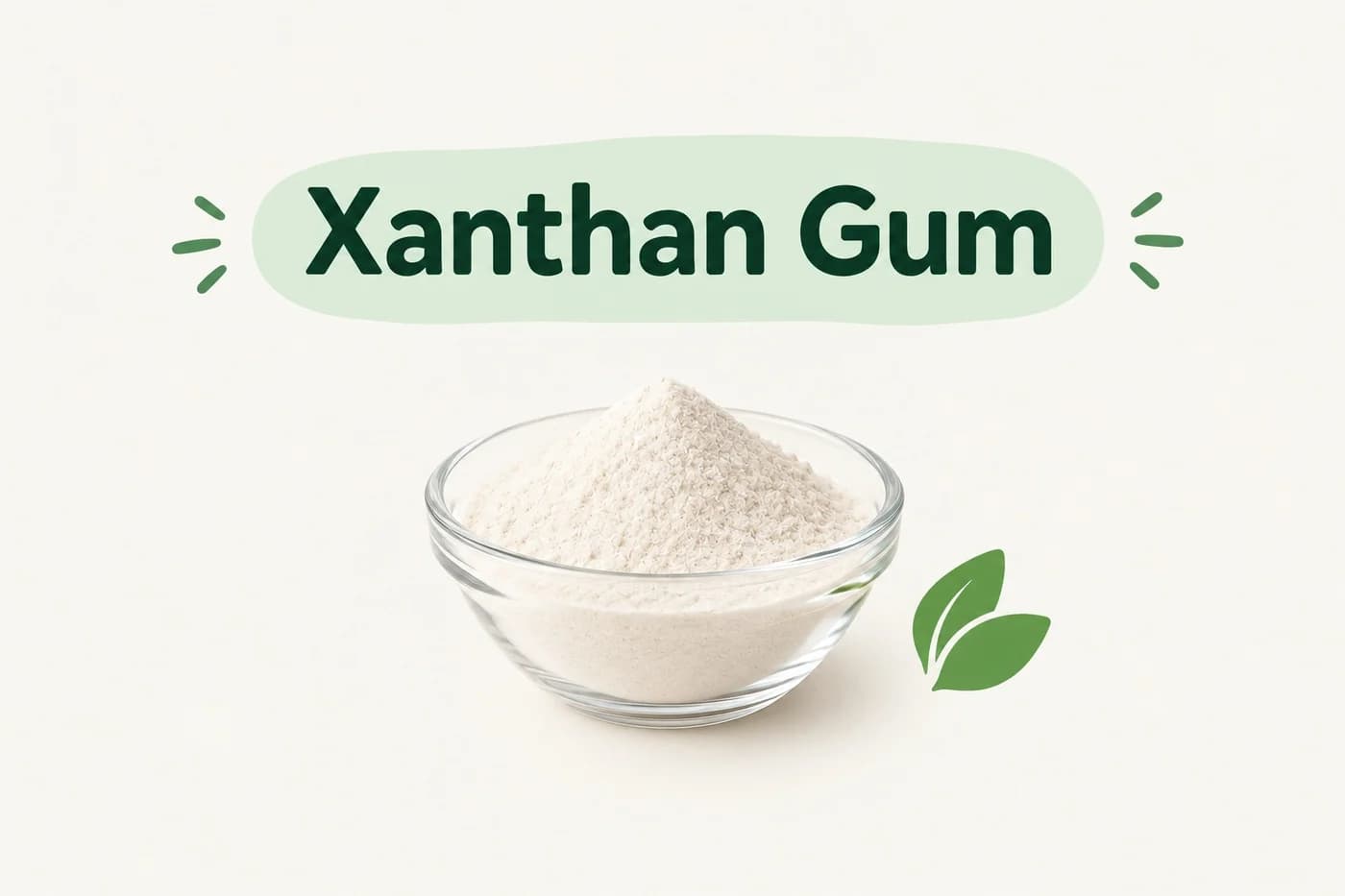
Xanthan gum is a carbohydrate-based substance produced through fermentation and then processed into a powder. It is used in small amounts as a thickener and stabiliser.
It can help a dressing remain mixed, give a sauce body or improve texture in some baked foods. On ingredient lists, it may also appear under the additive number E415.
The production method does not mean the final ingredient is a probiotic food. It is used for its physical effect on the recipe, not to deliver live beneficial bacteria. Fermentation describes how it is made, rather than a guaranteed digestive benefit.
Why a little can make a big difference
Xanthan thickens liquids even at small concentrations. That is useful when a recipe needs a particular texture without adding much bulk.
For example, a dressing may separate without a stabiliser, requiring repeated shaking. A gluten-free batter may need help holding together because it lacks the structure wheat gluten normally supplies.
These are food-preparation functions. They do not tell you whether the finished product has enough protein, fibre or vegetables. A rich sauce remains a rich sauce, and a sweet biscuit remains a sweet biscuit, even when xanthan improves its consistency.
Is it safe in ordinary foods?
Food-safety assessments have considered xanthan gum at permitted food-additive uses. EFSA's general-population evaluation found no safety concern at the assessed exposures, with separate considerations for very young infants and specialised uses.
That is different from saying unlimited amounts of the powder are sensible. An additive used sparingly in a recipe should not be treated as a supplement to take by the spoonful.
For most adults, a small quantity in a prepared food is not a reason for alarm. The nutritional priorities are usually the whole food, the serving and how often you eat it, rather than the presence of one stabiliser.
Can it cause gas or loose stools?

Larger amounts can affect bowel habits and cause digestive discomfort in some people. This is more relevant to concentrated intake than assuming every food containing a trace will cause symptoms.
If several packaged foods appear to bother you, consider their other ingredients too. Sugar alcohols, lactose, large portions and other additions can influence digestion. The last unfamiliar name on the ingredient list is not automatically responsible.
Do not remove a long list of foods based on one episode of bloating. Look for a repeated pattern, and seek assessment for persistent symptoms, blood in stools or unexplained weight loss rather than attributing everything to additives.
Using it in gluten-free baking
Xanthan can help bind some gluten-free mixtures and improve their texture. The useful amount depends on the flour blend and recipe, so follow a tested recipe rather than guessing.
Too much can leave a sticky or gummy result. If a loaf fails, increasing xanthan is not necessarily the answer; water, flour blend, mixing and baking time may all matter.
For someone with coeliac disease, the complete recipe needs to be gluten-free and protected from cross-contact. Xanthan itself does not make an otherwise unsuitable flour blend safe. It is one technical ingredient within a recipe, not a gluten-removal method.
Keep powder handling simple
Measure carefully and add it as the recipe directs, often mixed through dry ingredients or dispersed while blending. Avoid raising a cloud of fine powder close to your face.
Do not taste or swallow spoonfuls of dry thickener. Keep the container closed and out of reach of children or anyone who may mistake it for an ordinary drink powder.
Store it dry according to the product instructions. Buying a small amount is sensible if you bake only occasionally, because very little may be needed in each batch. You do not need a large pantry supply to make a few gluten-free recipes.
Swallowing thickeners have a medical role
Some products used for swallowing difficulties contain gums, including xanthan. They are designed to produce a particular consistency under a swallowing-care plan.
Do not replace a prescribed thickener with kitchen xanthan or decide on a thickness by appearance alone. A drink that looks thicker is not automatically safer for every person with dysphagia.
If you are caring for someone with swallowing difficulty, use the product and method specified for them. Store powders safely, since accidental ingestion of dry thickening powder can be dangerous. The goal is dependable preparation, rather than improvising from a home recipe.
Infants are a separate situation
Warnings about certain commercial thickeners in premature infants should not be turned into a claim that a trace of xanthan in adult food is equally dangerous. Age and clinical setting matter.
At the same time, do not thicken an infant's feeds yourself with xanthan or another kitchen ingredient. Feeding problems in a baby need an appropriate plan from the treating team.
This is one of the few settings where ordinary home-cooking advice is insufficient. A child with a feeding problem is not simply a smaller adult, and product substitutions can change the intended feed.
Does it belong in your shopping decisions?
If you do not have a relevant intolerance or specialised need, xanthan-free is not a dependable shortcut to healthier food. Compare foods according to the purpose they serve in your day.
A sauce with a little stabiliser can still be useful, while an additive-free dessert can still contain a lot of sugar and fat. You can prefer a particular recipe without attaching a medical claim to that preference.
Xanthan gum is best understood as a texture tool. Let it do that job where it is useful, and judge the meal by the food as a whole.
Editorial sources
Frequently Asked Questions
Related Articles
Gluten Free Foods: A Practical Guide for Celiac Disease and Sensitivity
Indian kitchens already have a long list of naturally gluten-free options — rice, millets, pulses, and more — that can form a complete diet without.
What Fortified Means on Food Labels
When a food is fortified, vitamins or minerals have been added to it. That can help, but it does not tell you whether the whole product is a good choice.

Sodium Benzoate: Uses, Safety and Label Reading
This preservative is used mainly in acidic foods and drinks to limit microbial growth. Its presence on a label does not mean a food is toxic.

Gluten Free Desserts: Naturally Gluten-Free Sweets to Try at Home
Indian sweet-making has long relied on rice flour, besan, ragi, and coconut rather than wheat, so many traditional desserts are naturally gluten-free.