
Arjunarishta Benefits: Tradition, Evidence and Heart Health
Arjunarishta has a traditional cardiac role, but research on arjuna extracts does not prove every claim made for the fermented preparation.

Key Takeaways
- Arjunarishta is a fermented tonic, not the same as arjuna bark extract.
- Human evidence for heart benefits is limited.
- Its sugar and alcohol content matter for some people.
- Chest pain or breathlessness needs a doctor, not a tonic.
Arjunarishta is often described as an Ayurvedic heart tonic. That description can sound reassuring, especially if you want something natural for tiredness, palpitations or blood pressure. Yet those concerns have different causes, and a traditional preparation should not be treated as a general answer to all of them.
The most useful distinction is between Arjunarishta itself and research on arjuna bark extracts. They are related, but they are not interchangeable. Understanding that difference helps put the claimed benefits into perspective without dismissing the tradition or overstating what has been proved.
What is Arjunarishta?
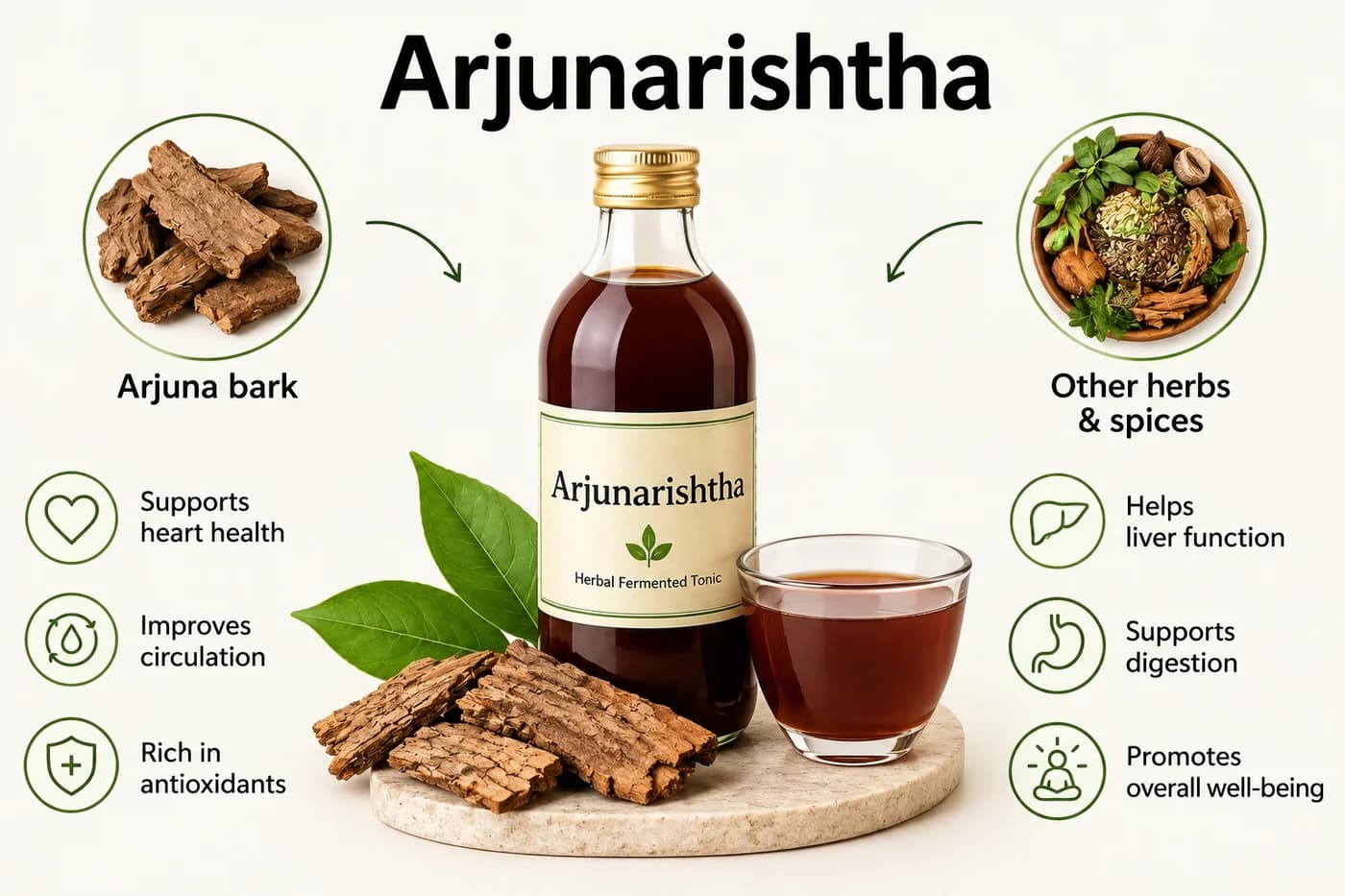
Arjunarishta is a fermented Ayurvedic liquid preparation in which arjuna bark, from Terminalia arjuna, is a principal ingredient. Traditional formulations also use other plant materials and a sugar source involved in fermentation.
It is a medicinal preparation rather than a food, juice or routine hydration drink. Fermentation produces alcohol, so a product described as herbal is not necessarily alcohol-free. The finished liquid may also contain residual sugars.
Arjuna bark powder, a standardised extract capsule and Arjunarishta differ in composition and concentration. You cannot convert a research dose of an extract into spoonfuls of the fermented preparation or assume they have the same effects.
Why is it associated with the heart?
Arjuna bark has a long history of use for cardiac complaints in Ayurveda. Researchers have investigated its constituents and possible effects on blood vessels, oxidative stress and heart function.
This gives a reason to study the plant, but laboratory findings do not establish that a commercial bottle prevents heart attacks or clears blocked arteries. The outcome that matters to a person is whether a preparation improves symptoms or health safely in well-designed human studies.
Traditional descriptions can also use language that does not map neatly onto a modern diagnosis. A claim about strengthening the heart should therefore not be read as proof of a specific effect on cholesterol, rhythm or pumping function.
What do human studies show?
Some clinical studies have explored arjuna extracts as an addition to conventional treatment. The results are not a firm basis for replacing established heart care, and the tested preparations differ.
In one randomised trial involving 100 people with chronic heart failure, a standardised arjuna bark extract was added to usual medicines. It did not improve the main measure of the heart’s pumping function over 12 weeks compared with placebo. Some other findings suggested possible benefits in selected analyses, but those do not overturn the main result.
Crucially, that was an extract trial, not a demonstration that every Arjunarishta formulation produces the same outcome. Short studies of symptoms or laboratory measures also cannot establish long-term prevention of heart attacks or strokes.
What about cholesterol and blood sugar claims?

Arjunarishta has been studied in animals for effects on blood glucose and blood fats. Those experiments can guide further research, but they do not tell us that it treats diabetes or high cholesterol in people.
If you have been prescribed a statin, blood-pressure medicine or diabetes treatment, replacing it with Arjunarishta could remove a benefit with much stronger supporting evidence. A supplement’s popularity does not make that trade safe.
For cholesterol, useful everyday work includes eating more pulses and soluble fibre, replacing some saturated fat with unsaturated fat, and keeping up activity. Our guide on how to reduce cholesterol explains those changes in practical terms.
Why sugar and alcohol matter here
A fermented medicinal liquid is not equivalent to a small serving of fruit. Its alcohol and sugar content may matter to someone with diabetes, liver disease, a history of alcohol-related problems or a requirement to avoid alcohol completely.
Diluting a measured serving with water changes the concentration in the glass; it does not remove the alcohol or sugar that was poured into it. Nor does a strong or bitter taste prove a stronger therapeutic effect.
During pregnancy and breastfeeding, an unproven fermented medicinal preparation is not a sensible self-prescribed heart tonic. Children should not be given it as a routine strengthening drink.
Can it cause side effects or interactions?
Digestive discomfort is possible, and individual formulations may differ. More importantly, information about interactions and long-term safety is incomplete. That makes it difficult to give a reassuring list of every medicine that can be combined with it.
Someone already taking heart or blood-pressure medicines should discuss the actual preparation with the clinician managing that treatment. The useful purpose is to avoid an unsafe combination or an interruption to effective care, rather than collect approvals from several unrelated advisers.
Do not increase the amount because symptoms persist. A faster heartbeat or breathlessness needs an explanation; taking more of a tonic does not establish what is causing it.
There is no universal heart-tonic dose
Internet instructions often give the same spoonful amount to everyone. That overlooks differences in the preparation, the reason for use and the person’s existing treatment. Evidence does not establish a single Arjunarishta dose for general prevention in healthy adults.
If it is part of a practitioner-led treatment, the dose and duration belong to that specific plan. It should have a clear purpose rather than continuing indefinitely because it is traditional.
There is also no reason for someone with no diagnosed problem to add it as insurance against future heart disease. Avoiding tobacco, managing blood pressure and keeping up regular movement address better-established risks.
Symptoms that should not wait
Chest pressure, pain spreading to the arm or jaw, sudden severe breathlessness, fainting or a new severe episode of palpitations needs urgent medical attention. Do not wait to see whether Arjunarishta settles it.
Less dramatic but recurring symptoms also deserve assessment. Fatigue can relate to sleep, anaemia, thyroid problems or many other causes, and describing it as a weak heart can send treatment in the wrong direction.
Arjunarishta is worth understanding as a traditional medicinal preparation with unresolved clinical questions. A realistic account of its benefits starts with what was actually studied and keeps proven heart care in place.
Editorial sources
Frequently Asked Questions
Related Articles

How to Improve Heart Health Naturally
People who move daily — through walking, yoga, or bodyweight strength work — develop better circulation and lower resting heart rates than sedentary.


How to Reduce Cholesterol: 8 Natural Ways to Lower LDL and Improve Heart Health
Daily exercise, dietary shifts, and stress management can lower LDL meaningfully within 8-16 weeks for most people, per the American Heart Association. See all 8 natural ways.


How to Prevent Heart Attack: Natural Methods through Yoga and Lifestyle
80% of heart attacks trace back to modifiable risk factors — elevated blood pressure, cholesterol, insulin resistance, inflammation, and stress — all.

Ayurvedic Herbs: Traditional Use, Evidence and Safety
How to judge Ayurvedic herbs safely: evidence for each herb, label checks, heavy-metal concerns, interactions and choosing a practitioner.
