
Meditation for Brain Health: What Actually Changes
Meditation for brain health has been studied more than almost any other aspect of the practice — here's what the research actually shows, not the exaggerated claims. Explore the real changes, and try Habuild's guided meditation sessions.
Key Takeaways
- Most consistently studied effects involve brain regions for attention and stress regulation.
- Tracks closely with what the practice trains: noticing drift and redirecting attention.
- Research involves modest sample sizes – treat findings as promising, not settled fact.
- Structural changes appear mainly in long-term, highly experienced meditators.
- Memory and language aren’t directly trained, so effects there are less reliable.
Meditation for brain health has been studied more than almost any other aspect of the practice, and it’s worth understanding what the research actually shows — not the exaggerated claims that circulate online, but the real, modest changes that consistent practice appears to support.
What the Research Actually Shows
Some of the more consistently observed effects of meditation on the brain involve the areas associated with attention and emotional regulation. Regular practice is linked to changes in activity in regions involved in focus and in areas that help regulate the stress response. This lines up with what practitioners report subjectively — better sustained attention and a calmer response to stressful situations — rather than anything dramatic or instant.
It’s worth being careful here: much of this research involves modest sample sizes and shorter time frames than we’d ideally want, and meditation for brain health should be understood as a promising, well-supported area of study rather than settled, absolute fact.
Why Attention and Stress Regulation, Specifically
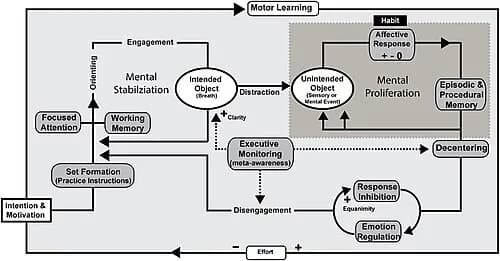
It helps to understand why these particular two areas — attention and stress regulation — keep showing up across meditation for brain health research, rather than some other brain function entirely. Most meditation techniques directly exercise one core skill: noticing that attention has drifted, and deliberately redirecting it. That is, quite literally, a repeated workout for attention-related circuitry, which is presumably why its effects show up more reliably than, say, effects on memory or language, which meditation doesn’t directly train. The stress-regulation piece follows a similar logic — slow, controlled breathing and sustained present-moment focus both directly engage the body’s calming (parasympathetic) response, which is closely tied to the brain regions that manage stress reactivity. In both cases, the observed changes track fairly closely with what the practice actually asks the brain to repeatedly do, which is a reassuring kind of internal consistency for this area of research.
The Benefits of Meditation for Brain Health You Can Realistically Expect
- Better sustained attention — the “notice and return” practice appears to strengthen attention-related brain activity over weeks of consistent practice.
- Lower stress reactivity — regular practice is linked to a calmer physiological stress response, which indirectly supports clearer thinking.
- Improved emotional regulation — many practitioners report a bigger gap between a triggering event and their reaction, which aligns with research on emotion-related brain activity.
- Possible structural changes with sustained, long-term practice — some research on long-term meditators, particularly those with years of consistent daily practice, points to modest structural differences in attention and stress-related regions, though this line of research involves smaller groups of highly experienced practitioners and shouldn’t be over-generalized to occasional or short-term practice.
None of these appear overnight. The benefits of meditation for brain health build gradually with consistent practice, the same way physical fitness builds through repeated training rather than a single session. This gradual pattern is really the honest summary of what meditation for brain health can offer.
Photo: The Human Brain Model 01, CC0, via Wikimedia Commons
How This Differs From Meditation’s Emotional or Mental Health Benefits
It’s worth distinguishing meditation for brain health, in the specific sense of measurable brain activity and structure, from the broader emotional and mental health benefits meditation is often discussed alongside — things like reduced anxiety or better mood. The two overlap heavily but aren’t identical: brain health research looks specifically at activity and structure in particular regions, using tools like brain imaging, while broader mental health benefits are often measured through self-reported mood, stress, or symptom questionnaires. A calmer emotional life and a more attention-trained brain likely reinforce each other, but they’re studied somewhat separately, and it’s worth not collapsing “meditation makes my brain healthier” and “meditation makes me feel better day to day” into exactly the same claim, even though both appear to be true to a meaningful degree.
A Practical Way to Approach Meditation for Brain Health
If your interest in meditation for brain health is practical rather than academic — you simply want the benefits, not a research review — the most evidence-aligned approach is a short, consistent, attention-focused sit rather than chasing a specific “brain-boosting” technique or app feature. Ten to twenty minutes of daily breath-focused sitting, where you notice when attention wanders and gently bring it back, closely mirrors the practices used in most of the underlying research. Consistency across weeks and months matters far more than the specific style you choose, or any single long session — the attention and stress-regulation changes associated with meditation for brain health appear to depend on repetition over time, the same way physical strength depends on showing up regularly rather than one exceptionally long workout.
What It Doesn’t Do
Meditation for brain health is not a treatment for neurological conditions like dementia or a substitute for medical care for any brain-related diagnosis. It supports general attention and stress resilience, not disease treatment. For a broader look at meditation’s benefits beyond brain-specific research, our piece on benefits of meditation covers the fuller picture.
Frequently Asked Questions
Related Articles

Meditation for ADHD: What Actually Helps
Meditation for ADHD isn't a treatment or cure — it's a support for attention regulation, used alongside proper diagnosis and care. See what realistically helps, and try guided sessions with Habuild.

Benefits of Meditation: A Simple, Honest Guide
What meditation can really do for your mind and body — and what it can't. Start noticing the shifts for yourself with Habuild's daily guided meditation practice.

Anapana Meditation: Technique and Benefits
Anapana meditation, one of the oldest breath-awareness practices, simply asks you to observe the natural breath without controlling it. Learn the technique with Habuild's guided sessions.