
Meditation for Sleep: A Gentle Nightly Practice for Calm
Meditation for sleep won't knock you out like a pill, but it teaches your mind and body how to let go, night after night. Try a guided nightly practice with Habuild.
Key Takeaways
- Meditation for sleep teaches the body to let go, not knock you out like a pill.
- Works by activating the relaxation response – slower breath, easing heart rate.
- Racing thoughts don’t stop on command; you train attention to notice and release them.
- Stress and screen time leave physical tightness that a body scan can release directly.
- A body-scan practice lying down needs just your bed and about ten quiet minutes.
It’s midnight. Your body is tired, but your mind is running its own late-night meeting — replaying today’s conversation, worrying about tomorrow’s deadline, wondering why you can’t just switch off. If this sounds familiar, meditation for sleep might be exactly the gentle nudge you need. It won’t knock you out like a pill, and it isn’t a magic switch. But it quietly teaches your mind and body how to let go, night after night, until falling asleep feels less like a struggle and more like a natural close to the day.
At Habuild, we hear this from so many people in our community — not that they can’t sleep at all, but that their mind simply won’t stop talking once the lights go off. That’s exactly where a short, simple practice of meditation for sleep can help.
Why Meditation for Sleep Actually Works
To understand why meditation for sleep is so effective, it helps to know what’s happening in your body when sleep won’t come.
Through the day, your nervous system stays in a mild state of alert — checking messages, solving problems, reacting to people and traffic and notifications. This is your body’s “fight or flight” mode, useful when you’re getting things done, but a real problem at 11 pm when you’re lying in bed and it simply hasn’t gotten the memo to switch off.
Meditation works by gently activating the opposite state — what’s often called the relaxation response. Your breath slows down. Your heart rate eases. Your muscles, which have been quietly holding tension all day without you even noticing, begin to soften. This shift doesn’t happen by force. It happens by giving your attention somewhere calm to rest, instead of letting it spiral through the same anxious loops.
There’s also the racing-thoughts piece, which is honestly the biggest reason most people struggle to fall asleep. Your mind isn’t built to simply stop thinking on command. But when you practice meditation for sleep, you’re not fighting the thoughts — you’re training your attention to notice them without getting pulled in, and to keep gently returning to your breath or your body instead. Over time, this becomes easier, and the mental noise that used to keep you up starts to lose its grip.
And then there’s the physical side. Stress and screen time both leave a kind of tightness in the body — clenched jaw, tense shoulders, a stomach that won’t unclench. A few minutes of guided meditation for sleep, practiced lying down, releases this tension directly, which matters because a tense body simply doesn’t fall asleep as easily as a relaxed one.
A Simple Body-Scan Meditation for Sleep to Try Tonight
The easiest way to begin is with a body-scan meditation. You don’t need an app, a special cushion, or twenty minutes. You just need your bed and about ten quiet minutes.
Lie down on your back, arms resting by your sides, palms facing up if that feels comfortable. Close your eyes. Take three slow breaths, letting the exhale be a little longer than the inhale each time.
Now bring your attention to your feet. Notice any tension there — maybe your toes are curled slightly, or your soles feel tight. Just notice it, and on your next exhale, imagine that tension softening and draining away, like water sinking into the mattress beneath you.
Move your attention slowly upward: ankles, calves, knees, thighs. At each spot, pause for a few breaths, notice what’s there, and let it loosen a little. Don’t force anything — this isn’t about controlling your body, just quietly paying attention to it.
Continue through your hips, your lower back, your stomach, your chest. Notice if your breathing has changed — for most people, it naturally becomes slower and deeper as the body relaxes. Move on to your shoulders (a place almost everyone holds tension without realising it), then your arms, your hands, your neck, your jaw, and finally your face — forehead, eyes, even the small muscles around your mouth.
By the time you reach the top of your head, most people find their whole body feels noticeably heavier and calmer. Some drift off before even finishing the scan — and that’s completely fine. There’s no “right” way to end a meditation for sleep session. If sleep comes first, let it.
If lying still and scanning your body feels difficult — some people find it makes them more restless, not less — a slow, counted breath is a gentler place to start. Simply breathe in for a count of four, hold gently for four, and breathe out for a count of six or eight, making the exhale longer than the inhale. Repeat this ten to fifteen times. This is night meditation at its simplest, and for many beginners, it’s actually easier to stick with than a full body scan.
If you want extra support for winding down, it’s worth pairing meditation with other calming practices too. Our guide on the mudra for insomnia walks through a simple hand gesture you can hold right alongside your breathing, and if you’re just starting out with meditation in general, our piece on meditation for beginners is a gentle place to build the basics before you bring them into your bedtime routine.
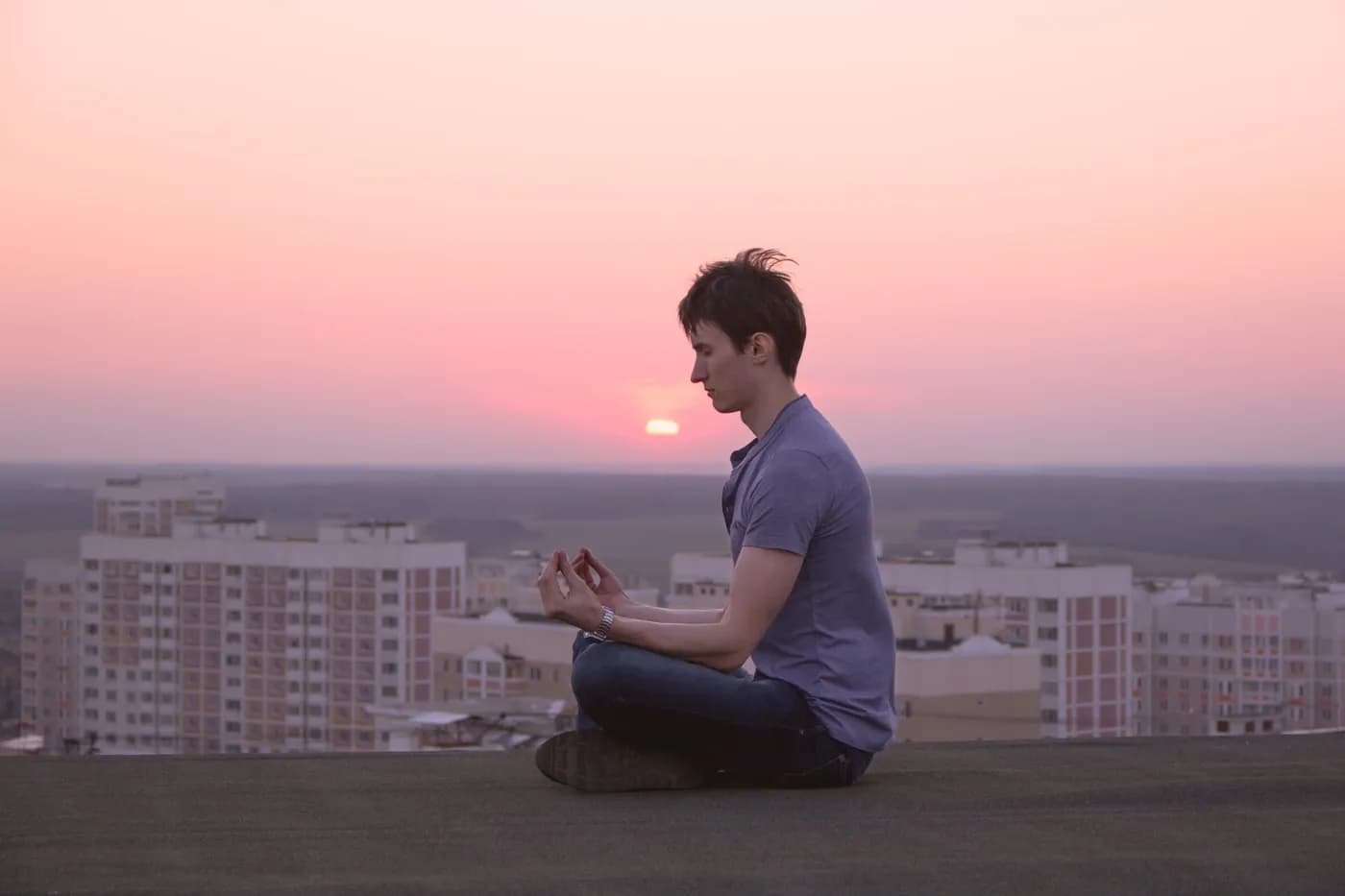
Photo: Joseph RENGER, CC BY-SA 3.0, via Wikimedia Commons
Being Honest About Meditation for Sleep and Insomnia
We want to be honest with you here, because overpromising helps no one. Meditation for insomnia works beautifully for the kind of sleeplessness most of us know well — the racing mind, the mental replay loop, the low-grade anxiety that keeps you scrolling or staring at the ceiling. For this, a regular practice really can make a meaningful difference over a few weeks.
But insomnia isn’t always this simple. If you’ve been struggling to sleep most nights for months, waking up gasping, dealing with severe daytime exhaustion, or living with an underlying health condition that disrupts your sleep, meditation alone isn’t the answer. That kind of chronic or clinical insomnia deserves a proper look from a doctor or sleep specialist. Think of meditation as a supportive habit that works alongside good care — not a replacement for it. There’s no shame in needing more support than a breathing exercise can give; that’s simply being kind to yourself.
It also helps to know the difference between occasional bad nights and a genuine sleep disorder. Everyone has the odd night of tossing and turning before a big exam or a stressful day at work — that’s simply being human, and meditation for sleep is a wonderful tool for exactly these moments. But if poor sleep is affecting your mood, your memory, or your ability to function most days of the week, that’s worth mentioning to a doctor rather than quietly hoping a breathing exercise will fix it. Meditation for sleep and medical care aren’t in competition with each other; they work well side by side.
For everyone else, meditation before sleep is one of the simplest, safest habits you can build. It costs nothing, needs no equipment, and the only side effect is usually a better night’s rest.
Meditation for Sleep Works Best as Part of a Routine
Here’s something we always tell people in the Habuild community: meditation for sleep rarely works well in isolation. It’s most powerful as one part of a broader wind-down routine, not a standalone fix you do once and expect miracles from.
A few small changes make a real difference. Try keeping your phone out of arm’s reach for the last half hour before bed — the blue light and the endless scroll both keep your brain more alert than you realise. Dim the lights in your room an hour before sleep; darkness genuinely helps your body produce the hormones that support sleep. And where you can, try to go to bed around the same time each night. Your body loves rhythm, and a consistent bedtime trains it to expect sleep at a certain hour, which makes drifting off far easier.
A few other small touches help too. Keep your room a little cooler than usual — most people sleep better in a cool space than a warm one. If your mind tends to jump to tomorrow’s to-do list the moment you lie down, try keeping a small notebook by your bed and jotting down anything urgent before you start your meditation, so your brain feels free to let it go instead of holding onto it all night.
None of these habits need to be perfect. You don’t need blackout curtains or a strict digital detox to benefit — even small, consistent steps in this direction add up. The goal isn’t a flawless routine; it’s a familiar rhythm your body starts to recognise and trust around your meditation for sleep practice.
Once these small habits are in place, your ten minutes of guided meditation for sleep becomes the calm, familiar close to your evening — a signal to your whole body that the day is done and it’s safe to rest.
Frequently Asked Questions
Related Articles

How to Sleep Better at Night: 8 Proven Habits for Deeper, More Restful Sleep
Sleep quality is highly responsive to a few specific evening habits — no medication, expensive devices, or complicated protocols required. See all 8 proven habits.


Mudra for Insomnia: Hand Gestures That Support Better Sleep
Each finger represents one of the five elements, and joining specific fingers is said to balance these elements and shift the body toward calm before


Meditation for ADHD: What Actually Helps
Meditation for ADHD isn't a treatment or cure — it's a support for attention regulation, used alongside proper diagnosis and care. See what realistically helps, and try guided sessions with Habuild.