
Shoonya Meditation: The Practice of Inner Emptiness
Shoonya meditation aims toward a state of complete inner stillness, reached gradually through consistent practice rather than effort alone. Build that consistency with Habuild's daily guided meditation.

Key Takeaways
- Shoonya means ’emptiness’ – a deep stillness reached gradually, not forced.
- An advanced state most practitioners meet only after months of practice.
- Built through extended breath or mantra sessions of 20 to 40 minutes.
- Straining or forcing stillness usually backfires – softening works better.
- A consistent time and comfortable seated posture support deeper sittings.
- Often arrives in the very sessions where you’ve stopped chasing it.
“Shoonya” means zero or emptiness in Sanskrit, and shoonya meditation aims toward a state of complete inner stillness — a mind so settled that even the usual background chatter of thought quiets significantly. It’s considered an advanced state within many meditative traditions, reached gradually rather than through direct effort alone, and most practitioners encounter it only occasionally, after months or years of consistent sitting, rather than summoning it at will.
Shoonya Meditation: How to Do It
Rather than a fixed technique, shoonya meditation how to do is best understood as a natural deepening of consistent, regular practice — typically approached through extended breath awareness or mantra meditation, allowing the mind to gradually settle into longer and longer periods of quiet, rather than forcing emptiness directly, which tends to backfire. In practical terms, this usually means sitting for twenty to forty minutes with a chosen anchor — the breath, a mantra, or a single sound — and simply staying with it, session after session, week after week, rather than switching techniques whenever the sitting doesn’t produce the deep stillness you’re hoping for. The depth builds cumulatively across many ordinary sessions; it rarely shows up because of anything special done differently in one particular sitting.
Signs You’re Forcing It Instead of Allowing It
Because shoonya meditation is often misunderstood as something to actively produce, it’s easy to slip into subtly straining for it — holding your breath unnaturally, tensing your forehead as though concentration alone could empty the mind, or feeling frustrated ten minutes in because “nothing is happening yet.” All of these are signs of forcing rather than allowing. The correction is almost always to soften rather than push harder: relax the jaw and shoulders, let the breath return to its normal rhythm, and return to simply noticing your anchor without any expectation that this particular sitting needs to produce a special result. Shoonya meditation, when it does arise, tends to arrive in exactly the sessions where you’ve stopped straining for it — which is part of why it can’t be scheduled or guaranteed.
Setting Up Practice That Supports Deeper Stillness
A few practical conditions make it more likely that longer, quieter sittings — and eventually shoonya meditation — become available to you. A consistent time of day, ideally early morning before the household and phone notifications wake up, removes one layer of distraction before you even sit down. A steady, supported seated posture matters more here than in shorter practices, since discomfort fifteen minutes into a sit will pull attention right back to the body exactly when it’s beginning to settle — sitting against a wall or on a slightly raised cushion is a reasonable adjustment if a fully unsupported cross-legged seat isn’t comfortable yet. And extending session length gradually, by two or three minutes every week or two rather than jumping straight to forty minutes, tends to build the capacity for depth more reliably than occasional long, effortful sittings.
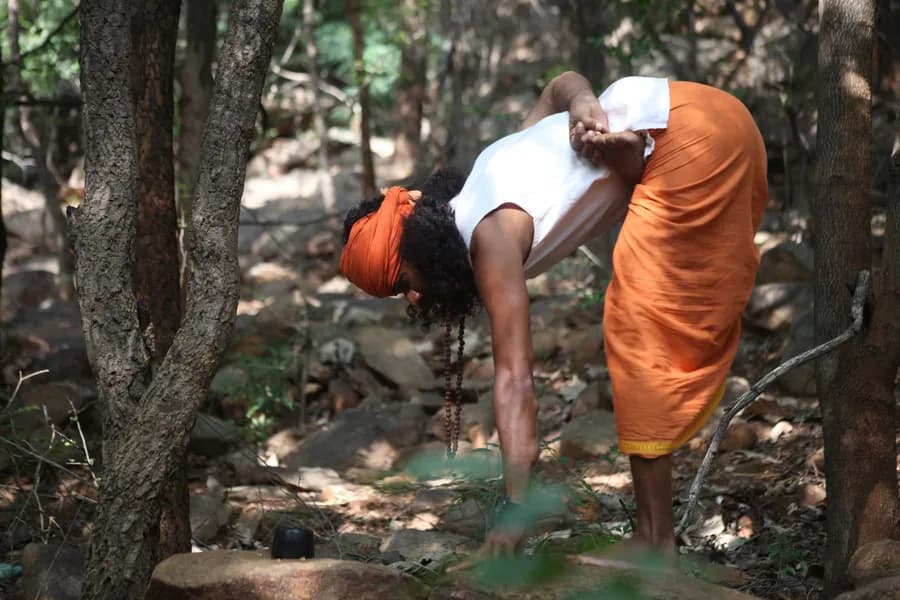
Photo: Chandrasen Yadav, CC BY-SA 4.0, via Wikimedia Commons
What the Shoonya Meditation Experience Actually Feels Like
The shoonya meditation experience is often described as a felt sense of spaciousness or vast quiet, distinct from ordinary calm — practitioners describe it as something that arrives on its own after sustained practice, rather than something you can will into being through effort in a single session. Some describe a brief loss of the usual sense of time passing, or a quiet in which even the “watcher” of thoughts seems to settle along with the thoughts themselves. It’s worth holding this as an occasional, deepening experience rather than a goal to chase anxiously every time you sit — chasing it directly is, somewhat paradoxically, one of the more reliable ways to keep it out of reach.
Who Should Be Cautious With This Practice
Shoonya meditation is generally safe for most practitioners, but if you’re managing a diagnosed dissociative condition, severe anxiety, or a history of depersonalization, it’s worth discussing any practice that deliberately courts a state of “emptiness” with a mental health professional first, since the language and aim of this practice can occasionally sit close to experiences that aren’t always benign for everyone. For the vast majority of practitioners without that history, this is simply a deep, restful state — but it’s a reasonable thing to check on if any of the above applies to you.
A Gentle Approach
Rather than striving directly for emptiness, most traditions suggest simply committing to consistent daily practice and letting deeper states arise naturally over time. If you’re earlier in your practice and want to understand the foundational mechanics first, our guide on what is meditation covers the basics this deeper state eventually builds from.
Frequently Asked Questions
Related Articles

Binaural Beats Meditation: Does It Work?
Binaural beats meditation plays two slightly different tones, one in each ear, so the brain perceives a third pulsing beat used as a calming anchor. Learn how to try it, and what the evidence actually supports.

10 Minute Meditation: A Quick Daily Reset
A 10 minute meditation is long enough to settle into real calm and short enough to actually do daily. Find your own quick daily reset with Habuild's guided sessions.
Meditation for ADHD: What Actually Helps
Meditation for ADHD isn't a treatment or cure — it's a support for attention regulation, used alongside proper diagnosis and care. See what realistically helps, and try guided sessions with Habuild.