
Walking 1 Hour a Day for a Month: Realistic Results
An hour of walking every day for a month adds up to over 30 hours on your feet. Here's what you can realistically expect, what research says and how to build up safely.
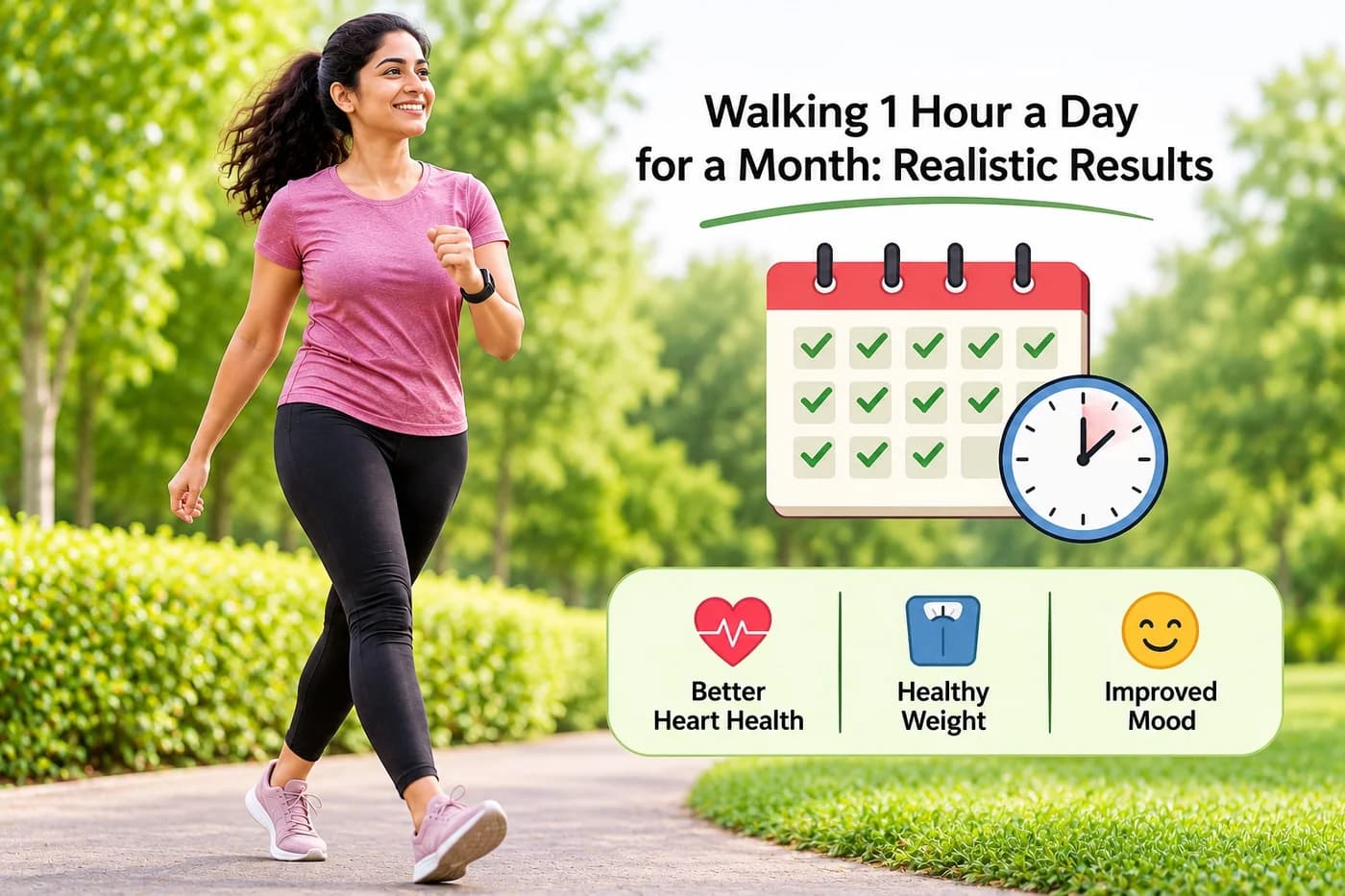
Key Takeaways
- An hour of brisk walking a day adds up to 420 minutes a week, well above WHO's minimum.
- For a 70 kg adult, an hour of brisk walking uses roughly 350 calories.
- In one large study, 60–75 minutes of daily activity offset the extra risk of long sitting.
- In a month, expect better stamina and mood more than dramatic weight loss.
- Build up gradually and add strength work on two days a week.
What an Hour a Day Adds Up To
Walking for an hour every day is a real commitment, and over a month it adds up fast. In a single week, that's 7 hours or 420 minutes of walking. WHO recommends that adults do at least 150 to 300 minutes of moderate activity a week, so an hour of brisk walking every day takes you well past even the upper end of that range.
In terms of steps, a brisk pace of about 100 steps a minute gives you roughly 6,000 or more steps in an hour, on top of your normal daily movement. At about 5 to 6 km an hour, you'd also cover 5 to 6 km a day, which works out to 150 to 180 km over a month. That's a lot of ground for something you can do in your own neighbourhood.
Calories burned in an hour of walking
Harvard Health publishes estimates for 30 minutes of walking at different body weights. Doubled for an hour, walking at about 5.6 km/h (3.5 mph) uses roughly 214 calories at 57 kg, 266 at 70 kg and 318 at 84 kg. At a brisker 6.4 km/h (4 mph), the figures rise to about 270, 350 and 378 calories respectively.
These are estimates, and your actual number depends on your body size, pace and the terrain you walk on. Hills, for example, will increase the energy you use.
What You May Notice Over 4 Weeks
Everyone responds differently, but here is what many people notice when they walk regularly for a month.
Week 1: getting used to it
In the first few days, your legs and feet may feel tired or slightly sore, especially if you were fairly inactive before. That's normal and usually settles within a few days. Sharp or worsening pain is not normal, though, and is a signal to rest and get advice.
Week 2: more energy
By the second week, the hour often starts to feel easier. Many people find they sleep better and feel more energetic during the day, and the walk starts to feel like a welcome break rather than a chore.
Week 3: better stamina
You may notice that you can walk faster or climb hills without getting as breathless as before. Your daily walk becomes part of your routine, and you no longer need to talk yourself into it.
Week 4: a habit you can keep
By the end of the month, you might notice clothes fitting a little differently, a better mood and more confidence. Most importantly, walking has become a habit, and that's what brings long-term benefits.
Weight Loss: What to Expect
Walking an hour a day uses a meaningful amount of energy, but weight loss in a month depends mostly on your diet. Some people lose a little weight, some see changes in their waist before the scale moves, and some see little change because they eat more when they're more active. That's normal and doesn't mean the walking isn't working.
Judge your first month by how you feel, your stamina and your consistency, as well as your weight. And be wary of any plan that promises a fixed number of kilos in 30 days.
What Research Says About Daily Activity
A major 2016 analysis in The Lancet pooled data from more than 1 million adults. People who sat for more than 8 hours a day had a higher risk of death, but about 60 to 75 minutes of moderate activity a day appeared to remove most of that extra risk. An hour of brisk walking is one practical way to reach that level, especially for people with desk jobs.
A 2020 study in JAMA followed about 4,800 US adults and found that those who took 8,000 steps a day had about half the risk of dying during the study period compared with those who took 4,000 steps a day. A daily hour of walking can easily take you past 8,000 steps. These studies show strong links between activity and health, though they can't prove that walking alone caused the difference.
How to Build Up to an Hour
If you're not walking regularly yet, don't start with an hour on day one. Building up gradually reduces soreness and makes the habit more likely to stick:
- Week 1: 20 to 30 minutes a day at a comfortable pace
- Week 2: 30 to 40 minutes, with part of it brisk
- Week 3: 40 to 50 minutes, mostly brisk
- Week 4: 60 minutes, brisk with a gentle warm-up and cool-down
You don't have to walk for an hour in one go, either. Two 30-minute walks in the morning and evening, three 20-minute walks after each meal, or one 40-minute walk plus shorter walks through the day all count just as well.
Mistakes to Avoid

The most common mistake is doing too much too soon. Sudden jumps in distance can cause shin, foot or knee pain, so increase your time gradually. Worn-out shoes are another problem, so replace your walking shoes when the soles start to wear down. Don't ignore pain that is sharp, gets worse or makes you limp.
It's also easy to forget that walking alone doesn't build much upper-body strength, so add two short strength sessions a week. Finally, drink enough water, especially in Indian summers, and carry a bottle on longer walks.
Who Should Check With a Doctor First
Speak to your doctor before starting a daily hour of walking if you have heart disease, high blood pressure, diabetes, joint problems or balance problems, or if you are pregnant or haven't exercised for a long time.
Make It Part of Your Routine
Habuild's live sessions include walking along with exercises, yoga and breathing, and the Habuild app's Walk Daily habit helps you keep track of your walks.
Editorial Sources
- WHO Europe – Physical activity fact sheet
- Harvard Health – Calories burned in 30 minutes for people of three different weights
- Ekelund et al. – Does physical activity attenuate the association of sitting time with mortality? The Lancet (2016)
- Saint-Maurice et al. – Association of daily step count and intensity with mortality, JAMA (2020)
Health Disclaimer
This article is for general information only and is not medical advice. Please consult a doctor before starting any new exercise routine, especially if you have a health condition, an injury or are pregnant.
Frequently Asked Questions
Related Articles

10 Benefits of Walking 30 Minutes a Day for Health, Fitness, and Weight Loss
The trick isn't to walk longer, it's to walk daily, at the right pace, with consistency over months. See all 10 benefits for health, fitness, and weight loss.


How Many Calories Do 10000 Steps Burn?
There is no single calorie number for 10,000 steps. Body size, pace and terrain change the result, so a realistic estimate is a range, not a promise.

Benefits of Walking after Dinner: What Post-Meal Walking Does for Your Health
Muscle contractions during walking consume blood glucose directly, bypassing insulin, while the movement also improves digestion and supports the.


Walking Exercise: a Complete Guide to Walking Programs, Treadmill Plans, and Daily Workouts
The difference between a casual stroll and a transformative walking routine isn't speed or distance — it's intentional pacing, consistent volume, and progression. See the complete guide to programs and plans.