
Dhanurasana (Bow Pose): Steps, Benefits & Precautions
The body forms the shape of a drawn bow — torso and legs as the frame, arms stretched back like a taut bowstring. See the steps, benefits, and precautions.
Key Takeaways
- Named after the bow used in ancient Indian archery, symbolising tension before release.
- Typically sequenced alongside Bhujangasana and Shalabhasana as a progressive backbend trio.
- The chest, abdomen, hip flexors, and thighs all open simultaneously in this prone shape.
- Belly pressure against the floor provides a rhythmic internal massage to digestive organs.
- Hands grip the ankles while both legs lift, stretching the quadriceps and hip flexors.
- Counteracts the forward-rounded posture that accumulates from desk work and screen time.
What is Dhanurasana?
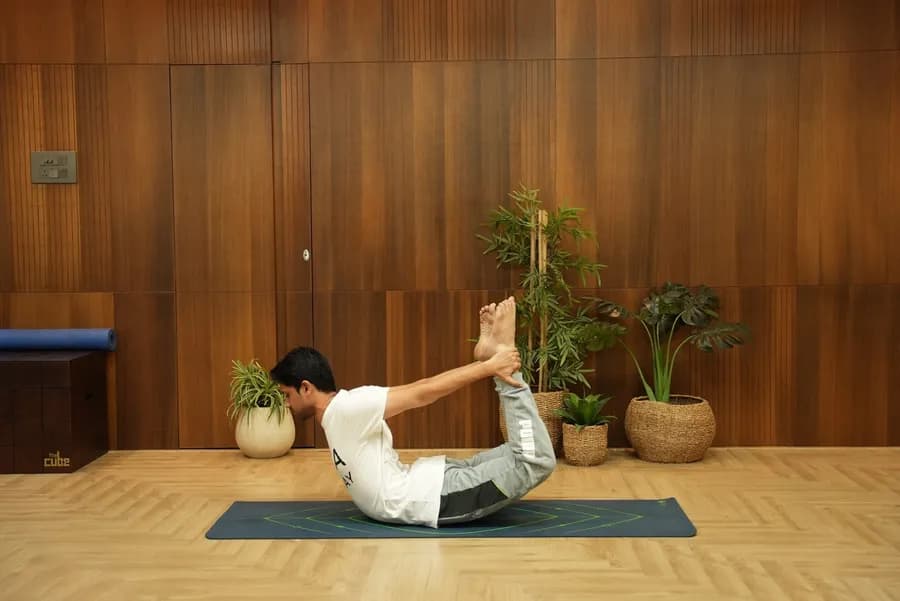
Dhanurasana comes from the Sanskrit words Dhanur (meaning bow) and Asana (meaning posture or seat). In English it is known as Bow Pose, pronounced roughly as duh-noo-RAH-suh-nah. Visually, the body forms the shape of a drawn bow — the torso and legs act as the wooden frame, while the arms stretch back like a taut bowstring connecting the two ends.
Named after the bow used in ancient Indian archery and warfare, Dhanurasana carries a symbolic depth: just as an archer draws the string to harness energy before releasing an arrow, this posture invites the practitioner to build controlled tension across the entire front body before surrendering into openness. It is a prone backbend that asks the chest, abdomen, hip flexors, and thighs to open simultaneously — a full-body conversation between effort and release.
Within the broader yoga system, Dhanurasana is classified as a prone backbend and appears prominently in both Hatha and traditional yoga lineages. It is typically sequenced alongside Bhujangasana and Shalabhasana, forming a trio that progressively deepens spinal extension and stimulates the digestive organs. Understanding dhanurasana precautions before you begin is what separates a safe, rewarding practice from one that risks strain. For a broader map of where this pose sits among all postures, explore the complete Yoga Asanas library.
Dhanurasana Benefits
Physical Benefits
- Strengthens the Spine and Back Muscles The full extension of Dhanurasana activates the erector spinae and deep paraspinal muscles along the entire length of the spine. Regular practice may gradually ease chronic stiffness in the lumbar and thoracic regions, making everyday movement feel more fluid. This is especially valuable for people with sedentary routines who rarely move their back extensors through a full range of motion.
- Improves Flexibility in the Hip Flexors and Quadriceps When both legs lift and the hands grip the ankles, the quadriceps and hip flexors receive a significant stretch — muscles that tend to shorten from long hours of sitting. Consistent practice may gradually improve hip extension and reduce the anterior pelvic tilt that contributes to lower-back discomfort. This makes Dhanurasana a useful complement to a yoga for lower back pain management routine.
- Stimulates the Digestive and Abdominal Organs The pressure of the belly against the floor, combined with the gentle rocking motion many practitioners use while holding the pose, provides a rhythmic internal massage to the digestive organs. Over time and with consistent practice, this may support better gut motility and help with sluggish digestion. It also naturally activates the core by creating a brace around the lower abdomen.
- Opens the Chest and Shoulders As the chest lifts and the shoulder blades draw together, the anterior deltoids and pectoral muscles receive a deep stretch. This counteracts the forward-rounded posture that accumulates from desk work and screen time. Over weeks of practice, many practitioners notice improved postural alignment and a greater sense of space across the chest and upper back.
Mental and Emotional Benefits
- Calms the Nervous System and Reduces Stress The chest-opening action of Dhanurasana encourages deeper, more expansive breathing, which in turn supports the parasympathetic nervous system. Practiced with slow, deliberate breath, this asana may support the management of everyday stress and mental fatigue when incorporated into a consistent routine. The combination of physical release and breathing depth makes it one of the more restorative backbends available to a home practitioner.
- Builds Focus and Mental Steadiness Holding Bow Pose requires genuine concentration — the body naturally wants to collapse back to the floor, and staying in the posture demands a calm, present mind. This builds a form of quiet mental resilience that practitioners often describe as carrying over into daily life. It trains the practitioner to remain steady under tension, a quality that extends well beyond the yoga mat.
How to Do Dhanurasana — Step-by-Step Instructions
Key Principles
Dhanurasana is a full-body backbend — not simply a leg lift. The movement should be initiated by the legs pressing upward and away, which naturally draws the chest skyward. Avoid forcing the shoulders back or cranking the neck sharply upward. Keep the breath slow and even throughout; if the breath becomes strained or disappears entirely, ease gently out of the posture.
Step 1: Starting Position
Lie face-down on your yoga mat with your chin resting gently on the floor. Place your arms alongside your body, palms facing upward. Allow your legs to be hip-width apart. Take two or three slow breaths here, feeling the belly expand against the mat on each inhale. This is your foundation — let the entire front body soften before you begin.
Step 2: Bend the Knees
On an exhale, bend both knees and draw your heels toward your glutes. Keep both knees hip-width apart — do not let them splay outward. Feel the activation in your hamstrings as they engage. At this stage, your thighs are still resting on the mat and your forehead can rest on the floor.
Step 3: Reach Back and Hold the Ankles
Reach your arms back and grip the outer edges of each ankle — not the tops of the feet. The grip should feel firm but not tense. If you cannot reach the ankles comfortably, loop a yoga strap around both ankles and hold the strap. Keep your elbows close to the sides of your body rather than flaring them outward.
Step 4: Inhale and Lift
On a strong inhale, press your feet upward and away from your body. This action automatically lifts your thighs off the floor and draws your chest upward simultaneously. The resistance between your arms holding the ankles and your legs pressing away creates the bow tension that gives this pose its name. Your weight should rest on the soft part of your lower abdomen — not on the hip bones.
Step 5: Final Position and Hold
Once both thighs and chest are lifted, gaze softly forward — avoid cranking the neck sharply upward. Draw the shoulder blades gently together to open the chest further. Hold for three to five steady breaths. Some practitioners rock gently forward and backward on the belly in time with the breath, which creates a pleasant massage-like effect on the abdominal organs.
Step 6: How to Come Out of Dhanurasana
On an exhale, slowly release the ankles and lower the chest and legs back to the floor with control — do not drop them suddenly. Rest your cheek on one side and take several breaths in Makarasana (Crocodile Pose) to allow the spine to decompress. The release is as important as the entry; never rush out of a backbend.
Breathing in Dhanurasana
The breath in Dhanurasana is the key that unlocks depth. Inhale to lift and expand; exhale to settle and find stability without collapsing. Maintain smooth, uninterrupted breathing throughout the hold. If you notice you are holding the breath or breathing in short, shallow sips, that is a signal to reduce the intensity of the backbend slightly until breathing becomes natural again.
Preparatory Poses Before Dhanurasana
Taking time to warm up the relevant muscle groups protects the spine and makes the full pose considerably more accessible.
- Bhujangasana (Cobra Pose) — Opens the chest and gently activates the spinal extensors without requiring the legs to lift, making it the ideal first backbend before Dhanurasana.
- Shalabhasana (Locust Pose) — Strengthens the posterior chain — glutes, hamstrings, and lower back — which are the primary movers that power the lift in Bow Pose.
- Supta Virasana (Reclined Hero Pose) — Provides a passive stretch for the quadriceps and hip flexors, both of which need significant opening for a comfortable Dhanurasana hold.
- Marjariasana-Bitilasana (Cat-Cow) — Mobilises the full length of the spine in both flexion and extension, warming up the vertebral joints before the sustained backbend of Bow Pose.
Variations of Dhanurasana
Variation 1: Ardha Dhanurasana (Half Bow Pose)
Difficulty: Beginner
In this variation, only one leg lifts at a time while the other remains on the floor. The same-side arm reaches back to hold the lifted ankle. This is ideal for beginners, those with limited spinal flexibility, or practitioners returning after a period of rest. It allows the body to experience the backbend sensation on one side at a time, making alignment easier to monitor and self-correct.
Variation 2: Parsva Dhanurasana (Side Bow Pose)
Difficulty: Intermediate
Once the full pose is established, the practitioner rolls onto one side, maintaining the grip on both ankles and balancing on the outer edge of the hip. The body rocks to the opposite side on the next exhale. This variation deepens the lateral stretch along the side body, requires strong core engagement to control the roll, and provides a different angle of compression and release for the abdominal organs.
Variation 3: Purna Dhanurasana (Full Bow Pose)
Difficulty: Advanced
In the advanced expression, instead of holding the ankles the hands reach further to grip the tops of the feet, and the soles of the feet press actively against the palms. This demands considerably greater quadricep flexibility and shoulder mobility, lifting the chest dramatically higher and deepening the spinal curve. This variation should only be explored after months of comfortable practice in the standard pose, ideally under live instruction.
Common Mistakes to Avoid in Dhanurasana
- Holding the Breath This is the most widespread error, especially when practitioners strain to lift higher. Holding the breath builds tension in the neck and shoulders and defeats the calming purpose of the backbend. Consciously exhale as you settle into the pose and keep the breath slow and even throughout the hold.
- Letting the Knees Splay Wide When the knees drift outward beyond hip-width, the lower back compresses instead of extending evenly, which can cause discomfort at the sacroiliac joint. Place a yoga block between the inner thighs to train hip-width alignment. This simple correction protects the lumbar spine throughout the posture.
- Forcing the Chest Up with the Shoulders Many practitioners try to yank the chest upward by aggressively squeezing the shoulder blades together. The lift should come from the legs pressing upward and away — the chest follows naturally and the opening feels more organic. Focus on the feet driving toward the ceiling and the arms will respond accordingly.
- Resting Weight on the Hip Bones When the legs do not lift high enough, the pelvis tilts forward and body weight falls onto the bony prominence of the anterior iliac crest rather than the soft abdomen. This is uncomfortable and counterproductive. Increase the leg-press effort first before attempting to lift the chest higher — the two actions are inseparable.
- Cranking the Neck Sharply Back The impulse to look as high as possible can compress the cervical vertebrae. The gaze should be forward and soft — the neck follows the natural curve of the upper thoracic extension rather than being forced independently. If you experience any neck strain, lower the gaze to the floor in front of you.
- Coming Out of the Pose Too Quickly Dropping suddenly to the floor after a held backbend can jar the spine. Always release the ankles with control on an exhale, and rest in a neutral prone position for several breaths before attempting a counter-pose or a second round. The transition out is as important as the posture itself.
Who Should Practise Dhanurasana?
- Those with Back Stiffness or Postural Issues People who spend long hours at a desk often develop a forward-rounded posture and a stiffened thoracic spine. Dhanurasana counteracts exactly this pattern by extending the spine and opening the chest — areas that rarely receive active movement in a sedentary day. With consistent guided practice, many members report that their back feels noticeably less stiff over several weeks. This is a supportive addition to an active lifestyle, not a replacement for medical guidance on any spinal condition.
- Those Looking to Support Digestive Wellness Through Movement The abdominal massage effect of Dhanurasana makes it a useful posture for anyone wanting to support digestive health through regular yoga practice. The combination of deep breathing, gentle compression, and the optional rocking motion creates a rhythmic internal stimulus that many practitioners find settling. It pairs naturally with other postures in a digestion-focused sequence.
- Is Dhanurasana Good for Beginners? Yes — with modifications. Complete beginners should start with Ardha Dhanurasana (one leg at a time) and use a yoga strap around the ankles to remove the flexibility barrier entirely. The priority for a beginner is learning to generate lift from the legs rather than pulling hard with the arms. Joining a live session where an instructor can observe your alignment in real time makes this learning curve significantly shorter and safer. You can find a welcoming entry point through Yoga for Beginners guided sessions.
- Intermediate Practitioners Building a Consistent Practice For those practising for several months, Dhanurasana is a rewarding posture to deepen. The intermediate practitioner can explore longer holds, Parsva Dhanurasana, and pairing the pose with pranayama techniques. Consistency matters more than depth — a Dhanurasana held for five breaths with proper alignment every morning will yield far more benefit than an occasional deep version done once a week with compromised form.
Make Dhanurasana a Part of Your Life
Dhanurasana is a powerful prone backbend that strengthens the spine, opens the chest and hip flexors, and provides a gentle internal massage to the digestive organs. It suits a wide range of practitioners — from complete beginners using a strap and the half-bow variation, to intermediate students exploring longer holds and side variations. Understanding dhanurasana precautions is the foundation that makes sustained, injury-free practice possible.
Whether you are new to yoga or returning after a long break, this pose is accessible with the right guidance and modifications. Live instruction allows a teacher to catch the alignment errors — splaying knees, a compressed neck, weight on the hip bones — that are nearly impossible to self-correct through a mirror or a recorded video. With proper support, the bow is genuinely within reach at any level.
Frequently Asked Questions
Related Articles
Dhanurasana Benefits: Steps, Form & Precautions
Grasping your ankles and lifting the chest and thighs off the floor forms the shape of an archer’s bow, strengthening the spine and opening the hip

Dhanurasana (Bow Pose): Steps Back Flexibility and Digestive Benefits
Practice Dhanurasana pose with Habuild. Follow the bow pose steps to strengthen your spine, open your chest, and improve full-body flexibility. Start today!
Backbend Yoga Poses: from Beginner to Advanced
Backbends extend the spine into posterior flexion, directly countering the forward-folded postural pattern that screen-based modern life produces. See the