
Manganese: Food Sources, Daily Needs and Safety
What manganese does, how much adults need, which everyday Indian foods supply it, and why most people do not need a supplement.
Key Takeaways
- Manganese helps enzymes involved in energy use, bone formation and protecting cells.
- NIH lists an adequate intake of 2.3 mg a day for men and 1.8 mg for women.
- Whole grains, pulses, nuts, leafy greens and tea supply enough for most people.
- Deficiency is very rare; the adult upper limit from all sources is 11 mg a day.
- Liver disease and inhaled dust from welding or mining raise the risk of excess.
Manganese is a trace mineral that helps many enzymes work. The body uses it to make energy, form bone and protect cells from damage, and it also plays a part in blood clotting, reproduction and immunity. You need only a small amount, deficiency is very rare, and a varied diet usually provides enough. Concentrated supplements and environmental exposure are a bigger concern than food.
Manganese is not magnesium
The names sound alike, but these are different minerals. Manganese is needed in milligram amounts for enzymes. Magnesium is needed in much larger amounts for muscles, nerves and bones. Check labels carefully so you do not buy one thinking it is the other.
How much do you need?
The US National Institutes of Health lists an adequate intake of 2.3 mg a day for adult men and 1.8 mg for adult women. Needs differ for children and during pregnancy and breastfeeding. These figures are background, not a reason to weigh ingredients.
The upper limit for adults, from food, drinks and supplements together, is 11 mg a day. An upper limit is a safety boundary, not a target. A capsule offering a large dose does not give a larger benefit.
Which foods provide manganese?
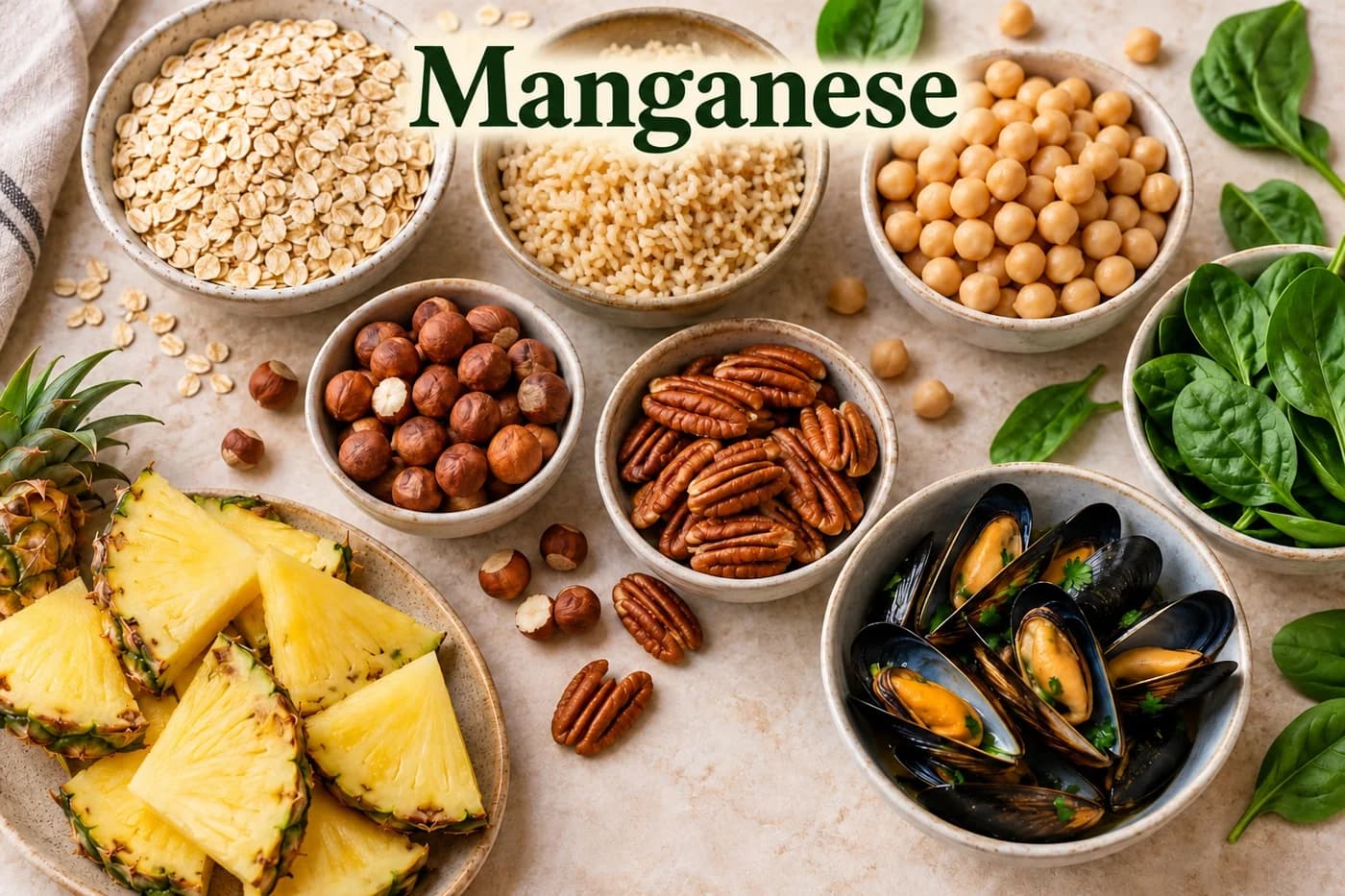
- Whole grains: oats, brown rice, whole-wheat atta and millets. Refining grains removes much of their manganese and other minerals.
- Pulses: dal, soybeans, chana and other beans.
- Nuts and seeds: a small handful adds a useful amount.
- Leafy vegetables: spinach and other greens.
- Some fruit: pineapple is a notable source.
- Tea and spices: tea is rich in manganese, and many spices such as black pepper contribute.
A day with oats at breakfast, dal and roti at lunch, and a vegetable dish at dinner covers most people's needs. You do not need to replace all white rice with brown rice; rotating grains and including pulses works well. Our guide to minerals in food shows how these foods supply other minerals too.
A note on tea
Tea counts as a source, but drinking extra cups is unnecessary. Tea with meals can reduce iron absorption from plant foods, so have it between meals if you rely on iron-rich foods like dal and greens.
Can you be deficient?
True deficiency is very rare and has not been clearly defined in people. It cannot be diagnosed from tiredness or weak nails. If someone has a confirmed nutrient problem, the cause, such as very limited eating or a digestive condition, needs a proper review. Choosing a mineral from an online symptom list is unlikely to help.
When is excess a concern?
Studies have not shown harm from the manganese in food and drinks. Problems come from other routes:
- Inhaled dust or fumes: Long-term exposure in welding or mining can cause manganese toxicity. Symptoms include tremors, muscle spasms, mood changes, poor sleep and headaches. Workplace protection matters more than diet.
- Drinking water: Some well water contains high levels. Clear water can still hold dissolved minerals, so rely on proper testing and local public-health advice, not taste or colour.
- Liver disease: The liver clears manganese into bile. People with chronic liver disease are more likely to build it up and should avoid unnecessary supplements.
- Intravenous nutrition: People on long-term IV feeding need trace minerals carefully set and monitored by their medical team.
Children are more vulnerable to excess and should not be given adult mineral products. Before combining supplements, check multivitamins, bone formulas and joint or hair products, as several may contain manganese. Tremor, walking changes or new mood symptoms need a medical assessment, not self-treatment.
Editorial sources
Frequently Asked Questions
Related Articles
Minerals in Food: Types, Functions and Everyday Indian Sources
Minerals are inorganic nutrients the body cannot make. Some are needed in larger amounts and others only in traces, yet both groups are essential.

Micronutrients: Small Nutrients with Big Jobs
Vitamins and minerals are needed in small amounts but do big jobs. Here is how to cover them through food and when testing helps.
Essential Nutrients: What Your Body Needs and Where to Get Them
The six classes of essential nutrients, how vegetarian foods work together to cover them, and the gaps like vitamin B12 that need deliberate planning.


Iron Rich Foods: The Complete Vegetarian Food List
Lentils, chickpeas, dark leafy greens, jaggery, and seeds cover the full daily iron requirement for most people — no meat or fish needed. See the.