
Types of Water: Which One Do You Actually Need?
Choose safe everyday water by its source and treatment needs, without paying extra for unsupported hydration or detox claims.
Key Takeaways
- Safe, accessible water matters more than the type.
- Boiling addresses germs, not every chemical.
- Mineral water is not a supplement plan.
- Alkaline and detox water claims go too far.
Tap, filtered, RO, mineral, sparkling and alkaline water can make a simple drink feel like a complicated choice. For everyday use, the priority is safe water that you can access, store cleanly and drink comfortably. A higher price or a fashionable description does not automatically make it more hydrating.
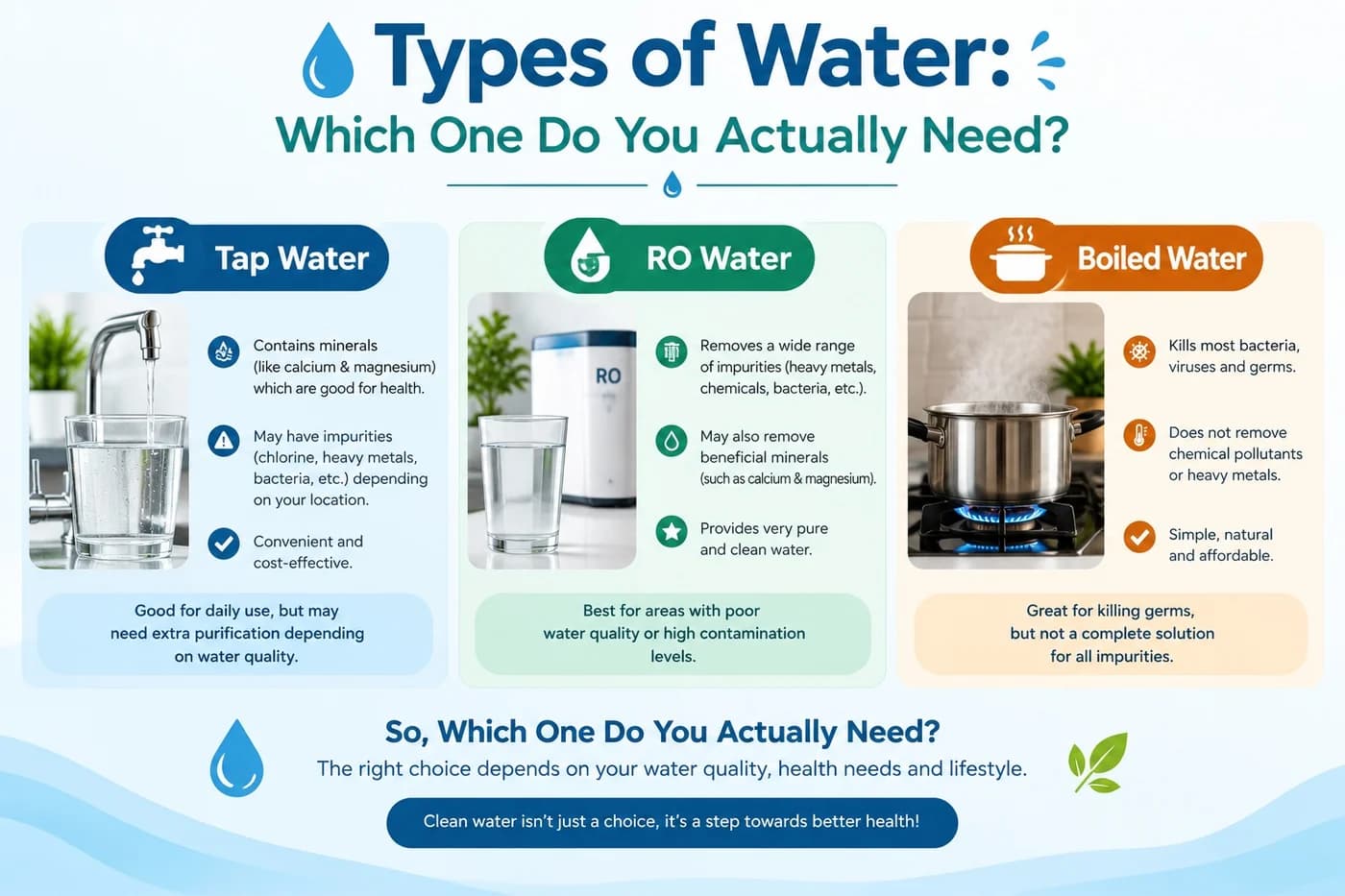
Different water types describe different things: where water comes from, how it is treated or what is added. Understanding those distinctions is more useful than trying to find one premium water for everyone.
Tap water depends on the supply
Tap water is simply water delivered through a supply system. Its suitability for drinking depends on treatment, pipes, storage tanks and local conditions. Clear appearance and a normal taste cannot reliably establish that it is free of harmful germs or chemicals.
Use the reliable information available for your supply, especially during contamination alerts or after flooding. In a building with stored water, tank maintenance matters too.
This is a local question rather than a verdict that all tap water is good or bad. The useful treatment is the one that addresses an actual problem in your source, rather than every available technology added for reassurance.
Filtered water is a broad description
A filter may improve taste, trap particles or remove particular contaminants. Different systems do different jobs; one small carbon filter is not automatically a complete defence against every germ and dissolved chemical.
Maintenance is part of the treatment. A neglected cartridge or dirty collection tank can undermine the purpose of buying a purifier.
If you already have a suitable system, keep its maintenance schedule and collection container clean. You do not need to compare new models every month. Confirming that the current system fits your water source is a more useful starting point than upgrading because another machine has more stages.
RO water is treated by reverse osmosis
Reverse osmosis pushes water through a membrane that can reduce many dissolved substances. It can be useful for certain source-water problems, but it is not automatically necessary in every home.
RO can also reduce minerals and produce reject water. Those features belong in the decision alongside the contaminants it is designed to address.
Do not use mineral content alone as a reason to drink unsafe water or assume a low reading on a handheld meter proves safety. Dissolved-solids measurements do not identify every harmful substance or detect all germs. A number can answer one limited question without certifying the whole supply.
Boiled water addresses germs, not every chemical
Boiling is effective for killing many disease-causing germs when done properly. CDC guidance recommends bringing clear water to a rolling boil for one minute, with a longer time at high altitude.
It does not reliably remove harmful chemicals such as heavy metals. If contamination is chemical, boiling is not a substitute for an appropriate safe source or treatment.
After boiling, allow water to cool safely and store it in a clean, covered container. Avoid dipping used cups or unclean hands into the supply. Water that was safe when prepared can become contaminated again through handling.
Packaged water is a convenience choice
Sealed packaged water can be useful when travelling or when a reliable drinking supply is unavailable. Buy an intact product from a dependable source and avoid bottles with damaged seals or signs of poor handling.
Packaged drinking water and natural mineral water are different product categories. Neither needs to become an everyday purchase if you already have a safe, practical household supply.
Store bottles away from excessive heat and direct sunlight. For regular use, a clean refillable bottle can reduce the need for repeated purchases. The aim is convenient safe drinking, not collecting the most expensive label.
Mineral water is not a supplement plan
Mineral water contains dissolved minerals, with amounts depending on its source and composition. It can contribute some minerals, but ordinary food remains the main way to meet nutritional needs.
Do not rely on it to treat calcium or magnesium deficiency. A bottle's name does not tell you that it provides a meaningful treatment amount.
If you have a prescribed sodium or mineral restriction, the composition can matter. Otherwise, you rarely need to choose water by ranking every mineral. Taste, safety, access and cost are usually more practical considerations.
Sparkling water can be a useful alternative
Plain sparkling water is water with dissolved carbon dioxide. If you enjoy the bubbles, it can replace a sweetened soft drink without adding sugar.
Flavoured products vary. Soda water, sweet tonic water and a sugary fizzy drink are not nutritionally identical simply because they all have bubbles.
Carbonation can cause belching or discomfort for some people. Choose still water if that happens. There is no need to tolerate bloating to make a healthier drink swap when a simpler option works.
Alkaline and detox claims go too far
Alkaline water has a higher pH than ordinary neutral water. That does not mean it resets the body's overall pH or cures acidity-related disease. The body regulates blood acidity closely.
Likewise, cucumber, mint or lemon can make water taste appealing, but they do not turn it into a liver-cleansing treatment. Adding fruit for flavour is enough of a purpose.
Use clean ingredients and refrigerate infused water appropriately. If the drink contains juice, syrup or sugar, it is no longer equivalent to plain water for energy and sugar content. Marketing words do not change the recipe.
Make the everyday choice easy
Keep safe water accessible during work, travel and exercise. Needs vary with heat, activity, food, pregnancy and health, so a rigid bottle challenge does not suit everyone.
For ordinary activity, plain safe water is usually enough. Vomiting or diarrhoea may require oral rehydration solution rather than an expensive water type. A prescribed fluid restriction is another reason to follow an individual plan.
The best water is not necessarily the one with the most claims. It is a safe supply, handled cleanly, that fits your routine without unnecessary cost or complexity.
Editorial sources
Frequently Asked Questions
Related Articles
Drinking Water: How to Make Hydration Fit Your Day
A flexible guide to hydration that accounts for your routine, weather and health.

Lemon Water Benefits: Hydration, Vitamin C and Dental Safety
Lemon water is simply water with lemon juice or slices, and its main value is helping some people drink more water. Learn dental safety.

Alkaline Water Benefits: Evidence, pH, Uses and Safety
Alkaline water has a higher pH than ordinary drinking water. It may also contain added minerals or be produced by an ionising machine.
How Long Can You Survive Without Food but With Water?
Survival reports do not define a safe fasting limit. Learn the risks of prolonged poor intake and why recovery may need supervision.