
Staphysagria 200: Uses, Evidence and Important Limits
A clear explanation of this homeopathic product and the practical limits of its claimed uses.

Key Takeaways
- Staphysagria 200 is a homeopathic remedy.
- Traditional uses are not proven medical benefits.
- Burning urination or slow-healing wounds need proper assessment.
- There is no evidence-based dose for self-treatment.
Staphysagria 200 is sold as a homeopathic remedy, often with claims involving urinary symptoms, emotional distress or healing after an injury or procedure. Those claims can sound reassuring when you are uncomfortable and want a gentle option. But traditional homeopathic uses are not the same as demonstrated medical benefits. The most useful guide explains what the product is and helps you act on the symptom that led you to consider it.
What does the name mean?
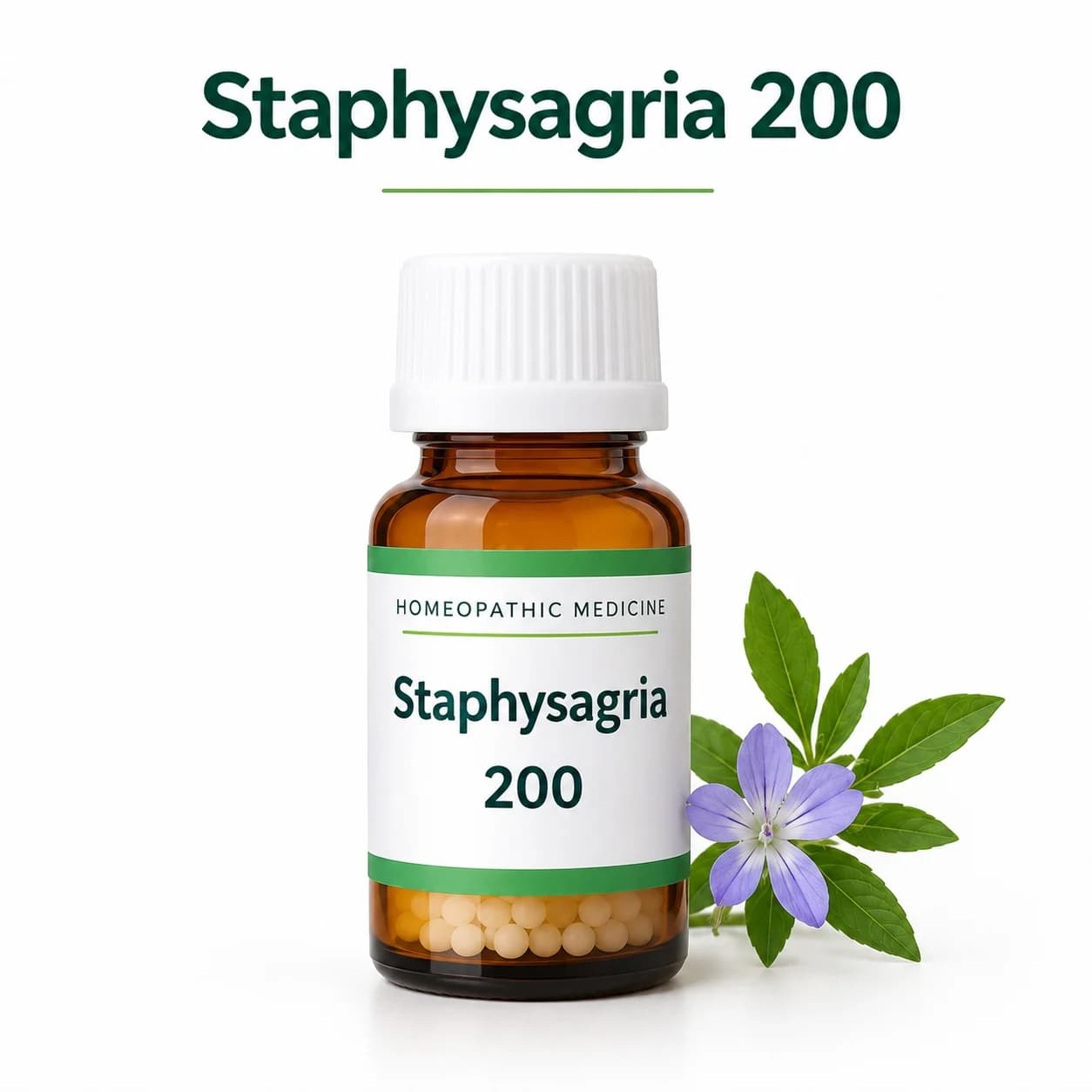
Staphysagria is a homeopathic preparation associated with the plant traditionally known as Delphinium staphisagria. It is sold in forms such as pellets and liquid drops.
The number 200 commonly appears with a dilution notation such as 200C or 200CK. It is a homeopathic designation, not a dose of 200 mg. A name without the full notation does not identify the precise preparation.
Homeopathy uses repeated dilution according to its own principles. It is therefore different from taking an ordinary measured plant extract. Neither a homeopathic product nor the raw plant should be treated as a food or a nutrient source.
What is claimed, and what is established?
Homeopathic descriptions connect Staphysagria with several symptoms and personality-based patterns. These descriptions come from the tradition's system of remedy selection; they do not establish that the product treats the underlying condition.
There is no reliable clinical basis for recommending Staphysagria 200 as an effective treatment for a urinary infection, surgical wound, anxiety disorder or another specific illness. Major evidence assessments have not found reliable evidence supporting homeopathy as a treatment for health conditions generally.
This does not mean a person's discomfort is unimportant. It means the symptom deserves a response that has a reasonable chance of helping, rather than a remedy chosen mainly because an online list sounds familiar.
If the problem is burning during urination
Burning, urgency and frequent urination may occur with a urinary tract infection, but other conditions can produce similar symptoms. A homeopathic remedy cannot identify the cause or reliably clear a bacterial infection.
If there is fever, shivering, pain in the back or side, vomiting or feeling significantly unwell, seek prompt medical care. Pregnancy, symptoms in a man or child, and recurrent or worsening symptoms also need appropriate assessment.
While arranging care, drink a comfortable amount rather than forcing litres. Do not use symptom relief as proof an infection has gone away. If antibiotics are prescribed, take them according to the instructions rather than substituting pellets when the burning starts to settle.
If the concern is a wound or recovery after a procedure
Healing depends on the nature of the injury, wound care, adequate food and management of any complications. Staphysagria should not replace the discharge instructions given after surgery or dental work.
Increasing redness, heat, swelling, pus, worsening pain or fever can indicate a problem that needs review. A wound that opens, bleeds persistently or looks increasingly unhealthy should not be managed by adding more doses of a remedy.
For a family member helping at home, practical support matters: prepare food, help with prescribed dressings and make it easier to attend follow-up. These actions directly address recovery needs without relying on an unproven healing claim.
If you are seeking help for emotional distress
Some descriptions link the remedy to suppressed anger, humiliation or grief. Such experiences deserve care, but matching an emotion to a product is not a dependable mental-health assessment.
Start with what is happening in daily life. Are you sleeping poorly, struggling to function, feeling persistently low or finding anxiety difficult to manage? Talking with a trusted person can help you begin, and persistent difficulties may benefit from professional support.
You do not need to interpret your personality correctly before you deserve help. Nor should a remedy delay counselling, practical support or prescribed treatment when these are needed.
Why an improvement does not prove the remedy worked
Symptoms can change naturally. Rest, reassurance, other treatments and time may all contribute. When several things change together, it is difficult to know which one made the difference.
For example, urinary burning might ease temporarily even while the cause still requires attention. A wound may become less painful during ordinary healing. Feeling heard during a long consultation can also be valuable without demonstrating that a particular product treated the illness.
Give credit to improvement without turning it into proof of a specific mechanism. A useful treatment should be assessed against reliable evidence and meaningful outcomes, not only the timing of a better day.
Highly diluted does not answer every safety question
Some highly diluted homeopathic products may contain little or no measurable starting material. However, products can differ, and manufacturing problems or additional ingredients can create risks. Liquid preparations may contain alcohol; pellets often use a sugar base.
The larger risk can be delaying appropriate treatment. A product that has little direct effect can still be harmful if it encourages someone to wait through a worsening infection or stop effective medicine.
Do not use the raw plant or make a preparation at home. The source plant is not an edible substitute for the homeopathic product. Keep all medicine-like products out of children's reach.
There is no evidence-based dose for self-treatment
Different sellers provide different schedules, but that does not establish a clinically proven dose for the conditions mentioned above. Repeating a dose more often is not a solution to uncertain effectiveness.
Instead, make the next step specific to the problem. Urinary symptoms need an appropriate assessment; wound changes need the treating service; ongoing emotional distress needs support suited to its impact.
Staphysagria 200 does not fill a nutritional gap, and you do not need it as a general wellness habit. The most useful decision is to put the symptom first and choose care that addresses its cause.
Editorial sources
Frequently Asked Questions
Related Articles
Homeopathic Medicine for Deep Sleep: Does It Work?
Homeopathic medicine for deep sleep is low-risk and popular in Indian households, but the clinical evidence behind it is genuinely weak. See where it can reasonably fit into a sleep routine.


Cranberry Juice: Benefits, Sugar and Safety
Cranberry may help prevent some recurrent UTIs but cannot treat one. How to read juice labels, manage sugar and stay safe on warfarin.

How to Make Kidney Strong: Exercises, Yoga & Daily Habits
Keeping kidneys strong comes down to consistent movement, good hydration, and managed stress, not a single supplement or shortcut. See the exercises.
