
Full Body Workout at Home Without Equipment: 30-Minute Daily Plan
This 30-minute daily plan covers all major muscle groups using bodyweight only, producing a complete training stimulus in the time most people spend commuting to a gym. See the full plan.
Key Takeaways
- A 2020 Journal of Strength and Conditioning Research study found 60% greater strength gains.
- Compound bodyweight moves burn 2-3 times the calories of isolated exercises in the same time.
- A 30-minute session burns 200-350 calories while simultaneously building lean muscle.
- Structured as six exercises, three sets each, 45 seconds on and 15 seconds rest.
- Full body training 3-4 days weekly outperforms split training for beginners and intermediates.
- Requires only a floor mat and two metres of space, with a resistance band optional.
A full body workout at home without equipment can produce the same muscle development, fat loss, and fitness improvements as a gym session — when programmed with the correct exercises and progressive overload. This 30-minute daily plan covers all major muscle groups using bodyweight only, producing a complete training stimulus in the time most people spend commuting to a gym.
Benefits of Full Body Home Workout Without Equipment
- Full Body Home Workout No Equipment — Maximum Training Efficiency — Training all major muscle groups in one session produces a stronger anabolic hormonal response (growth hormone, testosterone) than isolated split training — because the large-muscle compound exercises of a full body workout trigger a systemic hormonal signal that drives development across the entire body. Full body training 3–4 days per week consistently outperforms split training for beginners and intermediates in research comparisons.
- Full Body Exercise No Equipment — Maximum Caloric Expenditure — Compound movements (squats, push-ups, burpees) that engage multiple large muscle groups simultaneously produce 2–3× the caloric expenditure of isolation exercises. A 30-minute full body no equipment workout burns 200–350 calories while simultaneously building lean muscle — the most efficient combination for body composition improvement.
- 30 Minute Full Body Workout No Equipment — Sustainable for Any Schedule — 30 minutes, zero equipment, home location — the most accessible fitness format available. No planning, no travel, no cost. A 30 minute full body workout no equipment done consistently produces more results over a year than hour-long gym sessions done inconsistently.
Research: Full body training 3 days per week produces 60% greater strength improvement than split training at the same total volume for beginners and intermediates — Journal of Strength and Conditioning Research, 2020.
How to Get Started with Full Body No Equipment Training
What You Need to Begin
A floor mat. 2 metres of space. Nothing else. All exercises below use bodyweight only. A resistance band is optional for additional challenge when bodyweight becomes insufficient.
Setting Realistic Goals
Beginner: 3 full body sessions per week, 30 minutes each. Month 1: Master the foundational movements. Month 2–3: Add exercise progressions. Month 4–6: Full body composition transformation visible in measurements and photographs.
Start with the Basics
Structure: 6 exercises, 3 sets each, 45 seconds on / 15 seconds rest between exercises, 60 seconds rest between sets. Total time: 28–32 minutes. Follow the exercise list below in order — the sequence is designed to alternate muscle groups for maximum workout efficiency.
Best Full Body No Equipment Exercises
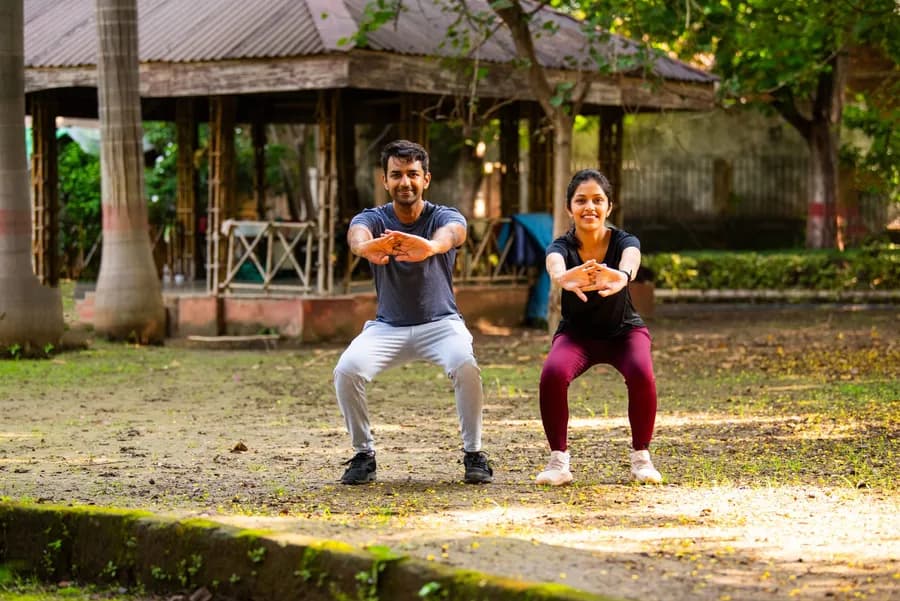
Squat 3×15 · Quads · Glutes · Core · Full Body Foundation
The king of full body exercises — engaging the largest muscle groups for maximum hormonal response and caloric expenditure. Begin each full body session with squats when legs are fresh. Progress to jump squats for elevated cardiovascular demand.
Push-Up 3×10–15 · Chest · Shoulders · Triceps · Core
The foundational upper body push. Alternate between push-up variations for variety: standard, wide, close-grip, decline. Each variation shifts emphasis between chest, shoulder, and tricep without requiring any equipment change.
Burpee 3×10 · Full Body · Cardiovascular · Fat Burning
The most metabolically demanding single bodyweight exercise — combining squat, push-up, and jump. 10 burpees in 60 seconds elevates heart rate to 80%+ maximum — equivalent cardiovascular demand to sprinting. The full body exercise no equipment fat loss.
Glute Bridge 3×15 + 2s Hold · Glutes · Hamstrings · Core
The essential posterior chain exercise in every full body home workout. Activates the glutes and hamstrings that compound exercises leave undertrained. Progress to single-leg when bilateral becomes easy for continued posterior chain development.
Mountain Climber 3×20 Each Leg · Core · Cardiovascular · Full Body
From plank position, drive alternate knees toward the chest at running pace. Simultaneously develops core stability endurance, and cardiovascular conditioning — one of the most space-efficient full body no equipment exercises available.
Plank with Alternating Arm Reach 3×10 Each Arm · Core · Shoulder Stability
From plank, reach one arm forward while maintaining body stability. The most demanding core stability exercise in the routine — requiring the anti-rotation core strength that transfers to all other exercises and athletic activities.
Common Mistakes in Full Body No Equipment Training
- Doing Only Cardio — No Strength — Performing the full body session exclusively at cardiovascular intensity (running in place, jumping jacks) without the strength component misses the muscle-building and metabolic elevation that makes the full body approach uniquely effective. Fix: include both strength-focused exercises (push-ups, squats, glute bridges) and cardiovascular exercises (burpees, mountain climbers) in every session — the combination produces 35% more fat loss than cardio alone.
- Inconsistent Session Structure — Doing random exercises without a structured plan produces unpredictable results and no systematic progressive overload. Fix: follow the same structured session for 4 weeks before changing — track reps and note improvements, since progressive overload requires a consistent baseline to measure progress against.
Who Should Try Full Body Home Workout?
- Beginners — Full body training 3 days per week is the most effective approach for beginners — producing strength and muscle development in every major muscle group simultaneously from the first session.
- Women — Full body training specifically develops the total body toning and lean composition that most women identify as their goal — without the "leg day/arm day" split that most women find tedious and inflexible.
- Older Adults — Full body training maintains all major muscle groups simultaneously — the most practical approach for older adults with limited training time who need comprehensive maintenance across all movement systems.
- Working Professionals — 30 minutes, zero equipment, maximum efficiency — the format that fits any schedule and produces professional fitness results without any gym infrastructure.
Thirty minutes of well-programmed bodyweight training can genuinely move the needle, but the results in this guide compound only when the plan gets followed on repeat, not just on the days motivation shows up. Progressive overload needs something tracking it — which exercises, which reps, which week you're in — and that's a gap sporadic sessions can't close on their own. Strong Everyday gives you exactly that daily full-body structure, so each session builds on the last instead of starting from zero.
Frequently Asked Questions
Related Articles
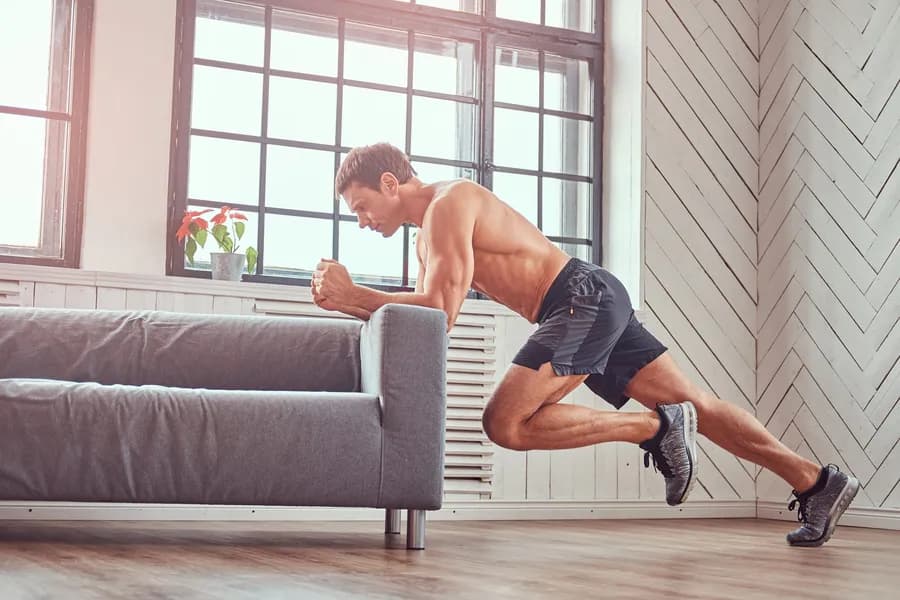
How to Build Body at Home: the Complete No-Equipment Muscle Building Guide
The best available workout is the one performed daily, not the theoretically best programme that requires a commute and a fee. See the complete no-equipment muscle building guide.
Calisthenics for Beginners: the Complete Starter Workout Plan
Your own bodyweight provides all the resistance needed for significant strength and muscle development in the first year of training — no gym, no weights required. See the complete starter workout plan.
What is a Calisthenics Workout? the Complete Beginner's Guide
Bodyweight resistance training, rather than external weights or machines, develops strength, endurance, coordination, and body control. See the complete beginner's guide.
Strength Training Calories Burned: How Much Does a Session Actually Burn?
Strength training burns fewer calories per session than cardio, but produces far greater long-term expenditure through the metabolic elevation it creates. See exactly how much a session burns.
Does Muscle Gain Increase Weight? What the Scale is Not Telling You
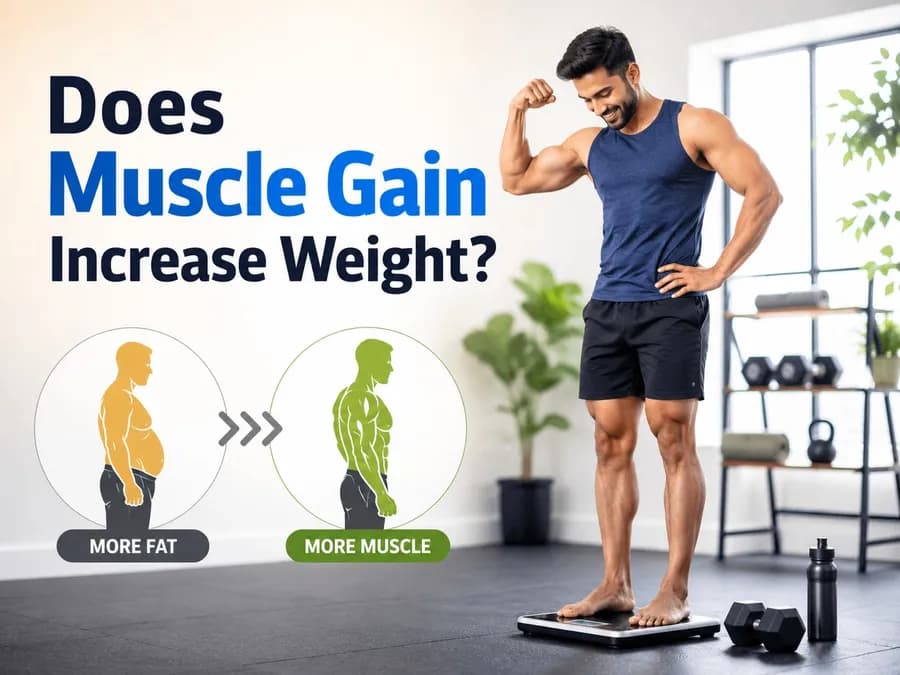
Muscle is roughly 18% denser than fat by volume, so a given weight of muscle takes up less space — the scale can rise, stay flat, or fall while the body visibly transforms. See what the scale isn't telling you.