
Walking vs Skipping for Weight Loss: Which Burns More?
Skipping burns more calories per minute, but walking is easier to keep up for longer. Here's how they really compare for weight loss, and how to combine them.
Key Takeaways
- Minute for minute, skipping burns roughly two to three times more calories than brisk walking.
- Most people can walk for far longer than they can skip, so total calories can end up similar.
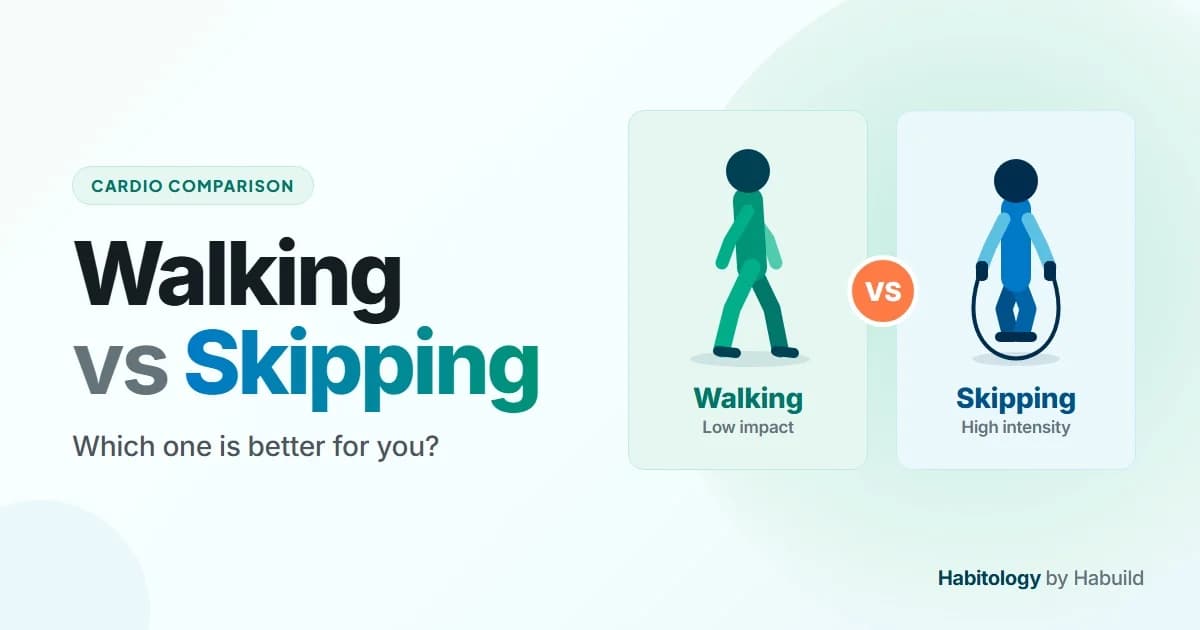
- Skipping is high-impact; walking is gentler on the knees, ankles and pelvic floor.
- Weight loss depends mainly on your overall diet and consistency, not on one exercise.
- Many people do best with daily walking plus short skipping rounds, if their joints allow.
The Short Answer
If you only have ten minutes to spare, skipping will burn more calories than walking in that time. But very few people can skip continuously for half an hour, while most people can walk for 30 to 60 minutes without much trouble. Over a full session, a long brisk walk can use as much energy as a short burst of skipping, or even more.
So the better question is "which can I do regularly, without pain, for months?" For most beginners, that's walking. For people who are already fit with healthy joints, skipping is a useful addition, and many people do best using both.
How Many Calories Do Walking and Skipping Burn?
Exercise scientists compare the effort of different activities using a unit called the MET, short for metabolic equivalent. One MET is roughly the energy your body uses while you sit quietly. An activity rated at 5 METs uses about five times as much energy as sitting. The 2024 Adult Compendium of Physical Activities, a large reference used by researchers around the world, gives these values:
- Walking at a moderate pace (about 4.5 to 5.5 km/h): 3.8 METs
- Brisk walking (about 5.6 to 6.3 km/h): 4.8 METs
- Very brisk walking (about 6.4 to 7.1 km/h): 5.5 METs
- Slow skipping (under 100 skips a minute): 8.3 METs
- Moderate skipping (100 to 120 skips a minute): 11.8 METs
- Fast skipping (120 to 160 skips a minute): 12.3 METs
To turn METs into calories, a commonly used formula is: calories per minute = METs × 3.5 × body weight in kg ÷ 200. Using this, a 60 kg person walking briskly for 30 minutes uses about 150 calories, while 10 minutes of moderate skipping uses about 125 calories. For a 70 kg person, 30 minutes of brisk walking comes to about 175 calories and 45 minutes to about 265 calories, while 10 minutes of moderate skipping uses about 145 calories.
These are estimates. Your real numbers depend on your fitness, body size, technique and how many breaks you take.
Why Calories Per Minute Isn't the Whole Story
On paper, skipping looks like the clear winner. In real life, several things even the score.
The first is duration. Skipping is so intense that most beginners need to stop after 30 seconds to a minute. Once you add the rest breaks, a "10-minute" skipping session may include only five or six minutes of actual jumping. Walking, on the other hand, can be kept up comfortably for an hour, and many people can walk every day without needing recovery days.
The second is consistency. Weight management is the result of what you do week after week, not in a single workout. An activity you enjoy, that fits easily into your day and that doesn't leave you sore, is far more likely to become a habit. For many people, that's a daily walk.
The third, and most important, is food. No exercise can make up for regularly eating more than your body needs. Physical activity supports weight loss and brings many health benefits of its own, but your overall diet usually has a much bigger effect on the number on the scale. Choosing between walking and skipping matters far less than eating sensibly and staying active most days.
How Each One Affects Your Joints and Body
Walking is a low-impact activity because one foot is always in contact with the ground. Each step lands with relatively little force, which is why walking suits most ages and fitness levels, including beginners, older adults and people carrying extra weight. It is usually comfortable for the knees, ankles and hips, and you can make it harder simply by walking faster or finding a slope.
Skipping is a high-impact activity. You land on the balls of your feet hundreds of times in a session, and each landing puts load through your calves, Achilles tendons, ankles and knees. For people with healthy joints who build up slowly, this is usually fine. But for people with existing joint pain, or who increase the amount too quickly, it can lead to aches and overuse injuries.
The repeated bouncing can also be hard on the pelvic floor, the group of muscles that supports the bladder and other organs. This matters especially for women who have recently given birth or who notice bladder leakage during exercise. In these cases, walking is usually the better choice until you have spoken to a doctor or physiotherapist.
There is one benefit to impact, though. The US National Institutes of Health notes that weight-bearing exercise helps build and maintain bone. Both walking and skipping are weight-bearing, and skipping adds more impact, which may give the bones a stronger signal. The key is to match the amount of impact to what your body can handle.
Which One Should You Choose?
Walking is the better starting point if you are new to exercise, returning after a long break, carrying a lot of extra weight, or dealing with knee, ankle, back or pelvic floor problems. It is also the safer choice for older adults and anyone with balance concerns. Because it is gentle, you can do it every day, which makes it one of the easiest ways to build a lasting habit.
Skipping makes more sense if you are already fairly fit, have no joint problems and want a short, intense workout when you are pressed for time. It is also a fun way to build coordination and stamina, and a rope fits easily into a bag. If you enjoy a challenge, a few minutes of skipping can make your routine feel fresh.
How to Combine Walking and Skipping
You don't have to choose just one. Many people get the best of both by walking most days and adding short rounds of skipping when their body is ready. A balanced week might look like this:
- 5 days a week: 30 to 45 minutes of brisk walking
- 2 or 3 of those days: 5 to 10 rounds of 30 seconds skipping and 30 seconds rest after your walk
- 2 days a week: strength training to help you keep muscle while you lose fat
This gives you the steady calorie burn and habit-building of walking, the extra intensity of skipping, and the muscle-protecting benefits of strength work.
Skipping Safely as a Beginner

If you decide to add skipping, start gently and give your body time to adapt:
- Check the rope length: stand on the middle of the rope; the handles should reach about your armpits.
- Wear supportive shoes and skip on a flat, slightly forgiving surface rather than hard concrete.
- Keep your jumps low, just high enough to clear the rope, and land softly on the balls of your feet.
- Start short, with 30 seconds of skipping followed by 30 to 60 seconds of rest.
- Build up over several weeks, so your calves and tendons can get used to the impact.
Stop if you feel sharp pain in your shins, ankles or knees, and rest for a few days before trying again with less volume.
Building a Routine You Can Keep
Whichever activity you choose, the real results come from doing it regularly. Habuild's live sessions include walking along with exercises and yoga, so you can move every day without needing much space or equipment, and the Habuild app's Walk Daily habit helps you keep track of your walks.
Editorial Sources
- 2024 Adult Compendium of Physical Activities – Walking
- 2024 Adult Compendium of Physical Activities – Sports (rope jumping)
- ACE Fitness – 5 Things to Know About Metabolic Equivalents
- NIH NIAMS – Exercise for your bone health
Health Disclaimer
This article is for general information only and is not medical advice. Please consult a doctor before starting high-impact exercise, especially if you have joint problems, a health condition or have recently had a baby.
Frequently Asked Questions
Related Articles

10 Benefits of Walking 30 Minutes a Day for Health, Fitness, and Weight Loss
The trick isn't to walk longer, it's to walk daily, at the right pace, with consistency over months. See all 10 benefits for health, fitness, and weight loss.


Is Running Good for Weight Loss?
Running burns 400-600 calories an hour and raises your resting metabolic rate, though it often plateaus alone after the first few weeks. See why pairing it with strength training produces lasting results.

What Is the Best Exercise for Weight Loss?
Squats, burpees, and HIIT all work — but consistency matters more than which exercise you choose. See the movement types that deliver the strongest results.

How Many Calories Do 10000 Steps Burn?
There is no single calorie number for 10,000 steps. Body size, pace and terrain change the result, so a realistic estimate is a range, not a promise.