
Karana Mudra: Benefits, Steps, Buddha Karana Mudra Meaning & Side Effects
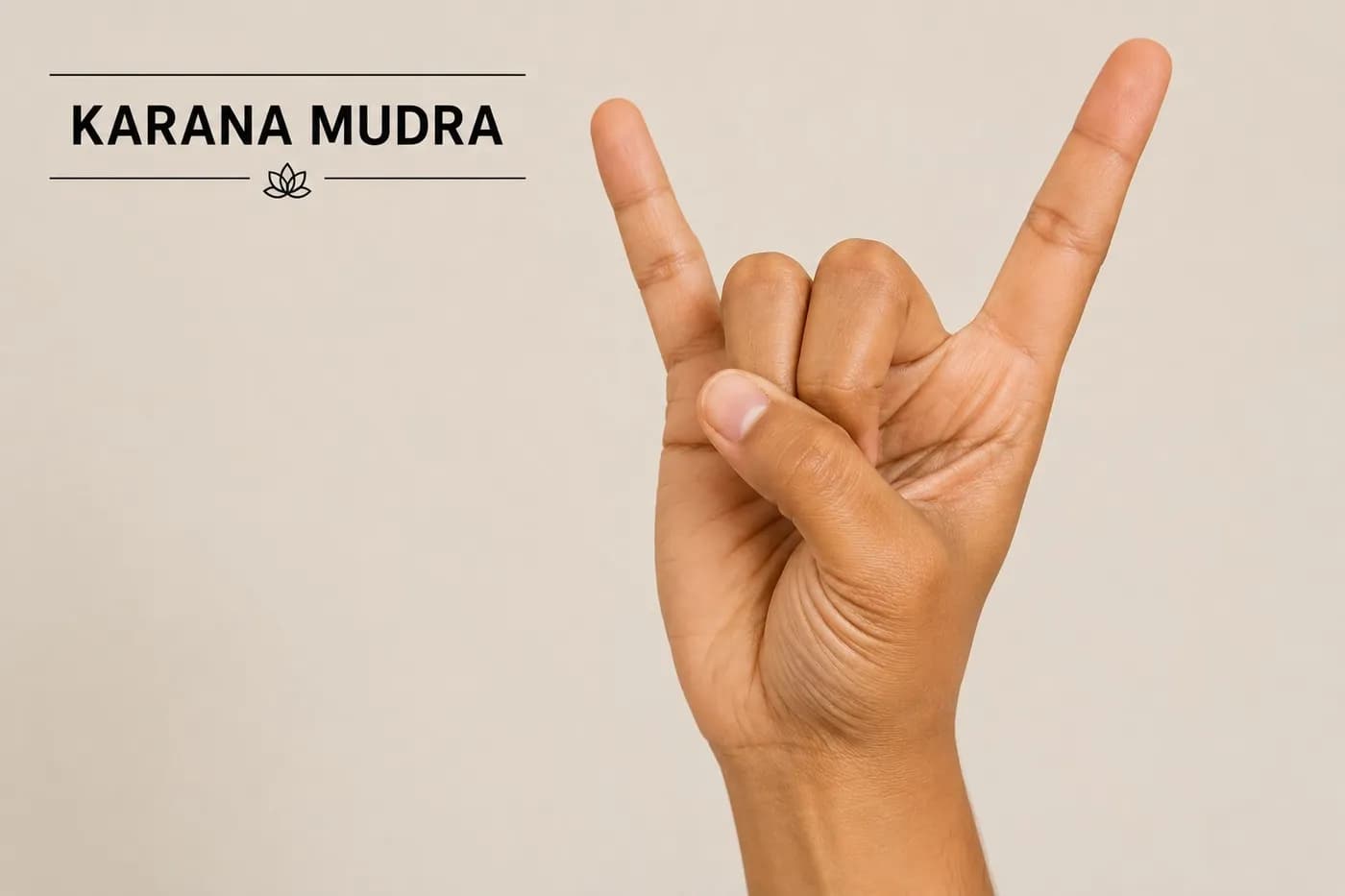
The index and little fingers extend straight up while the middle and ring fingers fold down under the thumb, resembling two upraised horns of energy. See
Key Takeaways
- Its Sanskrit name means ‘the action that ends’ or ‘the gesture that expels.’
- Formed by extending the index and little fingers while the thumb pins the other two down.
- Common in Buddhist iconography, shown warding off negativity in statues of the Buddha.
- Tibetan Vajrayana tradition links it specifically to expelling the five kleshas, mental afflictions.
- Often paired with Dhyana Mudra in Buddha depictions – one hand stillness, one hand protection.
- Engages index and little finger marma points associated with clarity and openness.
What is Karana Mudra?
The Sanskrit word karana means “the act of doing” — but in the specific context of mudra science, it refers to the act of ending, expelling or banishing. The mudra is therefore associated with the energetic action of warding off, removing obstacles and clearing inner negativity.
Karana mudra is most commonly seen in Buddhist iconography — in statues and thangkas of the Buddha, particularly Shakyamuni and various Bodhisattvas, the gesture appears as a protective seal projecting outward. Extended use in Tibetan Vajrayana Buddhism associates the gesture specifically with the practice of expelling kleshas (mental afflictions): greed, hatred, delusion, pride and envy. In buddha karana mudra depictions, the Buddha is shown with one hand in karana mudra and the other indhyana mudra — the combination representing both inner stillness and active protection.
The gesture is formed by extending the index finger and little finger straight up, while the middle finger and ring finger are folded down toward the palm and held there by the thumb. The two raised fingers represent the “horns” or rays that pierce through and expel negativity. Many practitioners explore the broader system through themudras and benefits introduction before adding the protective gestures of karana to their practice.
Karana Mudra Benefits
The benefits of karana mudra are concentrated in three areas — protective energy, mental clarity and the active removal of obstacles.
Physical Benefits
Reduces Physical Symptoms of Fear and Anxiety
The specific neurological activation of Karana Mudra — which engages the index and little finger marma points associated with clarity and openness — triggers a reduction in the physiological symptoms of fear: the breath deepens, heart rate slows, and the muscular tension of the defensive posture (hunched shoulders, contracted chest) begins to release as the gesture holds.
Activates the Throat and Head Energy Centres
The upward extension of the index and little fingers directs energy upward through the arm meridians toward the throat and head chakras. This activation is associated with clearer expression, more decisive thinking, and a reduction in the mental fogginess that accompanies fear and self-doubt.
Mental and Emotional Benefits
Dispels Negative Thought Patterns and Mental Obstruction
The primary psychological application of Karana Mudra is the interruption of repetitive negative thought cycles — worry loops, self-critical rumination, and fear-based anticipatory thinking. The gesture creates a decisive physical shift in the body’s energy posture that, over time, reduces the habitual re-entry into these negative patterns.
Builds Psychological Resilience and Protective Awareness
Practitioners who use Karana Mudra regularly report an increased capacity to maintain inner stability in the face of external challenge — the ability to acknowledge difficulty without being absorbed into it. This quality of protected, stable awareness is the practical meaning of “warding off” in its psychological dimension.
Supports Healing Intention and Focused Energy Direction
In therapeutic yoga contexts, Karana Mudra is used to direct focused protective or healing intent toward specific areas of the body or mind. The gesture is used as an intentional instrument — its effect amplified by clear mental intention held simultaneously with the physical gesture.
How to Do Karana Mudra — Step-by-Step Instructions
Key Principles
- The two raised fingers (index and little) are active — extended firmly but without strain.
- The thumb actively holds the middle and ring fingers down.
- Wrist neutral; elbow soft.
Step 1: Find a Comfortable Seat
Sit in sukhasana, vajrasana or padmasana. Spine tall, shoulders soft, eyes gently closed.
Step 2: Begin with One Hand (or Both)
The classical Buddhist version uses karana mudra on one hand (typically the right), with the other in dhyana mudra in the lap. Healing and tantric traditions sometimes use both hands simultaneously.
Step 3: Form the Gesture
Extend the index finger and little finger straight up, with both fingers fully extended.
Step 4: Fold the Middle and Ring Fingers
Bend the middle finger and ring finger down toward the palm.
Step 5: Press with the Thumb
Place the thumb tip firmly on the nails or upper joints of the bent middle and ring fingers, holding them in place.
Step 6: Position the Hand
Hold the hand at chest level (Buddha-style) or in front of the heart with the palm facing outward, away from the body. The two raised fingers project the protective energy outward.
Step 7: Begin Slow Nasal Breathing
Inhale 4 counts, exhale 6 counts. With each exhalation, internally project the intention of “expelling” what is unwanted.
Step 8: Hold and Observe
Stay for 5–15 minutes to start. Notice any subtle shift in the felt sense of protection, clarity or release.
Step 9: How to Come Out
Slowly release the fingers. Place both palms over the heart for 30 seconds of quiet rest before opening the eyes.
Breathing in Karana Mudra
Pair with slow nasal breath with deliberately extended exhalation. Some practitioners add a quiet “OM” or a personal mantra of release on the exhale.
Preparatory Practices Before Karana Mudra
- 3 rounds of slow anulom vilom — balances the nostril airflow before the active gesture.
- 5 rounds of bhramari pranayama — quiets the mind for focused intention.
- Brief grounding practice — touch the floor with both palms for 30 seconds; this anchors before the projective work.
- Set a clear intention — what specifically are you releasing today? Karana works best with a defined target, not a vague “clear my energy.”
Variations of Karana Mudra
Variation 1: Single-Hand Karana Mudra (Buddhist Classical)
Right hand in karana mudra at chest level, left hand in dhyana mudra in the lap. The most traditional configuration.
Variation 2: Both-Hand Karana Mudra
Both hands form the gesture simultaneously, one at each side of the body or both at chest level. Used in healing traditions for stronger protective effect.
Variation 3: Karana with Mantra
Add a release-focused mantra on each exhale. In Buddhist contexts, the Padmasambhava mantra or specific kleshas-clearing mantras are used. In yogic contexts, “OM Hreem” or a personal release intention works equally well.
Common Mistakes to Avoid in Karana Mudra
- Forming the gesture without an intention — karana mudra is active; it works through clear directed attention. Without intention, it becomes just a hand pose.
- Holding it for too long on day one — the active projecting quality can be tiring. Start with 5 minutes; build up over weeks.
- Skipping the grounding preparation — projecting energy without grounding first can feel destabilising.
- Using karana mudra in mental health crisis — the active expulsive quality is not appropriate during acute psychotic episodes, severe dissociation or active suicidal ideation. Stick to grounding receptive practices in those phases.
- Pointing the gesture at other people — karana mudra is for inner work, not interpersonal “directing.” Pointing it at others is energetically inappropriate and culturally insensitive.
- Approaching karana as the only practice you need — it is most effective as part of a balanced practice that includes receptive (dhyana, anjali) gestures alongside active ones.
Who Should Practise Karana Mudra?
- People Working through Long-Held Emotional Patterns The active, expulsive quality is uniquely well-suited to releasing patterns that purely receptive practices have struggled to shift.
- Practitioners of Buddhist or Tantric Traditions Foundational gesture in many Buddhist meditation lineages, particularly Vajrayana and Mahayana traditions. Approach the practice through your tradition’s specific framework.
- Energy Workers, Reiki Practitioners and Healing Traditions The protective and clearing functions are central to many modern energy-work modalities.
- People Struggling with Emotional Boundaries The “active no” quality of the gesture supports practitioners who find it hard to set clear emotional limits in relationships and at work.
- People in Recovery from Illness, Loss or Major Life Transition The felt sense of protection and active clearing supports the vulnerable phase of recovery. Combine with grounding practices likemuladhara chakra mudra for the lower-chakra anchoring that protective work requires.
- Is Karana Mudra Good for Beginners? Yes, with caveats. The hand position is intuitive within 2–3 attempts. The challenge is not the gesture but the active intentional quality it asks for. Beginners should approach it after at least a few weeks of basic seated meditation practice.
Karana mudra’s protective, grounding quality tends to mean more to practitioners who use it as a regular part of their sitting practice than to those reaching for it only in a difficult moment — familiarity with the gesture is part of what makes it work. Building a few consistent minutes with it into your week is a reasonable place to start. Habuild’s Yoga Everyday program can help fold mudra work like this into a daily meditation practice.
Frequently Asked Questions
Related Articles
Buddha Mudra (Enlightenment Gestures): Meaning, Types and Benefits
Dhyana, Bhumisparsha, Abhaya, Varada, and Vitarka each represent a specific quality of awakened consciousness depicted across Buddhist iconography. See

Gyan Mudra: How to Do It and Its Benefits for Focus and Memory
Practice Gyan Mudra with Habuild. Follow the wisdom hand gesture steps to improve focus, reduce anxiety, and enhance your meditation practice. Start today!
Prana Mudra: How to Practice and Its Life Energy Benefits
Practice Prana Mudra with Habuild. Follow the life force hand gesture steps to boost energy, strengthen immunity, and improve your eye health. Start today!