
Mudra for Stress Relief: Top 5 Hand Gestures for Anxiety, Calm & Emotional Balance
A precise physical gesture, a focused breath, and an inward attention shift together activate the parasympathetic nervous system the body needs for calm.
Key Takeaways
- Works on three levels at once – nerve activation, psychological anchor, and energetic seal.
- Requires no equipment or privacy – practisable at a desk, on a train, or in bed.
- Gyan and Anjali mudras are recommended specifically for acute, immediate calm.
- Hakini Mudra is recommended specifically for focused mental quieting rather than acute calm.
- Research on related contemplative practices links 4-6 weeks of daily practice to lower cortisol.
- Explicitly a supportive practice alongside, never a replacement for, therapy or medication.
What is a Mudra for Stress Relief?
A mudra is a yogic hand gesture that “seals” specific currents of vital energy (prana) inside the body. In the context of stress relief, the mudra works on three levels at once. Physiologically, the precise finger placement activates specific nerve endings in the hand that connect via the vagus nerve to the heart, lungs and gut — the “rest and digest” pathway. Psychologically, the focused attention required to hold the gesture provides a built-in anchor that interrupts rumination. Energetically, the closed circuit formed by the fingers is traditionally said to settle the chaotic outflow of prana that anxiety creates.
A daily hand mudra for stress relief is one of the most accessible mind-body practices available. It requires no equipment, no specific clothing, no privacy and no fitness. You can practise it at your desk between meetings, on a train, in a waiting room, or in bed before sleep. The best mudra for stress relief depends on whether you need acute calm (gyan or anjali), focused mental quieting (hakini), full-body energetic balance (prana) or deep peace (shanti). Many practitioners pair their mudra work with structuredyoga for stress management for compounded effect.
Mudra for Stress Relief Benefits
Physical Benefits
1. Activates the Parasympathetic Nervous System The slow breath that accompanies any mudra practice slows the heart rate, drops blood pressure and shifts the body out of fight-or-flight mode within minutes.
2. Reduces Cortisol and Stress-Hormone Load Daily 15–20 minute mudra practice over 4–6 weeks is associated with measurably lower cortisol levels in research on related contemplative practices.
3. Eases Tension Headaches and Jaw Tightness Many stress sufferers carry their stress in the head, jaw and shoulders. The combination of slow breath and held gesture releases this tension over weeks.
4. Improves Sleep Quality Pre-sleep mudra practice (especially shanti or anjali mudra) helps the nervous system drop into the rest mode that good sleep requires. Pairing the gesture with bhramari pranayama before bed amplifies this effect.
Mental and Emotional Benefits
5. Provides an Acute-Anxiety Anchor When panic or pre-event anxiety hits, forming a deliberate hand gesture and breathing slowly into it gives the mind something concrete to settle on, interrupting the thought spiral.
6. Mudra for Stress Relief and Anxiety — Long-Term Resilience Daily practice gradually rewires the stress response itself. Over months, the same triggers that once produced full-body anxiety begin to produce only a brief flutter that passes.
7. Cultivates Emotional Self-Awareness The quiet attention required to hold a mudra builds the meta-skill of noticing emotions as they arise — the foundation of emotional regulation.
How to Do the Best Mudras for Stress Relief — Step-by-Step
Mudra 1: Gyan Mudra (Wisdom Mudra) — the Universal Daily Practice
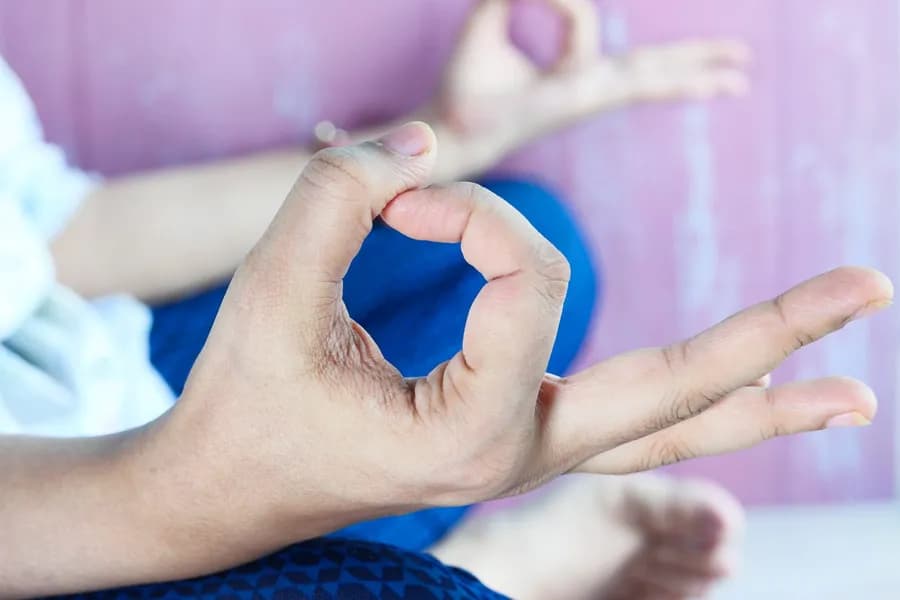
Step 1: Sit in sukhasana or on a chair. Spine tall, shoulders soft. Step 2: Touch the tip of the index finger to the tip of the thumb on each hand. Other three fingers extended. Step 3: Rest hands on knees, palms upward. Step 4: Slow nasal breathing — inhale 4, exhale 6. Step 5: Hold for 15–20 minutes daily, ideally morning.
Mudra 2: Hakini Mudra (Concentration Mudra) — for Pre-Meeting or Pre-Exam Anxiety
Step 1: Touch the corresponding fingertips of both hands together — right thumb to left thumb, right index to left index, and so on. Eyes look gently upward. Step 2: Hold at chest level or in front of the third-eye point. Step 3: Slow nasal breath. Hold 5–10 minutes before any high-stress task. The dedicatedbenefits of hakini mudra page covers the cognitive science behind this gesture.
Mudra 3: Prana Mudra — for Full-Body Energetic Balance
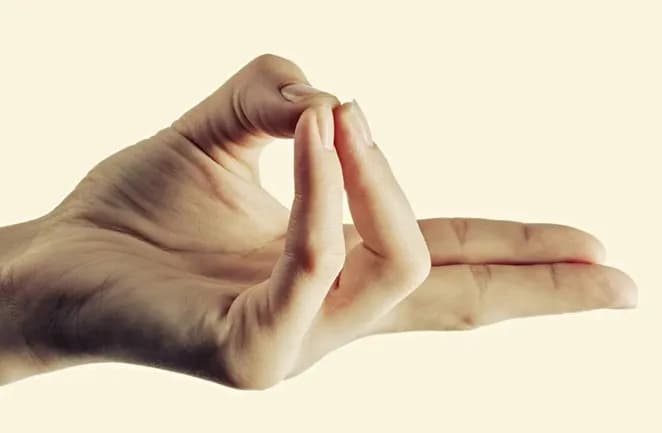
Step 1: Bring the tips of the thumb, ring finger and little finger together on each hand. Index and middle fingers extended. Step 2: Rest hands on thighs, palms upward. Step 3: Slow nasal breath. Hold 15 minutes daily for vitality and emotional balance.
Mudra 4: Anjali Mudra (Salutation Mudra) — for Heart-Centred Calm
Step 1: Bring both palms together at the heart-centre, fingers pointing upward. Step 2: Slow nasal breath, with attention at the heart. Step 3: Hold 5–10 minutes for grounding and gratitude.
Mudra 5: Shanti Mudra (Peace Mudra) — for Deep Pre-Sleep Calm
Step 1: Sit or lie comfortably. Touch the thumb tip to the tip of the ring finger on each hand. Other fingers gently extended. Step 2: Rest hands on the lower abdomen. Step 3: Slow diaphragmatic breath. Hold 15 minutes before sleep.
Breathing in Stress-Relief Mudras
Pair every mudra with slow nasal breath (4-in, 6-out). Add bhramari pranayama (humming bee breath) for acute anxiety. Avoid kapalbhati and bhastrika during high-stress phases — they can activate rather than calm.
Preparatory Practices Before Stress-Relief Mudras
- 3 rounds of slow anulom vilom — balances the nostril airflow and prepares the nervous system.
- Shoulder rolls (10 each direction) — releases the upper-back tension that holds chronic stress.
- Brief body scan (2 minutes) — releases physical tension before the mudra.
- 5 rounds of bhramari pranayama — the humming directly soothes the vagus nerve.
Variations and How to Sequence Them
Variation 1: Daily Stress-Resilience Sequence
Gyan mudra (15 min) → Anjali mudra (5 min) → Slow nasal breath (5 min). Use every morning before the day’s demands begin.
Variation 2: Acute Anxiety Sequence
Hakini mudra (5 min) → Slow nasal breath with extended exhale (5 min) → Bhramari pranayama (5 rounds). Use in the moment when anxiety strikes.
Variation 3: Pre-Sleep Sequence
Shanti mudra (15 min, lying down) → Slow nasal breath. Use 30 minutes before bed.
Variation 4: Workplace Stress Sequence
Hakini mudra (5 min before a meeting) → Anjali mudra at the heart (1 min between calls) → Gyan mudra during commute (10 min).
Common Mistakes to Avoid in Mudra for Stress Relief
- Pressing the fingertips so hard the hand cramps — feather-light contact only. Stress mudras should reduce tension, not create it.
- Holding the breath while concentrating — common mistake during anxiety. Keep breath flowing slow and steady.
- Practising for two minutes once a week — the practice is cumulative. 15 minutes daily for 6 weeks beats 60 minutes once a fortnight.
- Switching mudras every day looking for the magic one — pick gyan or prana mudra and stay with it for 30 days before evaluating.
- Hunching the shoulders forward during practice — closes the chest and raises the heart rate. Keep shoulders dropped.
- Replacing therapy or medication with mudra practice — for clinical anxiety, depression or panic disorder, mudras are supportive only. Continue prescribed care.
Who Should Practise Mudra for Stress Relief?
- People with Daily Workplace or Caregiver Stress A 15-minute morning gyan mudra practice provides a baseline of calm that the day’s demands chip away at slowly rather than overwhelming you in one rush.
- People with Pre-Event or Performance Anxiety Hakini mudra before meetings, presentations, exams or interviews is one of the most reliably useful mudra applications.
- People with Mild to Moderate Generalised Anxiety Daily practice supports nervous-system rebalancing alongside therapy, medication and lifestyle care.
- People with Sleep-Onset Difficulty Shanti mudra paired with slow breath is a gentle, non-pharmaceutical aid to falling asleep.
- People in Recovery from Burnout The compound effect of daily mudra practice with structured asana work and gentle pranayama is exquisitely suited to nervous-system recovery from burnout. Many practitioners also benefit from the dedicatedyoga for nervous system work.
- Is Mudra for Stress Relief Good for Beginners? Yes — and especially recommended for beginners because the practice requires no flexibility, no equipment and no privacy. Start with gyan mudra.
The calm a stress-relief mudra offers in the moment is real, but it’s the daily return to it — the same gesture, the same few conscious breaths, practised regardless of how the day has gone — that gradually lowers your baseline reactivity rather than just easing a single spike of anxiety. That’s a matter of repetition more than any single technique. Habuild’s Yoga Everyday program pairs calming mudra and breath work into a guided daily session you can return to.
Frequently Asked Questions
Related Articles
Gyan Mudra: How to Do It and Its Benefits for Focus and Memory
Practice Gyan Mudra with Habuild. Follow the wisdom hand gesture steps to improve focus, reduce anxiety, and enhance your meditation practice. Start today!

Prana Mudra: How to Practice and Its Life Energy Benefits
Practice Prana Mudra with Habuild. Follow the life force hand gesture steps to boost energy, strengthen immunity, and improve your eye health. Start today!
Hasta Mudras: A Complete Guide to Hand Gestures and Their Benefits
Practice hasta mudras with Habuild. Explore the best yoga hand gestures to balance the five elements, direct prana, and support health and healing. Start today!