
What Is Meditation? Meaning, History and How It Works
What is meditation, really? A simple answer — no mysticism, no special posture required — plus its history and how the practice actually works. Learn it step by step with Habuild's guided sessions.
Key Takeaways
- Meditation is training attention on purpose, not achieving a blank mind.
- Thoughts will keep appearing – noticing and returning is the actual practice.
- Built on three ingredients: attention, awareness, and non-judgment.
- Believing meditation requires total silence is the top reason beginners quit.
- Related to but distinct from yoga, pranayama, and prayer.
- Every ‘coming back’ from a wandering mind counts as a successful rep.
If you’ve typed “what is meditation” into a search bar, chances are you’ve also heard at least one confusing, contradictory answer already — sit and empty your mind, chant something, breathe a certain way, buy a special cushion. So let’s answer it plainly. What is meditation, at its core? It’s simply a mental practice of training your attention and awareness, on purpose, so your mind gets a little steadier and a little kinder over time. That’s it. No mysticism required, no special posture mandatory, no need to believe in anything at all. Every other definition you’ve heard is really just a variation on this same simple answer to what is meditation. In this guide, we’ll walk through what meditation actually means, correct the one misconception that makes most beginners quit in the first week, look briefly at where it came from, and show you how it’s different from — and related to — yoga, pranayama, and prayer.
What Is Meditation, Really?
Here’s the short version: meditation is the practice of deliberately directing your attention — usually to something simple like your breath, a sound, or a sensation in the body — and gently, repeatedly, bringing it back whenever it wanders. That’s what is meditation in one sentence. You’re not trying to stop thoughts from happening. You’re training a skill, the same way you’d train a muscle, except the muscle here is your attention.
This is where the meditation meaning gets misunderstood most often. A lot of people believe meditation means achieving total mental silence — a blank, thought-free mind, held that way for twenty minutes straight. If that’s your bar for success, you will fail at it almost immediately, feel like meditation “isn’t for you,” and quit. Please don’t. That definition of meditation was never accurate to begin with.
Thoughts will keep showing up. That’s what minds do. What is meditation actually asking of you is not the absence of thoughts, but a different relationship with them — noticing a thought has appeared, not chasing it down a rabbit hole, and gently returning your attention to your anchor (the breath, most commonly). Every single time you notice you’ve wandered and you come back, that’s a successful rep. Not a failure. That return is the whole exercise, repeated many times in one sitting, the same way a bicep curl is one small rep repeated many times to build strength.
So if someone asks you what is meditation in the simplest words possible, you can tell them this: it’s practising the art of coming back — back to the present moment, back to the breath, back to now — again and again, without judging yourself for having wandered off in the first place.
The Real Mechanics: Attention, Awareness, and Non-Judgment
Strip away the incense and the soft instrumental music, and what is meditation actually built from are three simple ingredients working together.
Attention is the anchor. It’s the one thing you choose to keep coming back to — your breath moving in and out, the feeling of your feet on the floor, a candle flame, a repeated word or mantra. Almost any single point of focus works, as long as you use the same one consistently in a sitting.
Awareness is the noticing. It’s the part of you that catches your mind drifting off to your to-do list, or replaying an argument from yesterday, or planning what to cook for dinner. Awareness doesn’t judge the drifting — it simply notices, “oh, I’ve wandered,” which is actually a small moment of clarity, not a failure.
Non-judgment is the gentleness you apply to that noticing. Instead of scolding yourself — “ugh, I’m so bad at this, my mind never stops” — you simply guide your attention back, the way you’d guide a puppy back to its bed without shouting at it. Over weeks and months, this gentle repetition is what builds the calmer, steadier mind that people talk about when they describe the benefits of a regular practice.
Put those three together — a steady point of attention, honest awareness of when you’ve drifted, and a non-judgmental return — and you have the entire mechanism. There’s no hidden fourth ingredient. This is genuinely what is meditation reduced to its simplest working parts, and it’s why the practice translates so easily across religions, cultures, and even secular, clinical settings today.
Where Meditation Comes From: A Brief History
The origins of meditation trace back thousands of years to the Indian subcontinent, long before the word “meditation” existed in English. Early references appear in the Vedas, some of the oldest sacred texts in the world, and the practice was refined further within Hindu, Buddhist, and Jain traditions over the centuries that followed. Long before smartphones or stress-management apps, sages and monks were already asking a version of what is meditation for, and building structured techniques — some focused on breath, some on sound, some on visualisation — to train the mind toward stillness and insight.
From India, these techniques travelled along ancient trade and pilgrimage routes into Southeast Asia, China, Japan, and Tibet, evolving into distinct schools like Zen and Vipassana along the way, each with its own flavour but the same underlying idea of trained attention. It stayed largely within spiritual and monastic settings for most of history, and for centuries, what is meditation actually for was answered almost entirely in religious terms.
The big global shift happened in the twentieth century, when meditation started moving out of temples and monasteries and into hospitals, schools, and offices, especially in the West, under the friendlier, secular label of “mindfulness.” Researchers began studying it seriously in clinical settings from the 1970s onward, stripping away religious framing so that people of any background could learn it purely as a mental training technique. That’s a big part of why, today, someone can practice meditation without following any particular faith — the tools were built inside a spiritual tradition, but the skill itself was never exclusive to one.
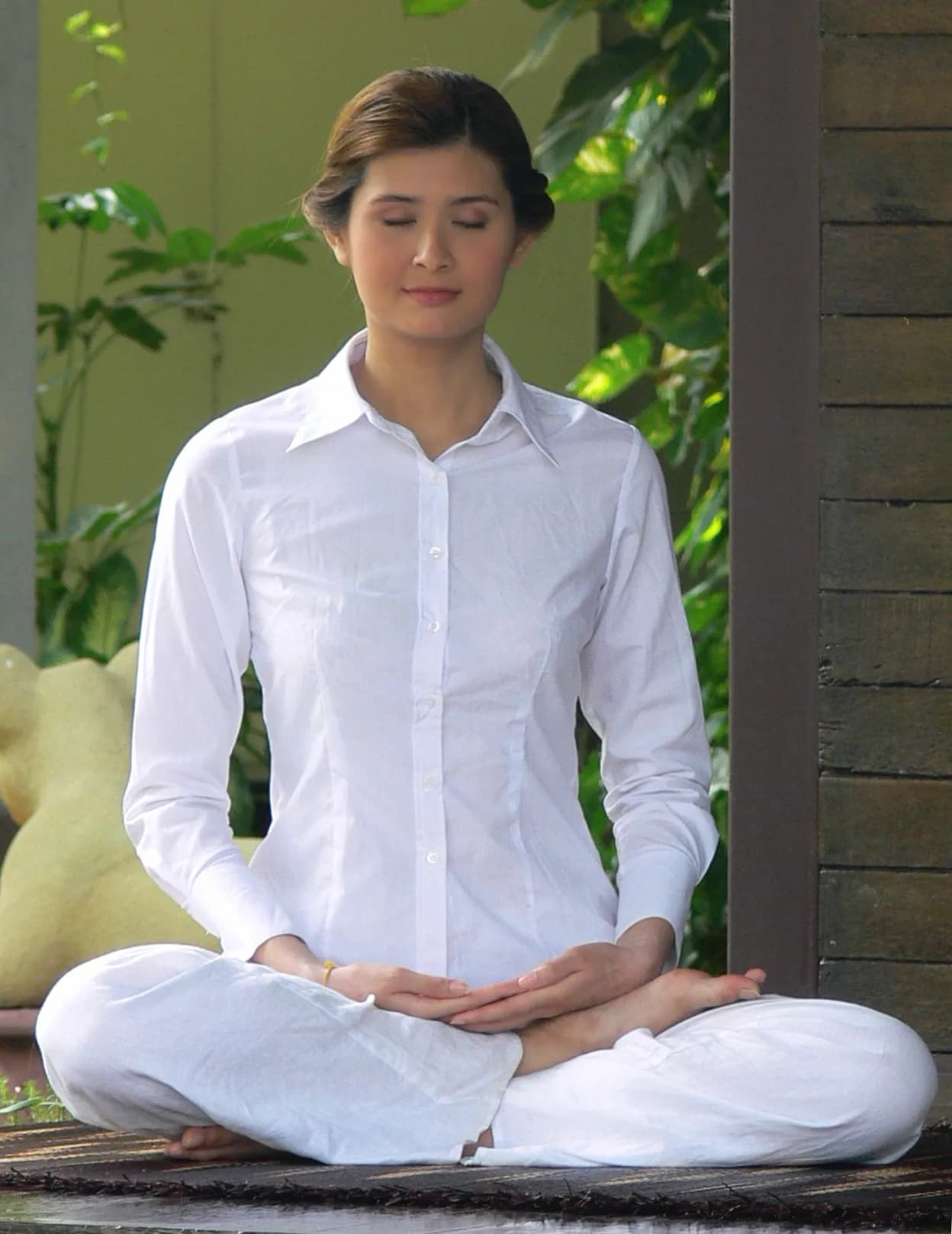
Photo via Wikimedia Commons, CC BY 3.0
Meditation vs Yoga, Pranayama, and Prayer
People often use these words interchangeably, so it’s worth being precise about what is meditation and what it isn’t.
Yoga, in the way most people use the word today, usually refers to asana — the physical postures like downward dog or warrior pose. Asana works the body: strength, flexibility, balance. Meditation works the mind: attention, awareness, calm. They’re closely related cousins from the same broader tradition, often practiced together, but they aren’t the same thing. If you’re curious about exactly where the line sits between them, our detailed guide on the difference between yoga and meditation breaks it down clearly.
Pranayama is breath control — specific techniques for regulating how you inhale, hold, and exhale, often used to energise or calm the nervous system quickly. Meditation can use the breath as its anchor, but pranayama’s real goal is managing the breath itself, while meditation’s real goal is training attention using the breath (or any other anchor) as a tool.
Prayer, in most traditions, involves addressing or communicating with a higher power — asking, thanking, surrendering. Meditation doesn’t require any of that. You can absolutely combine the two if you have a faith practice, and many people do, but meditation itself doesn’t need a deity, a doctrine, or a belief system to work.
If sitting still for meditation feels physically awkward at first, posture does matter a little, though far less than people assume — you really just need a spine that isn’t slumped and a body that isn’t in pain. Our guide to yoga poses for meditation is a good place to find a seated position your knees and back will actually thank you for.
Who Is Meditation For?
Everyone. Genuinely. There’s no entry requirement. If you’re still wondering what is meditation going to ask of you personally, the honest answer is: very little — a few quiet minutes and a willingness to keep returning your attention.
You don’t need to be flexible — meditation isn’t a physical practice like asana, so tight hips or a stiff back don’t disqualify you. You don’t need any special equipment — a chair, a cushion, or even your own bed works fine. You don’t need to follow any particular religion, or none at all; the technique itself is neutral, even though it was born inside spiritual traditions. You don’t need large blocks of free time either — five honest minutes a day beats an occasional forty-five-minute session you can never sustain.
This is really the heart of what is meditation for, in practical terms: it meets you exactly where you are. Students use it before exams. New parents use it to steady themselves through sleepless nights. Working professionals use it to reset between back-to-back meetings. Grandparents use it the same way their own grandparents once did, simply without a fancy label for it. Athletes, artists, homemakers, teenagers, retirees — the practice adapts to whoever shows up for it, because what is meditation asking of you is so basic (attention, awareness, gentleness) that it doesn’t discriminate by age, body type, or belief.
How to Actually Begin
Understanding what is meditation intellectually is one thing; sitting down and doing it is another, and that’s really where the value lives.
Start absurdly small. Sit somewhere quiet, close your eyes, and follow your breath for just three to five minutes. When your mind wanders — and it will, probably within the first ten seconds — notice it without frustration, and gently bring your attention back to the breath. That’s the entire practice. Repeat it daily, at roughly the same time if you can, because consistency teaches your mind to expect and settle into the habit far faster than intensity does. If you take away only one thing from this guide, let it be this: what is meditation, in practice, is simply this small loop, repeated without judgment, day after day.
Once this basic anchor-and-return skill feels familiar, it’s worth exploring the different styles built on top of it — breath-focused, mantra-based, body-scan, walking, and more — and our full guide to the types of meditation in yoga is a useful map for choosing one that suits your personality and goals. Some people are naturally drawn to sound and repetition, others to stillness and silence, and there’s no single “correct” style, only the one you’ll actually return to tomorrow.
If you’d like a structured way to build this into a genuine daily habit rather than a once-in-a-while good intention, Habuild’s free yoga challenge weaves short daily practice — including simple meditation — into a routine designed to actually stick, one manageable day at a time.
Frequently Asked Questions
Related Articles

10 Minute Meditation: A Quick Daily Reset
A 10 minute meditation is long enough to settle into real calm and short enough to actually do daily. Find your own quick daily reset with Habuild's guided sessions.
Meditation for ADHD: What Actually Helps
Meditation for ADHD isn't a treatment or cure — it's a support for attention regulation, used alongside proper diagnosis and care. See what realistically helps, and try guided sessions with Habuild.
Buddha Meditation: An Introduction to the Traditions
Buddha meditation isn't one technique but a family of traditions, all rooted in training the mind to see clearly rather than react on autopilot. Explore the main schools, and try guided sessions with Habuild.