
How Many Steps Per Day by Age? What Research Shows
Is 10,000 steps right for everyone? Research suggests the number that matters changes with age. Here's what studies show and how to reach your target.
Key Takeaways
- In a large 2022 study, the benefit levelled off at 6,000 to 8,000 steps a day for adults over 60.
- For adults under 60, the same study found the benefit levelled off at 8,000 to 10,000 steps.
- 10,000 steps is a useful goal, but it isn't a magic number for everyone.
- Children and teenagers usually take more steps than adults.
- Pace matters too: about 100 steps a minute is roughly moderate-intensity walking.
Why Steps Are a Useful Measure
Counting steps is one of the easiest ways to track how active you are. Most phones count them automatically, and the number is simple to understand: more steps usually means more movement. That makes step counts a popular way to set daily goals and see progress over time.
But "how many steps a day should I take?" doesn't have one answer for everyone. A target that suits a 30-year-old office worker may be unrealistic for an 80-year-old, and too low for an active child. Research suggests that the number that matters most changes with age, so it's worth looking at what studies show for each stage of life.
Steps Per Day by Age: What Research Shows
Children and teenagers
A 2011 review by Tudor-Locke and colleagues looked at step counts in young people around the world. It found that boys typically take about 12,000 to 16,000 steps a day, while girls typically take about 10,000 to 13,000. Step counts tend to fall during the teenage years, dropping to about 8,000 to 9,000 a day by age 18 as school, screens and other commitments take over.
The researchers also estimated how many steps match the 60 minutes of moderate to vigorous activity usually recommended for children each day. For primary-school boys, that was roughly 13,000 to 15,000 steps, and for girls roughly 11,000 to 12,000. The authors described these figures as preliminary, but they show that active play adds up to a lot of steps.
Adults under 60
In 2022, The Lancet Public Health published a large analysis led by Amanda Paluch. It combined data from 15 studies and more than 47,000 adults, who were followed for a median of about 7 years. The researchers found that people who took more steps each day had a lower risk of dying during the study period.
For adults under 60, the benefit kept increasing up to about 8,000 to 10,000 steps a day and then levelled off. Going beyond that wasn't harmful, but the extra benefit was small.
Adults 60 and over
In the same analysis, the benefit for adults aged 60 and over levelled off sooner, at about 6,000 to 8,000 steps a day. That's encouraging news for older adults, because it suggests that a realistic daily target can bring most of the benefit.
A separate review of older adults found that healthy older people typically take anywhere from 2,000 to 9,000 steps a day. It suggested that about 7,000 to 10,000 steps a day is roughly what 30 minutes of daily moderate activity adds on top of normal movement.
People living with a health condition
For people with long-term health conditions or disabilities, average daily steps vary widely, from about 1,200 to 8,800 in one review. Because needs differ so much, a doctor or physiotherapist can help you set a target that is safe and realistic for your situation.
Steps by Age at a Glance
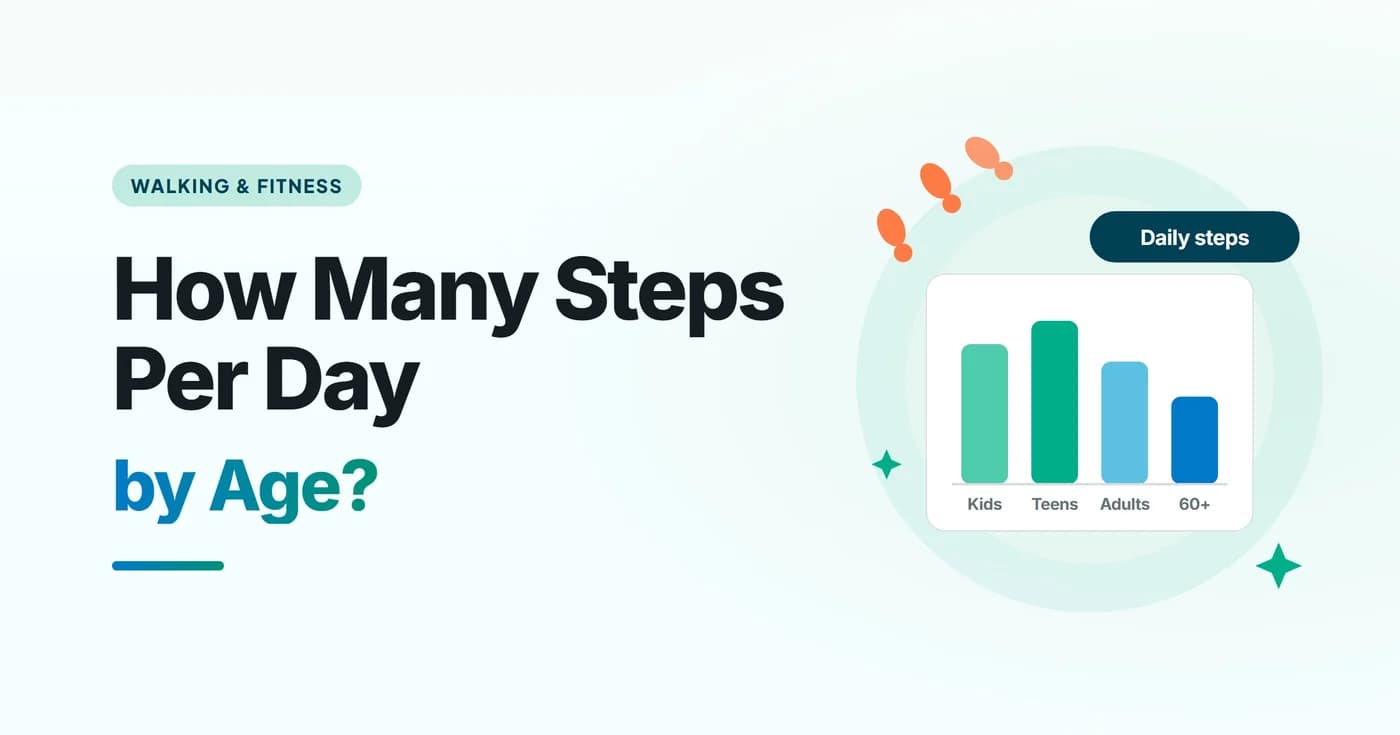
- Children (6 to 11 years): often 10,000 to 16,000 steps a day
- Teenagers: steps usually fall with age, to about 8,000 to 9,000 by 18
- Adults under 60: benefit levelled off at about 8,000 to 10,000 steps a day
- Adults 60 and over: benefit levelled off at about 6,000 to 8,000 steps a day
- People with health conditions: a personal target set with your doctor
These are research findings rather than strict rules. Any increase from where you are now is a step in the right direction.
What About 10,000 Steps?

10,000 steps a day is a popular goal, and it's a good one for many younger adults. But the research above shows that you don't need to reach 10,000 steps to benefit. For older adults, 6,000 to 8,000 steps may give most of the benefit, and for anyone who is currently inactive, smaller increases matter a lot. If you take 3,000 steps a day now, reaching 5,000 or 6,000 is already a meaningful improvement.
Why Pace Matters as Much as the Count
Not all steps are equal. Slow steps around the house are still good for you, but brisk steps give your heart and lungs more of a workout. Researchers often use about 100 steps a minute as a rough marker of moderate-intensity walking. At that pace, 3,000 steps in 30 minutes is roughly a brisk 30-minute walk.
WHO recommends that adults do at least 150 minutes of moderate activity a week, which you could meet with five brisk 30-minute walks. So a good daily goal combines both ideas: enough steps spread across the day, and at least some of them taken at a brisk pace.
How to Increase Your Daily Steps
Start by checking your baseline: look at your phone's average for the past week so you know where you're starting from. Then add a little at a time, increasing your daily average by about 500 to 1,000 steps and keeping it there for a week or two before adding more. Small, steady increases are easier to sustain than big jumps.
Short walks after lunch and dinner add up quickly, and walking in place indoors during TV breaks, phone calls or rainy days can fill the gaps. Taking the stairs for a floor or two instead of the lift helps too. Finally, try to make at least one walk a day brisk, aiming for 20 to 30 minutes on most days.
Do Steps From Workouts and Yoga Count?
Yes, if your phone or tracker records them. Walking in place, warm-ups and moving around during a workout all add steps. Habuild's live sessions include walking along with exercises, yoga and breathing, and the Habuild app's Walk Daily habit helps you keep track of your walks.
When to Talk to a Doctor
Speak to a doctor before significantly increasing your activity if you have heart disease, diabetes, high blood pressure, joint problems or balance problems, or if you are pregnant. Stop walking and seek advice if you get chest pain, dizziness or unusual breathlessness.
Editorial Sources
- Paluch et al. – Daily steps and all-cause mortality, The Lancet Public Health (2022)
- Tudor-Locke et al. – How many steps/day are enough? For older adults and special populations (2011)
- Tudor-Locke et al. – How many steps/day are enough? For children and adolescents (2011)
- WHO – Be Healthy: Physical activity
Health Disclaimer
This article is for general information only and is not medical advice. Please consult a doctor before increasing your activity, especially if you have a health condition, an injury or are pregnant.
Frequently Asked Questions
Related Articles

How Many Calories Do 10000 Steps Burn?
There is no single calorie number for 10,000 steps. Body size, pace and terrain change the result, so a realistic estimate is a range, not a promise.


Average Walking Speed by Age: What's Normal?
How fast do people normally walk, and does it change with age? Here's what research shows about average walking speed, why it matters for health and how to improve yours.


10 Benefits of Walking 30 Minutes a Day for Health, Fitness, and Weight Loss
The trick isn't to walk longer, it's to walk daily, at the right pace, with consistency over months. See all 10 benefits for health, fitness, and weight loss.

Strength Training for Older Adults: Benefits, Exercises & How to Start
Resistance exercise two to three times a week helps preserve muscle mass, support bone density, and maintain the functional strength needed for everyday independence, at any age from 50 onwards. See the key benefits and best exercises.