
Karana Mudra (Gesture of Warding off Evil): Steps, Benefits and Precautions
One of the most widely depicted mudras in Hindu and Buddhist iconography, used to dispel negative thought patterns and create a protected inner space for
Key Takeaways
- Also known as Tarjani Mudra, resembling the modern ‘rock on’ or devil-horns hand shape.
- Depicted as a gesture of the Medicine Buddha, specifically representing protection from harm.
- The extended little finger represents openness, distinct from the index finger’s clarity symbolism.
- Used at the start of meditation specifically to clear obstacles before settling into practice.
- Also used mid-practice to interrupt negative thought cycles during challenging emotional states.
- Its yogic and Buddhist origins predate the gesture’s modern Western associations by a millennium.
What is Karana Mudra?
The word “Karana” in Sanskrit has multiple meanings including cause, instrument, and action — but in this mudra context it is most commonly translated as the gesture that removes or wards off obstacles. It is pronounced “kah-rah-nah” and is also known in some traditions as the Tarjani Mudra or the gesture of admonition. In Buddhist iconography, it is depicted as a gesture of the Medicine Buddha and is widely used to represent protection from harm and the dispelling of negative forces.
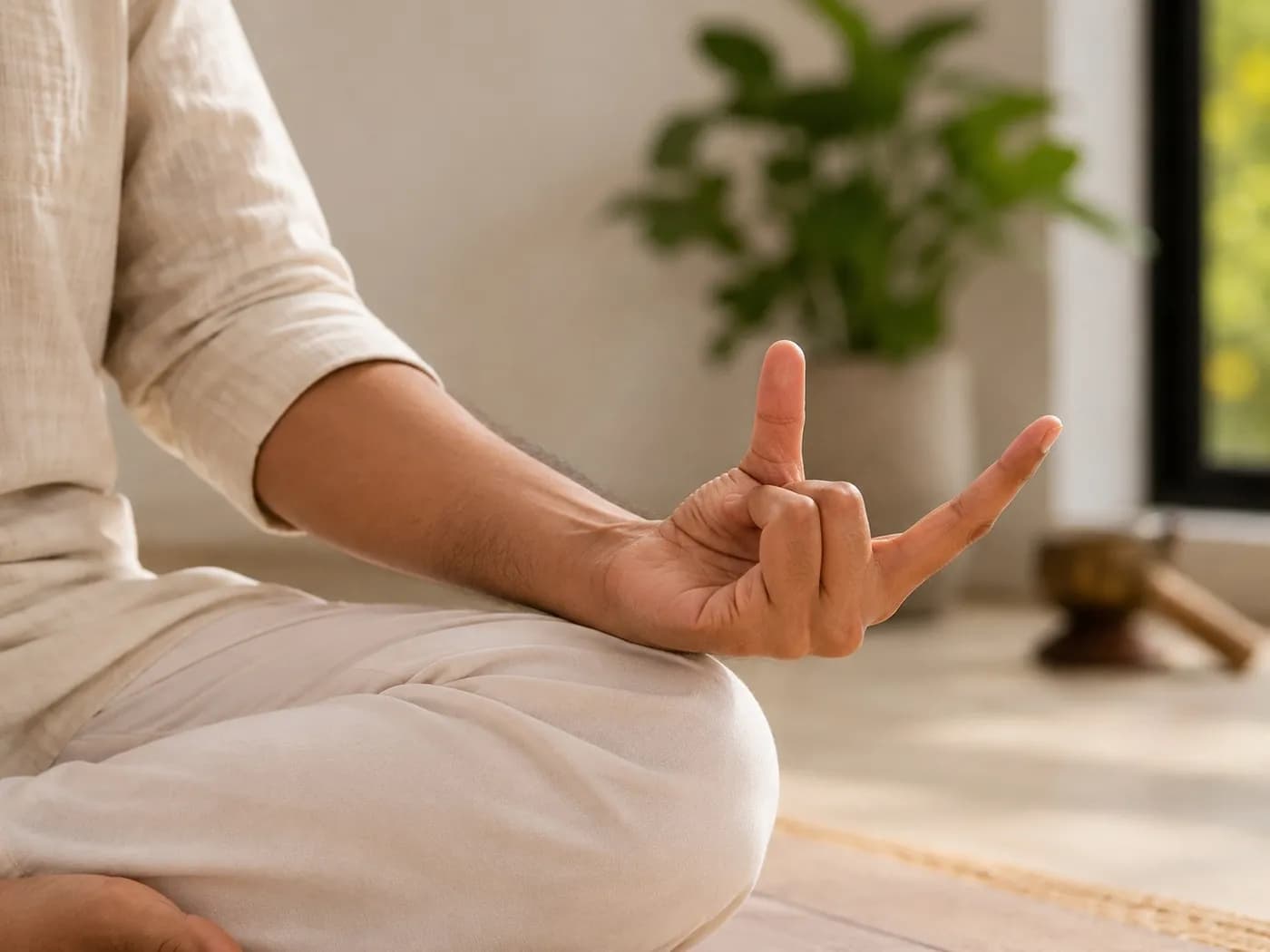
The gesture is formed by extending the index finger and little finger upward while the thumb holds the middle and ring fingers down. In Western contexts, this hand shape is sometimes recognised as the “rock on” or “devil horns” gesture — though its yogic and Buddhist origins predate these modern associations by over a millennium. The extended index finger represents clarity of mind and the pointing of awareness toward truth; the extended little finger represents openness; the thumb holding the middle fingers represents the controlled, directed nature of this protective awareness.
In practice, Karana Mudra is used at the beginning of meditation to clear mental obstacles, during challenging emotional states to interrupt negative thought cycles, and in healing contexts to direct protective energy toward areas of the body or mind that require support.
Karana Mudra Benefits
Physical Benefits
- Reduces Physical Symptoms of Fear and Anxiety The specific neurological activation of Karana Mudra — which engages the index and little finger marma points associated with clarity and openness — triggers a reduction in the physiological symptoms of fear: the breath deepens, heart rate slows, and the muscular tension of the defensive posture (hunched shoulders, contracted chest) begins to release as the gesture holds.
- Activates the Throat and Head Energy Centres The upward extension of the index and little fingers directs energy upward through the arm meridians toward the throat and head chakras. This activation is associated with clearer expression, more decisive thinking, and a reduction in the mental fogginess that accompanies fear and self-doubt.
- Dispels Negative Thought Patterns and Mental Obstruction The primary psychological application of Karana Mudra is the interruption of repetitive negative thought cycles — worry loops, self-critical rumination, and fear-based anticipatory thinking. The gesture creates a decisive physical shift in the body’s energy posture that, over time, reduces the habitual re-entry into these negative patterns.
- Builds Psychological Resilience and Protective Awareness Practitioners who use Karana Mudra regularly report an increased capacity to maintain inner stability in the face of external challenge — the ability to acknowledge difficulty without being absorbed into it. This quality of protected, stable awareness is the practical meaning of “warding off” in its psychological dimension.
- Supports Healing Intention and Focused Energy Direction In therapeutic yoga contexts, Karana Mudra is used to direct focused protective or healing intent toward specific areas of the body or mind. The gesture is used as an intentional instrument — its effect amplified by clear mental intention held simultaneously with the physical gesture.
Mental and Emotional Benefits
How to Do Karana Mudra — Step-by-Step Instructions
Key Principles
Karana Mudra can be practised with one or both hands. One hand is most common in iconographic tradition; two hands is used for intensified bilateral activation in meditation. It can be held at heart height, extended outward, or raised above the head depending on the application.
1 Step 1: Sit Comfortably
Sit in any comfortable meditation position. Spine upright. Take three settling breaths before forming the gesture. Set a clear intention — the specific mental obstruction or fear you are working with — before beginning.
2 Step 2: Form the Gesture
Extend the index finger upward. Extend the little finger upward. The middle and ring fingers fold down toward the palm, and the thumb holds these two folded fingers gently in place. The hand shape is clear and definite — not tense, but deliberate.
3 Step 3: Position the Hand
Hold the gesture at heart height, in front of the chest. For a more outward, protective application, extend the arm slightly forward with the gesture pointing outward. For an inward, contemplative application, keep it close to the chest.
4 Step 4: Breathe and Hold
Breathe slowly through the nose. Hold the gesture for 5 to 15 minutes. Maintain awareness of the specific intention set before the practice began — the gesture is most powerful when held with clear conscious intent.
5 Step 5: Release
Slowly open all fingers, allow the hand to rest open for one minute, then return to a neutral resting position. Take two normal breaths before opening the eyes.
Breathing in Karana Mudra
Slow nasal breathing with a gentle emphasis on the exhale. With each exhale, the practitioner can visualise the mental obstruction being released — the exhalation serving as a physical metaphor for the mental release the gesture intends to produce.
Preparatory Practices Before Karana Mudra
- Bhramari (humming breath) — 5 rounds: Creates initial inner quiet before the more directive application of Karana Mudra.
- Brief body scan — 3 minutes: Identifying where fear or mental obstruction is held in the body before the mudra begins makes the practice more targeted and effective.
Variations of Karana Mudra
Variation 1: Bilateral Karana — Both Hands (Intermediate)
Form the gesture simultaneously on both hands and hold both in front of the body. This bilateral application intensifies the protective and clearing effect and is used in more formal meditation and healing practice contexts.
Variation 2: Karana Mudra Extended Forward (Beginner-Intermediate)
Extend one arm slightly forward with the gesture held outward — the traditional iconographic position of protection and warding off. This externally directed variation is used when the practitioner needs to establish a psychological boundary with external circumstances rather than clearing internal mental patterns.
Variation 3: Karana Mudra with Affirmation (Beginner)
Hold the gesture while silently repeating a specific affirmation or intention statement three times before settling into silent awareness. Combining intentional verbal statement with physical gesture strengthens the neurological association between the mudra and its intended effect.
Common Mistakes to Avoid in Karana Mudra
- Practising Without Clear Intention Karana Mudra’s effectiveness is significantly amplified by clear mental intention. Holding the gesture while distracted or without a specific focus diminishes its psychological impact compared to practice with a defined, conscious intent.
- Confusing with Tarjani — the Scolding Gesture The wagging or extended index-finger-only gesture (Tarjani) is a gesture of admonition. Karana Mudra requires both the index and little fingers extended simultaneously — practising with only one finger is a different gesture with different applications.
- Expecting Immediate Negative Thought Elimination Karana Mudra interrupts and gradually weakens negative thought patterns through consistent practice. It does not eliminate them in a single session. The effect is most pronounced after two to three weeks of daily use.
- 14-Day Free Trial 650,000+ people building better habits every morning every morning
Live daily sessions · Real-time corrections · Cancel anytime
How Habuild Teaches You Karana Mudra
Those Managing Fear, Self-Doubt, or Persistent Worry
Karana Mudra is specifically indicated for fear-based and self-limiting mental patterns. Regular practice builds the capacity to recognise and interrupt these patterns before they consolidate into sustained negative states.
Those Dealing with Karana Mudra Buddha — a Buddhist Practice Context
Practitioners engaged in Buddhist practice or deity yoga who work with the Medicine Buddha’s iconography will find Karana Mudra a meaningful and direct connection to the protective and healing qualities attributed to this tradition.
Is Karana Mudra Good for Beginners?
Yes. The gesture is straightforward to form and the practice requires no prior yoga experience. The most important element for beginners is setting a clear intention before beginning — the physical gesture alone, without mental engagement, produces limited results.
What Consistent Karana Mudra Practice Produces
Karana Mudra is a practical tool for psychological protection and mental clarity that draws on over a millennium of yogic and Buddhist therapeutic tradition. Its primary benefit — the interruption and gradual dissolution of fear-based and self-limiting mental patterns — is most relevant in an age of constant information overload and ambient psychological stress.
The gesture’s power depends significantly on the clarity of intention brought to it. A physical gesture held with conscious purpose is categorically more effective than the same gesture held without awareness. This is why learning Karana Mudra within a guided session — where context, intention-setting, and correct application are taught by an experienced instructor — produces more reliable results than solo practice from written instruction alone.
Habuild’s morning sessions include mudra practice with guided intention — creating the conditions in which this ancient tool can produce the genuine psychological shifts it was designed for.
Karana Mudra’s protective, fear-dispelling effect works best as a practised response, not a one-off gesture reached for in a single anxious moment — the clear, protected inner space it’s meant to create is something you build familiarity with over repeated sittings. Making it part of a regular meditation routine gives your mind a dependable cue to settle into that space. Habuild’s Yoga Everyday program is a good way to keep that kind of daily meditation practice going.
Frequently Asked Questions
Related Articles
Abhaya Mudra: Meaning How to Practice and Its Benefits for Peace
Practice Abhaya Mudra with Habuild. Follow the fearlessness hand gesture steps to reduce anxiety, build confidence, and cultivate inner courage. Start today!

Gyan Mudra: How to Do It and Its Benefits for Focus and Memory
Practice Gyan Mudra with Habuild. Follow the wisdom hand gesture steps to improve focus, reduce anxiety, and enhance your meditation practice. Start today!
Dhyana Mudra: How to Practice and Its Benefits for Meditation
Practice Dhyana Mudra with Habuild. Follow the meditation hand gesture steps to calm the mind, deepen concentration, and support your daily practice. Start!