
Mudra for Anxiety (Gyan Mudra): Steps, Benefits and Precautions
Gyan Mudra, Prana Mudra, and Vayu Mudra shift the nervous system from the sympathetic fight-or-flight state to rest-and-digest, reducing baseline anxiety
Key Takeaways
- Yogic physiology frames anxiety as an excess of Vata dosha, the air element governing the nerves.
- Works through three parallel mechanisms – marma point activation, vagal breath, and body anchoring.
- Gyan Mudra targets mental anxiety and rumination specifically, distinct from other anxiety mudras.
- Prana Mudra instead targets anxiety driven by fatigue and vitality deficit, a different form.
- Vayu Mudra targets anxiety manifesting as physical restlessness and the inability to sit still.
- The Shanmukhi Mudra paired with Bhramari is called the most powerful acute-anxiety intervention.
What is Mudra for Anxiety?
Anxiety in yogic physiology is understood as an excess of Vata dosha — the air element that governs all movement, nervous system function, and the quality of awareness. When Vata is in excess, the nervous system becomes hyperactive, the mind races, the breath becomes shallow and rapid, and the body enters a state of physiological readiness for threat even when no threat is present. This is precisely the neurobiological description of the chronic anxiety state: sympathetic nervous system dominance, elevated cortisol, and a brain that cannot easily downregulate from alert to calm.
Mudra for anxiety addresses this state through three parallel mechanisms. First, fingertip marma point activation shifts the neurological state directly — the index finger points of Gyan Mudra correspond to the Vata reduction channel, immediately reducing the air element excess that drives anxious activation. Second, the passive holding of any mudra for 10 to 15 minutes with slow nasal breathing produces the extended exhale that activates the vagus nerve and parasympathetic response — the physiological brake on the anxiety state. Third, the concentration required to form and hold a precise gesture anchors awareness in the body, interrupting the ruminative mental loops that sustain anxiety in the absence of any actual threat.
The best mudra for anxiety and depression differs by presentation: Gyan Mudra for mental anxiety and rumination; Prana Mudra for anxiety driven by fatigue and vitality deficit; Vayu Mudra for anxiety manifesting as physical restlessness, nervous movement, and the inability to sit still. The Shanmukhi Mudra with Bhramari combination — detailed on the Shanmukhi Mudra page — is the most powerful single intervention for acute anxiety states.
Mudra for Anxiety Benefits
Physical Benefits
- Activates the Vagus Nerve and Parasympathetic Nervous System The extended exhale that accompanies mudra practice directly stimulates the vagus nerve — the primary neural highway of the parasympathetic (rest and digest) nervous system. This stimulation reduces heart rate, lowers blood pressure, decreases cortisol secretion, and shifts the nervous system from the sympathetic (anxiety) state to the parasympathetic (calm) state. This is the most important physical mechanism of mudra for anxiety, and it begins producing measurable effects from the first session.
- Reduces Excess Vata in the Nervous System Gyan Mudra’s index finger activation specifically reduces the air element excess that drives nervous system hyperactivity. The mudra for anxiety and fear mechanism targets the Vata-nervous system relationship directly — producing the calming, grounding quality that excess Vata lacks. Regular daily practice over 2 to 4 weeks progressively normalises the Vata balance, reducing baseline anxiety rather than merely addressing acute episodes.
- Regulates Cortisol and Stress Hormones Sustained mudra practice for 15 to 30 minutes with slow nasal breathing reduces salivary cortisol measurably — documented in multiple yoga research studies. For practitioners dealing with anxiety-driven sleep difficulty, digestive disruption, and immune suppression (all cortisol-mediated effects), this cortisol reduction produces wide-ranging health benefits alongside the direct anxiety reduction.
- Interrupts Ruminative Anxious Thought Cycles The precision required to form and hold a mudra anchors attention in the physical sensation of the fingers — providing the concentration object that interrupts the default mode network’s tendency to sustain anxious thinking in the absence of present-moment engagement. Mudra for anxiety and depression both benefit from this mechanism: the gesture provides a present-moment anchor that thought loops cannot survive alongside sustained focused attention.
- Builds Baseline Resilience to Anxiety Triggers Consistent daily mudra practice for 4 to 8 weeks produces measurable changes in the nervous system’s baseline reactivity — reducing the amplitude of the anxiety response to triggering stimuli, even when those stimuli cannot be avoided. This resilience-building effect is distinct from the acute calming that a single session provides and represents the most clinically significant long-term benefit of mudra practice for anxiety.
Mental and Emotional Benefits
Interrupts Ruminative Anxious Thought Cycles
The precision required to form and hold a mudra anchors attention in the physical sensation of the fingers — providing the concentration object that interrupts the default mode network’s tendency to sustain anxious thinking in the absence of present-moment engagement. Mudra for anxiety and depression both benefit from this mechanism: the gesture provides a present-moment anchor that thought loops cannot survive alongside sustained focused attention.
Builds Baseline Resilience to Anxiety Triggers
Consistent daily mudra practice for 4 to 8 weeks produces measurable changes in the nervous system’s baseline reactivity — reducing the amplitude of the anxiety response to triggering stimuli, even when those stimuli cannot be avoided. This resilience-building effect is distinct from the acute calming that a single session provides and represents the most clinically significant long-term benefit of mudra practice for anxiety.
How to Do Gyan Mudra for Anxiety — Step-by-Step Instructions
Key Principles
Gyan Mudra can be practised anywhere, at any time — making it the most accessible mudra for anxiety in both scheduled practice and acute anxiety moments. Morning practice for 20 to 30 minutes builds the daily resilience baseline. A brief 5-minute Gyan Mudra session with extended exhale breathing at the moment of acute anxiety provides immediate calming support.
1 Step 1: Find a Comfortable, Quiet Position
Sit, lie, or stand — any position accessible in the moment. For scheduled daily practice, sit comfortably with the spine upright. For acute anxiety application, even a seated position in a workplace chair is sufficient.
2 Step 2: Form Gyan Mudra
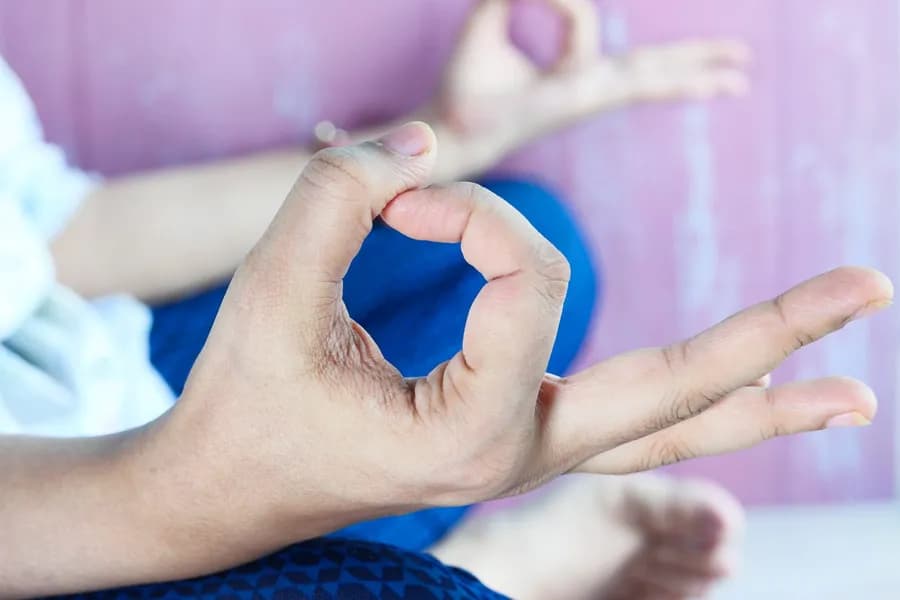
Touch the tip of the index finger to the tip of the thumb, creating a gentle circle. The contact is the soft pad of the fingertip only — not the nail or the side of the finger. Extend the middle, ring, and little fingers naturally.
3 Step 3: Rest Both Hands on Thighs
Both hands on the corresponding thighs, palms facing upward. The gesture is identical on both hands. The wrists are level — not drooping.
4 Step 4: Establish Extended Exhale Breathing
Inhale slowly through both nostrils for a count of four. Exhale slowly through both nostrils for a count of six to eight. The extended exhale is the most important element of mudra for anxiety practice — this ratio activates the vagal brake on the anxiety state. If the longer exhale creates any discomfort, start with 4:5 and build gradually.
5 Step 5: Hold for 15 to 30 Minutes
For scheduled daily practice: 20 to 30 minutes. For acute anxiety: 5 to 10 minutes of Gyan Mudra with extended exhale produces immediate measurable calming. The acute application can be used at a desk, in a waiting room, or anywhere the hands can rest.
6 Step 6: Release Gradually
Open the fingers slowly. Rest the hands open on the thighs for one minute. Take two normal breaths before resuming activity. Note the degree of reduction in anxiety from before to after the practice — this observation builds confidence in the practice’s effectiveness over time.
Breathing in Mudra for Anxiety
Extended exhale nasal breathing — 4:6 or 4:8 — is the non-negotiable component. The mudra gesture alone without the breath ratio produces partial benefit. The combination of Gyan Mudra gesture plus extended exhale breath produces the full vagal activation that makes this practice effective for anxiety.
Preparatory Practices Before Mudra for Anxiety
- 5 extended exhale breaths before beginning: Establish the 4:8 breathing pattern before forming the mudra — this primes the vagal brake before the gesture amplifies it.
- Brief body scan — 2 minutes: Note where anxiety is held in the body before beginning so you can observe its specific reduction during the practice.
- Nadi Shodhana — 5 rounds: The most effective preparatory pranayama for anxiety — balancing left-right hemisphere activation and directly reducing the neurological pattern of anxious arousal.
Variations of Mudra for Anxiety
Variation 1: Prana Mudra — for Fatigue-Driven Anxiety (Beginner)
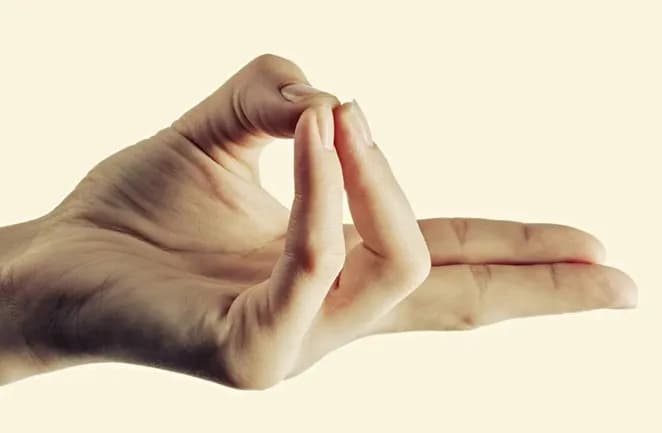
Touch the ring and little finger tips to the thumb tip. The most effective mudra for anxiety driven by depletion and low vitality — when anxiety is accompanied by exhaustion, weakness, or a sense of the nervous system being stretched to its limit without adequate resource. Practise for 20 minutes with eyes closed.
Variation 2: Vayu Mudra — for Physical Restlessness and Anxious Movement (Beginner)
Fold the index finger to the base of the thumb and press the thumb over the first knuckle. Most effective when anxiety manifests as physical restlessness — the inability to sit still, nervous foot tapping, fidgeting, and the compulsion to pace. Hold for 10 to 15 minutes.
Variation 3: Shanmukhi Mudra with Bhramari — for Acute Severe Anxiety (Intermediate)
The most powerful available yoga intervention for acute anxiety — both hands covering all six facial gates with Bhramari humming exhalation. Complete sensory withdrawal combined with vagal humming activation. Full instructions on the Shanmukhi Mudra page. 5 to 10 minutes provides rapid relief even in severe acute anxiety states.
Common Mistakes to Avoid in Mudra for Anxiety
- Using Only the Mudra Without the Extended Exhale Breath The mudra gesture alone produces partial benefit. The combination of Gyan Mudra with the 4:6 or 4:8 extended exhale breathing produces the full vagal activation mechanism. Never practise mudra for anxiety with normal unregulated breathing — the breath ratio is half the practice.
- Practising Only During Acute Episodes Daily preventive practice that builds baseline nervous system resilience produces far greater long-term anxiety reduction than reactive practice during acute episodes. Use mudra for both — but prioritise the daily scheduled practice over the reactive application.
- Expecting Results in One or Two Sessions Measurable anxiety reduction appears at 2 to 4 weeks of consistent daily practice. Practitioners who try the mudra twice and conclude it does not work have not completed the minimum practice window for nervous system change to become apparent.
- 14-Day Free Trial 650,000+ people building better habits every morning every morning
Live daily sessions · Real-time corrections · Cancel anytime
How Habuild Teaches You Mudra for Anxiety
Those with Generalised Anxiety Disorder (as Complement to Treatment)
Daily Gyan Mudra and Prana Mudra practice provides measurable complementary support alongside CBT, medication, and other evidence-based anxiety treatments. It does not replace professional treatment but adds a practical daily tool for nervous system regulation.
Working Professionals with Stress-Driven Anxiety
For those whose anxiety is driven by workplace pressure, deadline stress, or the accumulation of professional demands, 20 minutes of morning mudra practice provides the daily cortisol-reduction and nervous system reset that prevents stress from accumulating into chronic anxiety.
Those Dealing with Anxiety and Depression Together
Mudra for anxiety and depression requires a combined approach: Gyan Mudra for the anxious component; Uttarabodhi Mudra (see page) for the depressive, low-energy component. Alternating these two gestures — one morning, one afternoon — addresses both dimensions of the mixed anxiety-depression presentation.
Is Mudra for Anxiety Good for Beginners?
Yes — Gyan Mudra is the simplest and most accessible yoga gesture available. The primary learning is establishing the extended exhale breathing alongside the gesture. Both can be mastered in a single guided session.
What Consistent Mudra for Anxiety Practice Produces
Mudra for anxiety works through the direct neurological mechanism of vagal activation, the Ayurvedic mechanism of Vata-excess reduction, and the attentional mechanism of present-moment anchoring — three parallel pathways that together address the physiological, energetic, and psychological dimensions of the anxiety state. Gyan Mudra, Prana Mudra, and Vayu Mudra form a complete toolkit that covers the major presentations of anxiety from mental rumination to physical restlessness to fatigue-driven depletion.
The most important guidance for any practitioner beginning mudra for anxiety is this: the practice works through accumulation, not instant results. Two weeks of consistent daily practice with proper breath ratio will produce measurable change that one session cannot. The commitment to showing up daily — particularly on the days when anxiety makes everything feel impossible — is itself the practice.
Habuild’s live morning sessions provide the daily structure that makes consistent mudra practice achievable even through the resistance that anxiety characteristically generates toward any committed routine. The community and accountability of a live session remove the decision from the equation — the session happens, and you show up.
The shift from a fight-or-flight state to a calmer, rest-and-digest one that Gyan Mudra supports is a nervous-system pattern that deepens with repeated practice — fifteen minutes on one anxious day helps in the moment, but a steadier baseline comes from returning to it daily. Anchoring the gesture to a fixed time, rather than reaching for it only when anxiety spikes, makes the calming effect more reliable over time. Yoga Everyday can give that daily anchor some structure.
Frequently Asked Questions
Related Articles
Gyan Mudra: How to Do It and Its Benefits for Focus and Memory
Practice Gyan Mudra with Habuild. Follow the wisdom hand gesture steps to improve focus, reduce anxiety, and enhance your meditation practice. Start today!

Prana Mudra: How to Practice and Its Life Energy Benefits
Practice Prana Mudra with Habuild. Follow the life force hand gesture steps to boost energy, strengthen immunity, and improve your eye health. Start today!
Hasta Mudras: A Complete Guide to Hand Gestures and Their Benefits
Practice hasta mudras with Habuild. Explore the best yoga hand gestures to balance the five elements, direct prana, and support health and healing. Start today!