
Ghee vs Refined Oil: Choose Healthy Fats Wisely
Understand ghee vs refined oil in simple words. Learn how to use fats in moderation, avoid reheated oils and choose better Indian cooking habits.
Key Takeaways
- The bigger issue is total daily fat, not just which specific fat you choose.
- A small spoon of ghee on dal or roti adds flavour without needing to be poured freely.
- Reheating and reusing oil repeatedly is a bigger daily concern than the oil type itself.
- Cold-pressed or kachi ghani oils are preferred but still need controlled portions.
- Rotating mustard, groundnut, sesame, or coconut oil is fine if it suits the family.
Many people ask which is better: ghee vs refined oil? The answer is not one word. It depends on how much you use, how often you use it, and how you cook with it.
Ghee can be used in small amounts in Indian meals. Oils can also be used in cooking. The problem usually starts when fats are used too much, heated again and again, or chosen without checking quality.
The healthy fat habit is simple: do not fear fat, but do not overuse it. Choose better fats, use smaller amounts and avoid reheating oil again and again.
What Is the Real Issue With Cooking Fats?
The real issue is not only ghee versus oil. The bigger issue is daily excess.
Too much oil in sabji, extra ghee on roti, fried snacks, packaged namkeen and bakery foods can all add up. Health guidance says to use fats and oils in moderation. It also says high intake of saturated fats is a risk factor for heart disease and that butter or ghee should be limited.
So the first rule is simple: reduce the total amount of fat before arguing about which fat is best.
Where Ghee Fits In
Ghee is a traditional Indian fat. It gives aroma and taste even in small amounts. You can add a small spoon to dal, khichdi or roti.
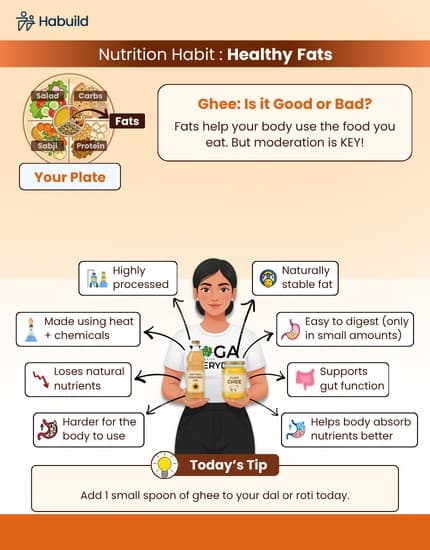
But ghee is still concentrated fat. It should not be poured freely. A small spoon can make food tasty. Too much can make the meal heavy and add extra calories.
Use ghee like this:
- Add one small spoon to dal.
- Use a light layer on roti.
- Avoid adding it to already oily food.
- Do not use it with fried snacks daily.
- Keep the rest of the plate balanced.
What About Refined Oil?
Refined oils are oils that go through processing before they reach the kitchen. Some processing is done for taste, shelf life, colour or smell. That does not mean every refined oil is poisonous. But it does mean you should not use any oil blindly.
The bigger concerns are reheating, deep-frying often, reusing old oil and eating too many packaged fried foods. Reheated oil and vanaspati-style fats are not good daily habits. Eat Right India advises avoiding vanaspati ghee and not heating oil for a very long time while frying.
A simple home rule: use fresh oil in small amounts and avoid reusing oil again and again.
Cold-Pressed or Kachi Ghani Oil
Cold-pressed or kachi ghani oils are often preferred because they are closer to traditional extraction methods. FSSAI food standards also define when oils can be labelled as kachi ghani or cold pressed.
This does not mean you can use unlimited cold-pressed oil. It is still oil. The benefit comes when you use a good quality oil in a controlled amount.
For Indian kitchens, common options include mustard oil, groundnut oil, sesame oil and coconut oil depending on region, taste and cooking method. Rotate oils if your family is comfortable with it.
Ghee Versus Refined Oil: A Simple Comparison
Ghee
Ghee adds strong flavour in a small amount. It works well as a finishing fat on dal, khichdi or roti. It is rich, so portion control matters.
Refined Oil
Refined oil is commonly used for cooking because it is easy to find and has a neutral taste. But use it in moderation and avoid repeated heating.
Cold-Pressed Oil
Cold-pressed oils can be a good choice for daily cooking when used properly. Choose based on taste, cooking style and family preference.
Vanaspati and Reused Oil
Avoid these as much as possible. They are not good daily fats and are often linked with trans fat concerns.
How to Choose Fats Wisely at Home
Use this simple checklist:
- Keep oil and ghee amounts small.
- Do not reuse oil many times.
- Avoid vanaspati and deep-fried packaged snacks.
- Use ghee as a small finishing touch, not as the main cooking fat every time.
- Choose quality oils for cooking.
- Do not mix many fats in one meal.
- Eat more vegetables, dal, curd and whole foods so the meal is not only oil and carbs.
This is easy to follow and does not require a perfect diet.
Better Indian Meal Examples
- Dal rice — use a light tadka and one small spoon of ghee only if needed.
- Roti sabji — cook the sabji with less oil and avoid extra ghee if the sabji is already oily.
- Poha — use less oil and add peanuts, sprouts or curd for balance.
- Paratha — avoid loading it with ghee and then adding pickle, butter and fried snacks on the side.
- Salad — use a small amount of cold-pressed oil or a few nuts and seeds.
Today's Tip
Try this today: replace one heavy-fat habit with a lighter one.
- If you usually add two spoons of oil, try one.
- If you reheat oil, start using fresh smaller quantities.
- If you use ghee, keep it to one small spoon.
- If you eat fried snacks daily, reduce the frequency.
- If possible, keep a cold-pressed oil for simple cooking.
Small changes are easier to repeat.
Who Should Be Careful?
People with high cholesterol, heart disease, liver issues, gallbladder problems, diabetes or a medical diet should get personal guidance. Fat needs vary from person to person.
Also remember that healthy fat does not cancel an unhealthy meal. A plate full of fried food is still heavy even if the oil is good quality.
Remember
Ghee and oil both have a place in food. The best habit is to use them wisely. Keep the quantity small, avoid reheating, avoid vanaspati and keep the meal balanced.
It is not ghee versus oil. It is smart fat use versus careless fat use.
Related reads: Is ghee good for health? A simple healthy fats habit · Good fats vs bad fats: choose fats wisely
Choosing between ghee and refined oil comes down to balance rather than a single right answer, and the same is true for balancing food with movement. Fats fuel your body, but how well that fuel gets used depends partly on how active you are through the day. Pairing thoughtful cooking choices with regular movement, like the sessions in Habuild's free yoga challenge, gives your meals somewhere useful to go.
Frequently Asked Questions
Related Articles
Is Ghee Good for Health? Healthy Fats Habit
Is ghee good for health? Learn how to use ghee in moderation, why portion size matters and how one small spoon can fit into Indian meals.
Dals Cause Gas? Simple Digestion Tips
Dals cause gas for many people because of fibre and complex carbs. Learn simple ways to soak, cook and eat dal for better digestion.
How to Get Enough Protein on a Vegetarian Diet
Learn how protein rich vegetarian foods support energy, strength and fullness. Use the perfect plate habit with greens, grains and protein.