Tyrosine: What It Does and Whether Supplements Help
Tyrosine helps make proteins and important chemical messengers. Explore why those roles do not automatically justify a daily focus supplement.
Key Takeaways
- Tyrosine is an amino acid found in protein foods.
- Dal, paneer, milk and soy provide tyrosine.
- It does not replace sleep or fix burnout.
- People with PKU need special guidance.
Tyrosine often appears in products promising better focus, motivation or stress resistance. The scientific explanation can sound persuasive: your body uses this amino acid to make important chemical messengers. But supplying more of a starting ingredient does not guarantee that the body will produce a useful extra effect.
For most healthy people, tyrosine is already available through food and the body's own production. Understanding that helps put a supplement advertisement in perspective before you spend money on a “brain boost”.
What exactly is tyrosine?
Tyrosine is an amino acid, one of the building blocks used to make proteins. The body can produce it from another amino acid called phenylalanine, so it is usually described as non-essential in the diet.
“Non-essential” does not mean unimportant. It means a healthy body can generally make what it needs, rather than depending entirely on tyrosine arriving directly from food.
You may see the name L-tyrosine on supplements. That refers to the form used in normal biological processes. The more technical name does not show that a particular product improves concentration, and it does not establish that your diet is missing something.
Its role goes beyond muscle protein
Tyrosine is involved in making dopamine and noradrenaline, chemical messengers that help nerve cells communicate. It is also a starting material for thyroid hormones and melanin, the pigment associated with skin and hair colour.
These connections explain the interest in it. They do not establish that extra tyrosine raises motivation, speeds metabolism or restores hair colour. The body regulates these pathways through several steps, rather than simply converting every extra dose into more of the desired substance.
A person with low thyroid hormone, for example, needs the cause assessed and appropriate treatment. Taking an ingredient used in hormone production is not equivalent to replacing a hormone when that is medically necessary.
Which foods provide it?
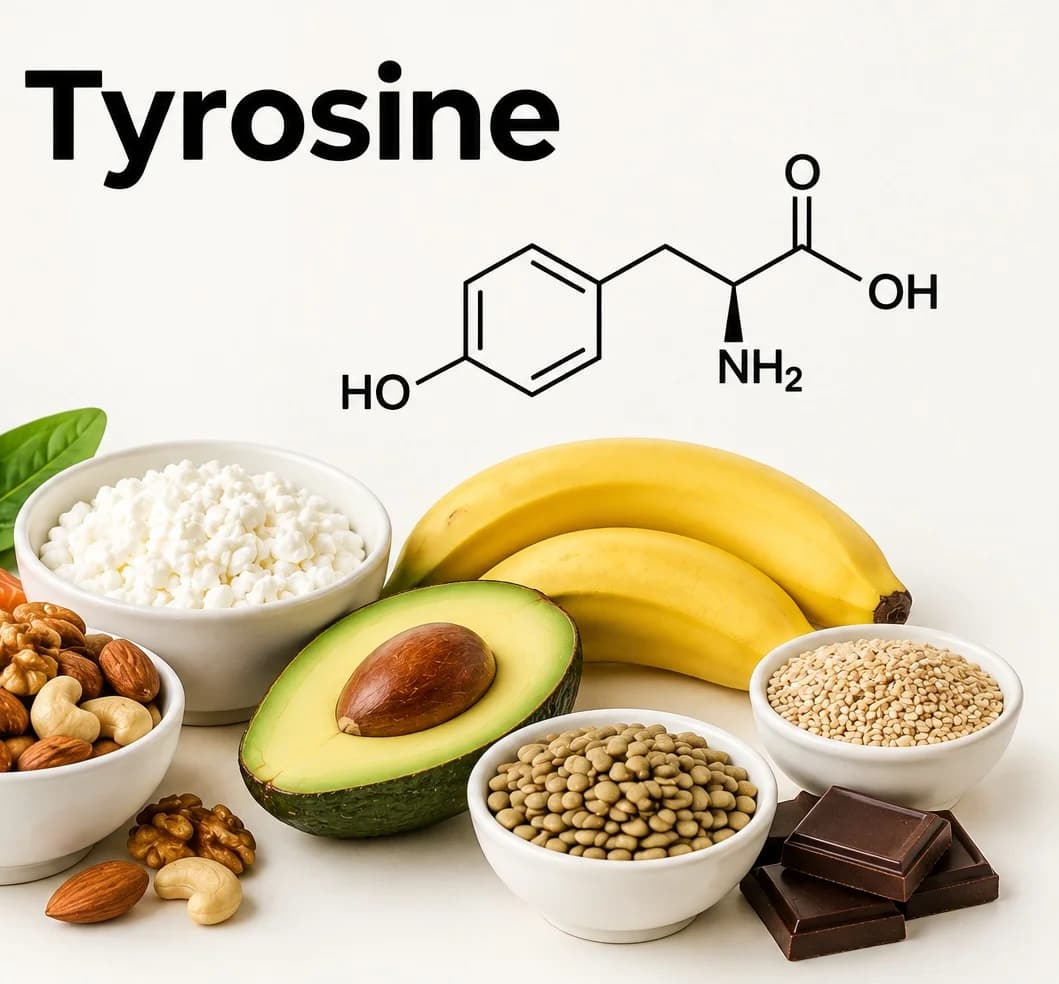
Tyrosine occurs in many protein-containing foods. Dairy foods, soy foods, pulses, nuts and seeds can all contribute to a vegetarian eating pattern.
You do not need to rank every meal by its tyrosine content. A bowl of dal, tofu added to vegetables, curd with a meal or a paneer filling can contribute protein and amino acids together. These foods offer more than one isolated nutrient.
If you need ideas, our guide to protein-rich vegetarian foods can help you plan variety. There is usually more value in making protein-containing foods a regular part of meals than in searching for a special tyrosine snack.
Why is it studied for stress and concentration?

Some research has tested tyrosine during demanding conditions such as sleep deprivation, cold exposure or tasks placing a heavy load on working memory. Certain studies suggest benefits for specific aspects of performance in those settings.
That is a narrower question than whether a capsule makes everyday office work easier. Participants, doses, test conditions and outcomes differ. Positive findings on one laboratory task do not mean every type of memory, mood or attention improves.
The evidence is also not uniformly positive. Results depend on the situation, and more is not necessarily better. It is more accurate to describe tyrosine as an area of research than as a dependable daily focus supplement.
It does not replace sleep or solve burnout
A difficult workday can involve poor sleep, too many interruptions, irregular meals or unrealistic demands. A capsule does not remove those causes. Even if someone feels briefly more alert, that is different from recovering from sleep loss.
Before buying a focus product, look at the specific problem. If you are skipping lunch, a proper meal is a practical intervention. If you are working late every night, the issue may be the schedule. If concentration problems are persistent or new, they deserve a broader assessment.
This does not make every tired day a medical problem. It simply avoids turning an ordinary human limit into a presumed amino-acid deficiency that an advertisement offers to fix.
Claims about mood need particular care
Because dopamine is involved in reward and motivation, tyrosine is sometimes marketed for low mood. That link is not enough to establish it as a treatment for depression, anxiety or ADHD.
These conditions are complex, and symptoms can overlap with other problems. Self-treating them with an amino acid can delay support that is more likely to help. Do not replace a prescribed medicine with tyrosine because both are discussed in relation to brain chemicals.
There is also no established home test that tells you to take tyrosine based on cravings, low enthusiasm or an online neurotransmitter quiz. A list of common symptoms is not a diagnosis of a specific nutrient shortage.
PKU is a special case
In phenylketonuria, or PKU, the body cannot process phenylalanine normally. That changes the role of tyrosine and requires a carefully managed medical diet, often involving specialised nutritional products.
Advice for the general public about eating more high-protein foods should not be applied to someone with PKU. Their plan must control phenylalanine while meeting other nutritional needs.
This exception is one reason broad claims about amino acids can mislead. A nutrient being necessary in a particular medical situation does not mean that everyone benefits from adding a separate supplement.
What to consider before using a supplement
There is no single established tyrosine dose for improving everyday focus. Research doses should not be copied into a personal routine, particularly when a product combines tyrosine with caffeine or other stimulants.
If you take regular medicines or have a thyroid condition, discuss a proposed supplement with the clinician or pharmacist managing that treatment. Bring the actual product name: a multi-ingredient powder is a different decision from an isolated amino acid.
For most readers, the useful next step is simpler. Eat adequately, include varied protein foods and protect time for sleep and recovery. Tyrosine already has a normal role in your body; it does not need to become another target you chase each morning.
Editorial sources
Frequently Asked Questions
Related Articles

Pea Protein Benefits: Uses and Supplement Safety
Pea protein is usually made from yellow peas and concentrated into a powder.

Protein in 50 g Paneer: How Much Does a Small Portion Provide?
A 50 g portion of regular paneer often supplies about 9 to 10 g protein. Learn the simple calculation and how the serving fits a full meal.
Protein Bread: Is It Worth the Extra Cost?
Protein bread can make a meal more convenient, but the useful choice depends on the serving, filling, taste and extra cost.
A 100 Gram Protein Diet: A Practical Vegetarian Example
See how a suitable protein target can be built from ordinary meals without compulsory shakes.