
How Many Exercises Per Body Part: Smart Training Guide
The general answer is 2 to 5 exercises per muscle group, depending on its size, your training experience, and how often you train it each week. See the ideal numbers and how to structure a routine.

Key Takeaways
- The general range is 2 to 5 exercises per muscle group depending on size and experience.
- Research on training volume suggests 10-20 working sets per muscle group each week.
- Stacking 7-8 movements for one muscle in a single day produces fatigue without extra growth.
- Large muscle groups like back, chest, and legs handle 3-4 exercises well each session.
- Smaller muscles like biceps, triceps, and calves usually need only 2 exercises.
- A focused 3-4 exercise block can be completed in just 30-45 minutes.
One of the most common questions in strength training is exactly how many exercises per body part you should perform in a single session. The honest answer is 2 to 5 exercises per muscle group, depending on its size, your training experience, and how often you train it each week.
This guide breaks down the ideal numbers, the best movements, common mistakes, and how to structure a routine that delivers consistent results from home.
Why the Number of Exercises Per Body Part Matters
The number of exercises you choose for each muscle group directly affects three things — muscle growth, recovery, and consistency. Too few exercises and you under-stimulate the muscle. Too many and you bury yourself in fatigue, lose form, and skip workouts. The sweet spot keeps you progressing week after week.
Builds Lean Muscle Efficiently
Research on training volume suggests that 10–20 working sets per muscle group per week drives consistent hypertrophy. Split across 2 sessions, that lands at roughly 3–4 exercises per body part.
Prevents Overtraining
Stacking 7–8 movements for a single muscle in one day produces excess fatigue without extra growth. The last 3 exercises typically suffer from poor form and reduced output.
Saves Time Without Sacrificing Progress
A focused 3–4 exercise block can be completed in 30–45 minutes, making it sustainable for working professionals and home trainees.
Improves Form and Mind-Muscle Connection
Fewer, well-chosen exercises let you concentrate on technique rather than rushing through a long list of movements.
Supports Recovery Across the Week
Smart exercise selection lets you train each muscle group twice a week — currently considered the most effective frequency for natural lifters.
How Many Exercises Per Body Part to Build Muscle
For muscle building, the working number is 3 to 5 exercises per body part per session if you train that muscle once a week, or 2 to 3 exercises per session if you train it twice a week. The total weekly target stays similar — roughly 10 to 20 hard sets per muscle group. Beginners should stay at the lower end. Anyone exploring a structured plan can pair this with a complete strength training program that progresses sets and intensity gradually.
Setting Realistic Goals
Pick a weekly volume target first, then divide it across the number of training days. Consistency beats intensity over a 12-week window.
Choose Compound Before Isolation
Start each session with one heavy compound lift (squat, press, row), then add 1–2 isolation movements to finish the muscle off.
Adjust for Body Part Size
Large muscle groups — back, chest, legs — handle 3–4 exercises well. Smaller muscles like biceps, triceps, and calves usually need only 2.
Recommended Exercise Count by Body Part
Below is a practical breakdown of how many exercises per body part per day works best for most people training 3–5 days a week. These numbers blend compound and isolation movements for balanced development.
Chest — 3 to 4 Exercises
Bench press or push-ups for strength, an incline variation for the upper chest, and a fly or cable movement for the stretch. Push-ups remain one of the most accessible chest builders and stay central to any chest strength routine.
Back — 4 to 5 Exercises
Pulls, rows, and a deadlift variation. Back is large and benefits from both vertical and horizontal pulling patterns: pull-ups, bent-over rows, lat pulldowns, and seated rows.
Legs — 4 to 5 Exercises
Squats, lunges, Romanian deadlifts, leg curls, and calf raises. Legs respond well to higher exercise variety because of the multiple muscles involved — quads, hamstrings, glutes, and calves.
Shoulders — 3 Exercises
One press (overhead or dumbbell), one lateral raise for the side delt, and one rear-delt fly. This covers all three heads of the shoulder.
Arms — 2 Exercises Each
Biceps: one curl variation plus one hammer curl. Triceps: one pressing movement plus one extension. Small muscles don't need more.
Core — 2 to 3 Exercises
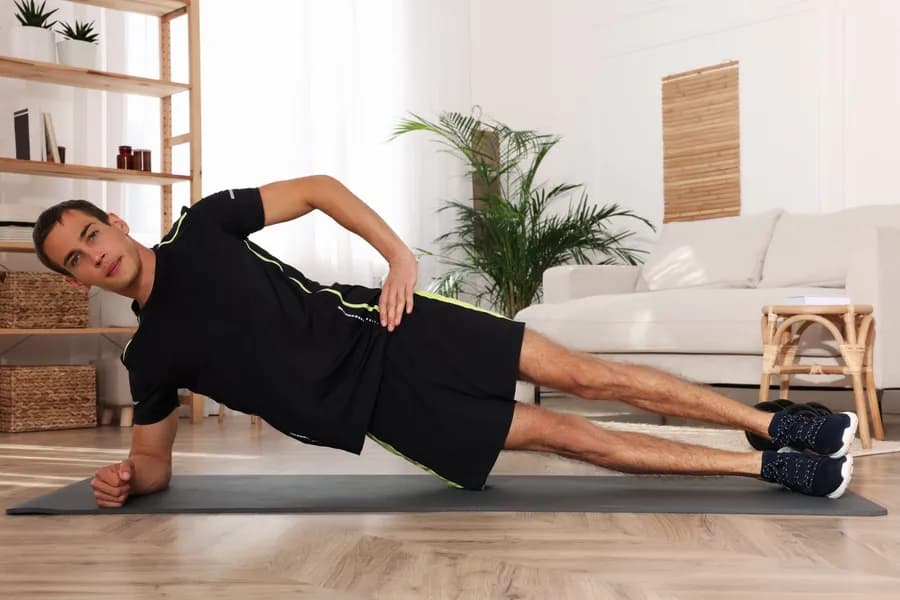
One anti-extension (plank), one anti-rotation (Pallof press), and one flexion movement (leg raise or crunch).
Best Exercises for Each Body Part

If you're building a home routine and want the most return for each movement, these are the staples most lifters lean on. They form the backbone of nearly every effective muscle building workout plan.
Squats
The king of lower-body exercises. Builds quads, glutes, and core stability. 3 sets of 8–12 reps.
Push-ups
A complete upper-body builder when programmed with progressions. Targets chest, shoulders, and triceps. 3 sets to near failure.
Bent-Over Rows
The single best builder for back thickness. Works lats, rhomboids, and rear delts. 3 sets of 8–12 reps.
Overhead Press
Develops strong, capable shoulders and improves overhead mobility. 3 sets of 6–10 reps.
Romanian Deadlift
Targets hamstrings, glutes, and lower back. Excellent for posterior chain strength. 3 sets of 8–10 reps.
Plank
The foundation of core stability. Hold for 30–60 seconds for 3 sets. Pairs well with broader core muscle exercises in any structured plan.
Common Mistakes to Avoid
- Poor Form — Adding more exercises while form falls apart is the fastest way to plateau and pick up injuries. Quality always wins over quantity.
- Skipping Warm-up — Jumping straight into heavy sets without 5–8 minutes of mobility and ramp-up sets puts joints at risk. A short warm-up makes every working set more productive.
- Overtraining a Single Body Part — Doing 8 exercises for chest in one session doesn't double your gains — it doubles your recovery debt. Stick to 3–4 well-chosen movements.
- Inconsistency — Switching exercises every week stops progressive overload from happening. Pick your movements, repeat them for 6–8 weeks, then change.
Who Should Try This Approach?
- Beginners — Start with 2–3 exercises per body part, focusing on compound lifts. Mastery first, volume later.
- Women — Strength training builds tone, posture, and metabolic health without bulk. The same 3–4 exercise structure works perfectly.
- Older Adults — Stick to 2–3 controlled exercises per body part to support bone density and mobility. Always check with a doctor before starting if you have a medical history.
- Working Professionals — A 3–4 exercise plan fits inside 40 minutes. Time-efficient and consistent — the two things that drive results.
Build Strength with a Routine That Actually Works
Building strength isn't about doing random workouts or stacking endless exercises — it's about consistency, smart structure, and following a plan that fits your life. With the right support from guided strength training, you can train effectively from home and see real progress week after week.
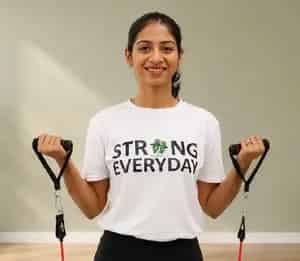
What you get with Habuild's Strong Everyday Program:
- Daily live guided strength sessions
- Beginner to advanced progression built in
- No-equipment and home-friendly workouts
- Expert guidance to ensure correct form
- Community support to stay consistent
Related reads: Easy Strength Training Exercises for Seniors You must Know · Strength Training Leg Workout: Best Exercises, Benefits & How to Start
Getting the exercise count right per muscle group only matters if the rest of your programming — sets, frequency, recovery — is dialed in too, which is hard to figure out through trial and error alone. A structured plan takes that decision-making off your plate. Habuild's Strong Everyday program offers guided, well-sequenced strength sessions so you're not left guessing how much is enough.
Frequently Asked Questions
Related Articles

What Are Compound Exercises? Benefits & Best Moves
Squats, push-ups, deadlifts, and rows work two or more muscle groups across multiple joints at once, training your body as a system. See the benefits and best moves.
What Are Isometric Exercises? Benefits & Best Moves
Planks, wall sits, and static holds contract your muscles and produce force while the joint angle and muscle length stay the same. See the benefits and best moves.

What Is the Best Exercise Routine? A Complete Guide
A balanced weekly plan of 3 strength sessions, 2 yoga or mobility sessions, and 2 light cardio walks, each 30-45 minutes, beats intensity with structure. See the complete guide.

How to Build Body at Home: the Complete No-Equipment Muscle Building Guide
The best available workout is the one performed daily, not the theoretically best programme that requires a commute and a fee. See the complete no-equipment muscle building guide.

What Are the Benefits of Strength Training? 7 Evidence-Based Benefits That Transform Health
Strength training reduces all-cause mortality risk, prevents age-related disability, and builds bone density across every age group and sex within 8-12 weeks. See all 7 evidence-based benefits.